EQAO Test Scores Show Alarming Results For Ontario Students

The EQAO scores are in, and they paint a concerning picture of the state of Ontario’s education. The Education Quality and Accountability Office, also known as the EQAO, is an organization in Ontario that assesses education quality in the province’s publicly funded schools. The EQAO administers standardized tests to students in grades 3, 6, and 9 in math and grades 3, 6, and 10 in literacy. This data is then used by the government and school boards to evaluate educational effectiveness and make changes to improve student achievement. 

According to the data, an alarming number of kids are struggling with basic literacy and numeracy skills. This is cause for concern, as these deficiencies could have significant implications down the road. Parents need to be aware of these troubling findings and take steps to help their children improve their academic performance. Math tutoring may be required for many Ontario students who have fallen behind in their education. 

Put On Hold

These EQAO scores are the first in two years since the previous ones were put on hold during the pandemic. With students bouncing back and forth between in-class learning and virtual classes, it was difficult for the province to perform the testing that is typically done each year. 

Educators and parents were eager to see the results this year because of the delay in testing. There was much speculation about how students would test after two years of disruption from the pandemic. With no testing available, it was unknown exactly how much school closures and transitions into virtual learning had affected students’ education. 

Math and Literacy Hardest Hit

It was thought that the learning loss would be hit hardest in math and literacy. A handful of studies pulled data from millions of students participating in computer-adaptive tests to estimate students’ learning growth during school closures and how much that growth rate was likely to slow over the following few years.   

Three studies even predicted that students might learn only half of what they normally would in a typical year. None of the research went far enough to find any specific skills students may have lost, such as content or foundations in math like number sense or fractions. However, these studies did help to show the possible overall impact that the pandemic had on students and their math learning

Experts believe math may be more sensitive to pandemic-related disruptions for a few reasons, including:

  • Teachers often find it more difficult to engage in effective math instructional practices via virtual learning. 
  • Stress related to the pandemic may worsen existing math anxiety in some students.
  • Math is almost always formally learned at school, as parents are often less well-equipped to help their children with their lessons. 

Verified Test Results

As expected, these various tests that were performed throughout the pandemic were verified with the EQAO test results.  In the primary division, only 59% of students met provincial standards in math, while in the junior division, it was just 47%. For grade 9, 52% meet provincial standards. While these numbers are concerning on their own, the results get even worse when looking even further. For grade 9 students, in 2018-2019 (the last EQAO tests performed), 75% met the provincial math standards. However, these new EQAO test results drastically drop to only 52%, meeting those standards. This is the most significant gap seen across the three groups of students tested. 
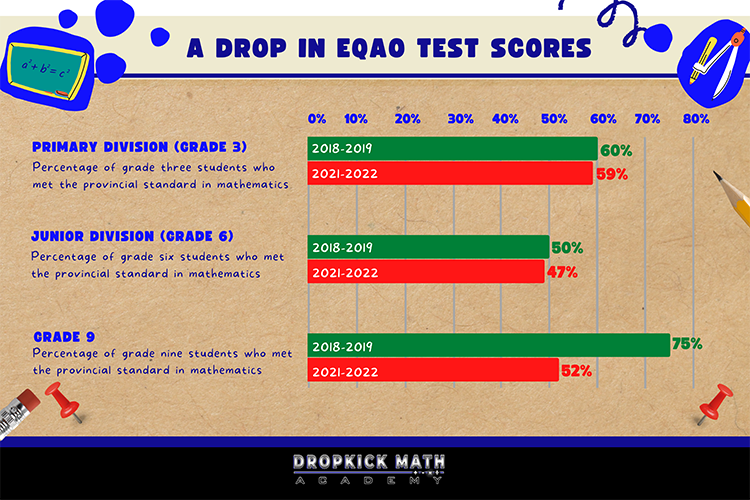
 

EQAO-Stats-graph

This is worrisome as grade 9 marks the start of high school, a time when students need to be more aware of their grades if they want to get into college/university. With only just over half of the students meeting provincial standards, it offers a bleak look into the future, where students will struggle to get into STEM-related career paths. 

Does The Assessment Affect Students’ Grades?

While the EQAO assessments may not significantly impact an individual student’s grade, they can provide valuable insights into the performance trends of students as a whole. By analyzing assessment results, teachers and administrators can identify areas where the majority of students are struggling, allowing them to tailor their teaching methods and lesson plans to better address these subjects. 

Assessment results can also reveal changes in student performance over time, providing valuable information for educators and parents about the success of certain teaching strategies or educational programs. While assessment results may not directly affect individual grades, they should still be regarded as valuable tools for evaluating and improving student performance overall.

What’s The Plan?

So now that these test results have been released, many parents are asking what is going to be done to help students catch up with their missed learning. While it may seem like there is no real plan to get things back on track, educators are working to implement measures to ensure that students can catch up on their education. Each school board is working to help students catch up from the lost learning experienced through the pandemic. 

The Ontario government has also released their Learning Action Recovery Plan, which is designed to help students who have been struggling in school catch up and get back on track. It invests heavily in tutoring support and includes a focus on reading, math and other foundational skills, as well as targeted initiatives to address unique barriers some students may face. This will help bridge students’ learning gaps, support academic success, and focus on overall mental health and wellness. Ontario’s plan is based on the latest scientific evidence and will provide students with the necessary resources to succeed.

At Dropkick Math, we proudly offer our math tutoring services as part of the Learning Action Recovery Plan. We have partnered with school boards throughout the province and are able to offer some students FREE programs. These programs are funded by the Ontario government and offer students math help services by certified Ontario teachers. 

Our programs help students boost their confidence while learning math operations. Our game-based learning offers a fun and engaging way to help those who experienced a gap in learning caused by the pandemic. Learn more about our programs and register your child for math tutoring today!

5 Tips for Overcoming Math Anxiety

Math anxiety is a genuine phenomenon affecting many students, no matter their age. It’s a feeling of dread, fear, and apprehension that can overtake anyone when they’re faced with a math problem. For some children, math anxiety is so intense that it can cause them to completely freeze up, making it impossible even to attempt to solve the problem. It is often caused by a fear of failure, self-doubt, and negative past experiences with math. However, parents and children need to remember that everyone experiences anxiety at some point in their lives and that it’s nothing to be ashamed of. 

Many children can overcome their math anxiety by trying different approaches to learning, including taking a brain break, learning a positive mindset or other such modalities. At Dropkick Math, our math tutoring can also help children who may be experiencing math anxiety. All of our programs are run by certified Ontario teachers who have been trained in how to address math anxiety. 

Nervousness vs Anxiety

Some children may get nervous, but for others, it is not simply a matter of feeling nervous. Being nervous is a perfectly sensible reaction to something that is truly scary. In a 1972 Journal of Counseling Psychology article, educational psychologist Frank Richardson and counselling psychologist Richard Suinn defined “math anxiety” as:

“A feeling of tension and anxiety that interferes with the manipulation of numbers and the solving of mathematical problems in a wide variety of ordinary life and academic situations.”

Steps To Overcome Anxiety

If your child is struggling with math anxiety, don’t worry – there are steps they can take to overcome it and improve their performance in math class. Math anxiety can be managed and overcome with practice, patience, and perseverance. With the right support and mindset, anyone can learn to love math. The following are our top 5 tips on how to help your child overcome math anxiety. 

  1. One of the best things your child can do is experiment with different learning methods. Some students learn better by listening to lectures, while others prefer working through problems on their own using math manipulatives. There is no one right way to learn mathematics, so find the best method for your child and stick with it. With a little effort, they will be able to overcome math anxiety and succeed in math class!
  2. If you notice your child feeling overwhelmed while studying math, it’s okay for them to take a break. A brain break can help refresh their mind, making it easier for them to focus later on. Brain breaks can be active or passive, depending on the child’s needs. Active brain breaks focus on physical movement and may involve jumping or dancing around. Passive brain breaks are more about mindfulness or sensory and may include taking deep breaths or listening to calm music.  Taking breaks is essential for keeping their mind sharp and ready to tackle challenging math problems. 
  3. Explain to your child the difference between understanding and memorization. Memorization can be beneficial in certain circumstances, but it may produce a procedurally competent student who can’t think their way out of a box. The sooner you can encourage your child to understand math operations instead of memorization, the sooner they will develop number sense and mental math skills, which will help boost their confidence in mathematics. 
  4. Never underestimate the impact that a few encouraging words can have on your child. Children experiencing math anxiety can feel hopeless and lost, but knowing that a caring adult is there and cheering them on could help boost their confidence. A study published in the Journal of Emerging Investigators explored the effects of positive and negative reinforcement and their impact on students’ mathematical performance in 6th grade. All participants were required to do mental math to calculate fraction problems after receiving a negative, positive, or neutral form of reinforcement. They wore a heart monitor to track their anxiety, and it was found that students who received positive reinforcement had significantly lower heart rates when calculating fractions. So, next time your child is struggling, try motivating them through positive, encouraging words or even rewards to help improve their learning and academic success. 
  5. Make math fun! At Dropkick Math, we believe that all children can become interested in math and overcome math anxiety if it is presented in a fun and engaging way. All of our programs offer game-based learning to help those who may be struggling. Through encouragement and rewards, children will begin to excel at completing complex math questions and beat their fear of math. 

Physical Symptoms Of Math Anxiety

Anxiety can cause physical symptoms such as a racing heart or sweating. With such physical reactions, many children who have math anxiety tend to avoid situations in which they have to do math. However, by following these simple tips, you can help your child overcome math anxiety and start to enjoy learning mathematics. 

Along with interventions, Dropkick Math offers programs that can help a child improve their math skills. When a child becomes more confident in mathematics, their level of math anxiety decreases. With our fun and engaging programs, children will learn to become more at ease with math problems.

Learn more about our math help services today!

3 Steps To Boost Mindset For Back To School

As the back-to-school season rolls around, it’s important to help your children gear up for success. A positive mindset is crucial for dealing with the challenges of school and life. By following three simple steps, you can help your children stay focused and motivated to go back to school. First, remind your child that transitions can be stressful, but you will be there to help guide them. Second, set goals for academic and extracurricular activities that can be accomplished throughout the year, such as math tutoring. Finally, set the tone for your child’s return to school. Following these simple steps can help your children maintain a positive mindset and set them up for success in school and life.

Excited or Anxious?

The back-to-school season can be both exciting and anxiety-inducing for children. On the one hand, they get to see their friends again and learn new things. It brings structure and fresh extracurricular activities. Some children love getting the latest supplies and may have their backpacks packed weeks before school starts. 

On the other hand, some children hate having to deal with homework, tests, and other challenges. With new subjects come unfamiliar teachers, frustrations and new challenges. This can create anxiety for many children and cause sleepless nights before the start of school. 

Whether your child is excited or anxious for back to school, some steps can be taken to help boost their mindset and help with their confidence. 

Dealing With Transitions

Routine changes can be stressful and cause anxiety for some children. Some may suffer a great deal while figuring out their new school year rhythm. As a parent, it can be hard to know how to help a child who is unsure of change, but talking to them and addressing the subject can go a long way. Let them know that the stress of transition is only temporary and isn’t an indicator that something is wrong. It is simply their mind trying to figure out how things fit together in their new environment, schedule, and peers. 

When letting your child know that their feelings of anxiety about the new school year are normal, you can also tell them how you feel when faced with uncomfortable feelings of creating a new routine. Relating to your child and letting them know their stress is normal can help them relax.

Children who are stressed about transitions may also have trouble making decisions. By boosting their confidence and letting them know their stress is normal, it can help them make wiser decisions. 

Set Goals

Something about a new school year and the promise of a fresh start can make parents put our rational, realistic brains in a box. We will then start planning three times too many things for our children to do. It is almost as if summer gives us amnesia to the number of subjects, activities and “fun” things we can commit our children to do. It is all done out of love for our children as we get easily distracted by all of the possibilities and want them all for our children. However, this can lead to overcommitment, and we often find ourselves and our children burning out in the early fall. 

But it isn’t just the parents who often over-commit. Children may not know their limits and could overcommit and overextend themselves even without a parent’s help. Whether it be the pressure to excel academically, peer pressure, or even pressure they may feel to make their parents proud, children can often take on too much. This can lead to burnout, stress and a poor mindset. 

The start of a new school year is the perfect time for your child to set their primary purpose. Take the time to sit down with your child and discuss what choices they have this year in academics and extracurricular activities. Ask them what it would be if they were to grow in one area this year. This can help to narrow down what to focus on and set a goal for the year ahead without becoming too overworked. Start with the activities that will help them grow and build confidence in their chosen area, and then add on from there, thinking realistically about how much time they have each week. 

Who Do They Want To Be

One of the best ways to boost your child’s mindset before the start of school is by reminding them that they can be whomever they want to be. Give them some freedom to choose their clothes, supplies, textbooks, and even schedules if they are older. This can be a major confidence boost and help them to set the tone for the upcoming year ahead. 

As parents, we can sometimes go into an almost robotic zone when getting our children ready for back to school. You have done it millions of times and are just on auto-repeat. But if your child has decided they want to become a mathematician this year, or a science expert, they should focus on these aspirations. This is why letting your child take the lead when selecting new clothes and supplies for the upcoming year is essential. They may want to ditch the unicorn binder you got them last year for a space-themed binder and pens this year. This is an excellent way to foster aspirations and boost their confidence so they can excel in school and life. 

Creating A Math Mindset

The new school year can be a wonderful time of learning, growing, and developing new habits that can last a lifetime. As a parent, setting a positive mindset for your child can help ensure a smoother transition. Establishing a mindset is all about creating a positive experience. When it comes to creating a math mindset, we have a whole blog on the topic! Check it out here!

At Dropkick Math, our math help services work with the parent and child to build a positive mindset which can boost confidence and help children overcome any learning gaps in mathematics. Our programs offer a unique math tutoring approach by focusing on relationships and engaging the parent/guardian. Students learn math operations through fun and engaging games focusing on the four pillars (number sense, operational sense, proportional reasoning, and algebraic reasoning). 

Start creating a positive math mindset in your child by visiting our website and learning more about our programs today! 

When You Should Speak To Your Child’s Math Teacher

Any parent with a school-aged child knows that math can be a challenge. Sometimes, it can be hard to know when to step in and offer math help with their homework or when to let the teacher take the lead. By contacting your child’s teacher, they may be able to help. However, many parents often wonder when they should be reaching out.

While there is no definite answer as to when parents should start communicating with their children’s teachers about their academics, there are some guidelines that could be of help. As a general rule, if you are questioning whether you should reach out to your child’s teacher, it is time to speak with them. 

Staying Informed

The decision of when exactly to start speaking with one’s child’s teacher depends on multiple factors such as individual parenting styles, the age of the student, and subjects being covered in class. In general, communication between all these entities should gradually increase as the academic year progresses. By following these simple guidelines, parents will hopefully find themselves more informed and able to assist their children in reaching success at school and home!

A Support System

Good communication between parents and teachers is essential for ensuring that children thrive in school. Even if a child is doing well in math and seems to be having no trouble in school, it is still generally recommended that parents communicate with teachers regularly to build a support system for the child. This is because the home and school environments are both important for a child’s development, and parents and teachers need to work together to provide the best possible education for the child. If there are no immediate problems, most teachers recommend checking in with them every couple of months. 

A supportive system is essential for every child to reach their full potential. A support system should include a parent or guardian involved in their child’s education and a teacher invested in their students’ success. A parent or guardian can provide support at home by helping with homework, monitoring progress, and communicating with the child’s teacher. A teacher can support the classroom by teaching effectively, providing feedback, and creating a positive learning environment. When both a parent and teacher are providing support, it increases the child’s chances of academic success.

Addressing Issues

As a math teacher, I am often asked by parents how their child is doing in class. While report cards provide a snapshot of a student’s grades at the end of each marking period, they may not be able to identify any areas of struggle until it is too late to address them. For this reason, I believe it is extremely helpful for parents to receive regular updates on their child’s progress. Whether it is through a parent-teacher conference, email, or phone call, taking the time to keep parents in the loop can make a world of difference. Not only will they be able to identify any areas of concern early on, but they will also be aware of any successes their child is having. As a result, parents can play an active role in their child’s education, allowing them time before report cards come out to address any issues if necessary. 

However, it is important not to smother one’s child with too much guidance and hovering; otherwise, they may feel inadequate or shy away from asking for help when needed. Your child’s teacher will be able to help advise you on how much help you should be offering your child if they are struggling and how often you should stay in contact with the school.  

Asking For Help

It can be difficult for parents to know how their child is progressing in school, especially if their child is hesitant to ask for help. However, by keeping communication channels open with their child’s teacher, parents can help ensure their child doesn’t fall behind. This communication can be especially important for those students who tend to be shy or introverted, as they may be less likely to ask for help independently. By remaining involved in their child’s education, parents can play an essential role in helping them succeed in school.

When reaching out to a teacher for support, they can offer advice for homework or activities that parents can do with their children that can be beneficial for math learning. Teachers are a wealth of information and are happy to offer advice to help your child succeed in their education. Just like you would tell your child to ask for help, as a parent, there is nothing wrong with asking a teacher for help!

Relationships

At Dropkick Math, we believe relationships are the primary key to learning success. Our programs offer the option for parents to become involved in the learning process. Our instructors will help build a parent’s mathematics capacity so they can adequately support their child’s journey in elementary math. We believe that success is achieved by learning together!

Our teachers offer a different approach to math tutoring, breaking down the misunderstanding of mathematics and making learning fun. While there are many math help websites, Dropkick Math Academy is the first of its kind in Ontario to offer an interactive, fun learning experience taught by certified Ontario teachers. 

Learn more about our programs today!

How To Know If Your Child Is Struggling With Math

If you’re a parent, there’s a good chance that you’ve experienced the following situation: You’re helping your child with their math homework, and they just can’t seem to get it. They don’t understand what they’re doing, they can’t remember how to do basic operations, and everything seems to be a struggle. It’s frustrating for both of you – and it may leave you wondering if your child is struggling with math. So, how can you tell if this is the case? 

As frustrating as this experience can sometimes be, there are some simple ways to know if your child is struggling with math. One of the best ways to tell if your child is struggling is when they bring home their report card. Report cards often mention milestones they should be reaching, and if a teacher is reporting that they are missing milestones, it is a sure sign that your child is struggling with math. Grades don’t lie, and teacher remarks can help you understand where your child may fall behind.  

Also, if your child is exhibiting signs of math anxiety, it could be a sign that they are having trouble. This well-documented condition can manifest in various ways, so it is important to understand math anxiety and how to notice any signs. 

In this blog post, we’ll discuss these signs and more to help if you are wondering if your child may be struggling with math. We will also cover some simple tips for how to help them overcome these struggles. Keep reading for more information!

What Causes Children To Struggle?

A common complaint among children is that math is too complicated or that they are not smart enough. Unfortunately, this belief can severely impact any child’s success in mathematics. Math is a subject that requires focus and concentration, two things that are often in short supply for young kids. In addition, math requires a certain amount of abstraction, which can be difficult for children who are still learning to think in concrete terms. However, math is also a subject that rewards effort and perseverance. With time and practice, any child can learn to master math basics. The key is to keep trying, even when it seems difficult. Any child can succeed in math with a positive attitude and a willingness to persevere.

Report Cards

Report cards offer an excellent view of your child’s education. There is no better way to check if they are struggling than by looking at their grades. It should be a warning sign if your child appears to perform well in every subject except math. Lower grades in math that go unnoticed may lead a child to focus more on subjects they are already succeeding in and spend less time studying math. 

The key is not just to look for a failing grade in math. A lower grade than usual can signal that your child is struggling along with teacher remarks about missing concepts or misunderstandings of core components of the curriculum. By catching these signs early, you can get your child the extra help they may need to keep up with their peers. 

Math Anxiety

Math anxiety is a genuine phenomenon that can be frightening and deter many children from learning math. Chances are that if your child is showing any signs of math anxiety, they are struggling. But what does math anxiety look like in children? For some children, math anxiety manifests as a physical response, such as a racing heart or sweating palms. For other children, math anxiety manifests itself as more of an emotional response, such as feeling overwhelmed or anxious. In either case, math anxiety can significantly hinder a child’s ability to learn math. If your child is showing any of these symptoms, such as saying things like “I hate math” or “I’m not good at math,” or if they are trying to avoid math-related activities, it’s usually a sign that they have math anxiety and are struggling with the subject. 

The good news is that there are ways to help children overcome math anxiety. Parents and teachers can help children see math more positively by providing encouragement and positive reinforcement. Additionally, there are many helpful resources available that can provide children with the tools they need to succeed in math. With a little bit of effort, math anxiety can be overcome.

Hitting Milestones

Generally, children hit certain milestones in math around the same age. However, sometimes they have trouble developing these skills at the same rate and end up falling behind. For example, an expected milestone for children in grades 1 and 2 may include counting to 100 by ones to twos, fives, and tens. While others pick it up without any problems, some children may struggle with the concept. This noticeable milestone should be corrected before the child moves on to the next concept. 

Similarly, in grades 4 and 5, your child should start being able to apply math concepts to the real world and be able to solve a problem in more than one way. If they don’t quite grasp that yet, they may be struggling with math. (For more math milestones, see our blog “Math Milestones: What To Expect As Kids Grow Up”)

If you feel like your child is not hitting their milestones, you may want to speak with their teacher. By addressing the issue early, your child can catch up and not get left behind the other children in their class. 

The Building Blocks of Math

Math can be a challenging subject for some children because it is cumulative. In other words, each year builds upon the concepts learned the previous year. If a child falls behind, it can be difficult to catch up. For parents, it is important to understand that this does not necessarily mean their child is lacking in intelligence or motivation. In fact, kids who struggle with math are often working very hard – both mentally and physically. 

Researchers from the University of Akron recently published a study called “The Importance of a Strong Mathematical Foundation,” where they tested 39 ninth and tenth graders. Each student had to complete questions ranging from third to seventh grade on fractions, proportions, and ratios. Only seven students were able to pass the assessment.

Researchers were able to conclude that students were simply being taught math concepts matched with their current grade level and not based on the mathematical knowledge they brought to class. Because of this, students were falling behind at each grade level. This was due to them not mastering the concepts before continuing on to higher-level instruction. These education gaps can create misunderstanding, hindering students from making the necessary content connections and gaining conceptual understanding.

If your child shows signs of a gap in learning, it may explain why they are struggling. Try returning to concepts they would have learned in the previous grades and test their knowledge. It is also important to talk with them about how math is essential and that everyone struggles with it at some point or another. 

By providing them with resources, such as a math tutor or supplemental math activities, children can catch up and excel in math. With patience and understanding, math can be mastered by any child.

Disruptions In Education

After two years of educational disruptions caused by the pandemic, many students are behind in mathematics. This is causing children to exhibit signs that they are struggling to keep up with what they are learning in math class. 

At Dropkick Math, we offer math online tutoring programs that can help children who may be struggling. We start by assessing children so they can be placed in the appropriate programs, not based on their grade level but on their current understanding of math concepts. This allows our certified Ontario teachers to work with children to build upon their knowledge and help with any misunderstandings they may have. 

If you are looking for math help online for your child, Dropkick Math can help! Check out our programs today!

Top 5 Trends In Technology Used In Education

As technology becomes more and more a part of our everyday lives, it’s no surprise that its use is becoming more prevalent in education as well. Many different types of technology can be used in the classroom, and new ones are being developed all the time. 

An Evolving Classroom

The classroom is evolving. Technology is changing what, where, and how students learn. Classrooms are no longer limited to physical spaces – with remote learning, students can learn from anywhere in the world. And with online learning, anyone can access education, regardless of location or circumstances. Technology is making education more accessible than ever before. From virtual reality to artificial intelligence, the future classroom will be more immersive and interactive than ever before. With the rise of technology, the possibilities for education are endless.

Staying Up To Date

Classrooms are now filled with computers, tablets and other devices that provide new learning opportunities. For parents, it is essential to understand technology’s role in education. By staying up to date on the latest trends and developments, parents can help their children make the most of classroom technology. Additionally, parents should be aware of the potential risks associated with technology use, such as cyberbullying or online predators. By understanding the role of technology in education, parents can ensure that their children have a safe and productive learning experience.

The following are the top 5 popular trends in technology that are now being used in education. 

Remote Learning

The most common trend in technology in the classroom today is remote learning. With the global pandemic, all students were suddenly thrust into the unknown of distant learning. Although it was unknown at the time, remote learning became a great tool in education. It gave students who could not attend classes in person the opportunity to stay up to date on work and stay in touch with their teachers and peers. 

Now that most classes have returned to normal, remote learning is still being utilized in various ways. Educators found that some remote elements can give students structured independence and new ways of learning. Students can pause and rewind lessons as needed and revisit concepts they might not have fully understood the first time. This type of flexible learning is ideal for students who want to be more independent in their studies. 

Interactive quizzes, games, videos, and multifunctional online boards can also be integrated into lessons in remote learning to keep students engaged, giving teachers more tools to get the best out of their lessons. Ultimately, remote learning provides a broadened field of education that is highly beneficial for both students and teachers.

Nano Learning

Nano learning is a popular educational technique that provides students with information in short, easily digestible bursts. This method of learning is especially well-suited to today’s digital world, where most students have access to a smartphone or other device that they can use to review nano learning content anytime, anywhere. 

Nano learning is an ideal way to fill an existing knowledge gap or get an introduction to a whole new subject matter. Plus, because the content is concise, students can review it as often as needed to ensure they fully understand the material. 

Nano learning is available to students through apps such as WhatsApp and TikTok, which convey the information through videos, text, and audio clips. This convenient and accessible way of learning means students can learn anytime, anywhere. 

Immersive Learning Technology

Immersive learning technologies like augmented reality (AR) and virtual reality (VR) are emerging as powerful educational tools. These technologies offer students unprecedented access to learning environments they otherwise would not be able to experience. For example, students could experience periods of history through virtual field trips rather than just reading about them in books. 

Similarly, virtual reality could bring other subjects to life, off the page and into the 3D world in an unforgettable way. Imagine your child being able to experience a scientific experiment in 3D while learning. This would not just provide memorable experiences but also a chance to gain experience in a safe environment. Immersive learning technologies have the potential to transform education and provide students with valuable experiences that they will remember for a lifetime.

AI And Automation

As classrooms become increasingly more technology-rich, artificial intelligence is starting to play a more significant role in education. AI helpers like chatbots and virtual assistants can provide immediate responses to simple questions from students, freeing up teachers to focus on more complex tasks. In addition, AI can be used to automate routine tasks like clarifying instructions and answering questions about schedules and time. And with the help of voice notes, teachers can even provide information on demand for more complex queries. As AI continues to develop, it is likely that its role in education will only become more important.

By automating time-consuming tasks such as grading and attendance, AI could also free up teachers to focus on more important responsibilities. In addition, AI could provide accurate and up-to-date data on student performance, helping educators identify improvement areas. AI could even be used at the most advanced level to suggest personalized learning pathways for each student based on their individual needs. In short, AI has the potential to significantly improve the education system by making it more efficient and effective.

Remote Tutoring Services

The days of the neighbourhood tutor coming to your home are gone as more students log online to get tutoring help. Online tutoring is becoming increasingly popular as technology advances, and more parents realize the benefits. Unlike traditional tutors, online tutors are available 24/7 and can be accessed from anywhere in the world. This means that students can get help when they need it, rather than waiting for a weekly session. In addition, online tutors can offer a more personalized service, as they can tailor their teaching to the individual needs of each student. Online tutors are also able to utilize technology to keep students engaged and excited about their studies. As a result, online tutoring is an effective way for children to get the extra help they need to succeed in school.

Online Math Tutor

Here at Dropkick Math, we fall under an online math tutor category. However, we differ from traditional tutors. We offer fun and engaging programs that have children excited to learn while helping to boost their confidence. 

Our math learning techniques focus on the four pillars, and our programs are designed specifically around closing skill gaps. All programs are taught by certified Ontario teachers who use modern innovative teaching techniques to address deficiencies while correcting any underlying misunderstood formulas. 

How To Keep Your Child On Track This Summer

It’s summertime! School is out, and the temperatures are rising. While this may be a carefree time for your child, staying on top of their education is also important. Online math help is a great way to keep your child engaged and excited to continue their education throughout the summer. 

For parents, the summer months bring a break from the rigidity of the school schedule. They can sleep in, take vacations, and generally enjoy a more relaxed lifestyle. For children, summertime means no more homework, no more early mornings, and no more responsibility. It’s a time to relax and have fun. 

However, summer is also a great time to get ahead on school work and avoid the summer slide. Reviewing material from the previous year can help students stay sharp and prepare for the upcoming school year. In addition, summer learning can help close the achievement gap by providing opportunities for students to review concepts they may have struggled with during the school year. As a result, summer can be an excellent time for students to catch up and get ready for the grade ahead. 

Getting Creative

With so many exciting and fun activities available to children in the summer, we understand it can be tough to get them on board with school work. This is when, as a parent/caregiver, you must get creative. 

Whether it is summer or not, children thrive on structure and routine. Creating a schedule without getting back into a rigorous academic routine may be tricky, but it can be done. Start by thinking about what type of parent you are when it comes to thinking of summer plans. Do you often have unrealistic fantasy-sized expectations of how wonderful the summer months will be, or do you tend to be pessimistic, concentrating on how hard it will be without the structure of school to keep everyone on track? 

Regardless of your category, either perspective can set the whole family up for failure. But this year, you can work to change your outlook and set your child up for success in the upcoming school year. Having some structure can help children be more creative and productive. With a few deadlines and commitments mixed in with some time off, they will begin to enjoy the mixture of routine and freedom. 

Dropkick Math Academy offers summer programs that can help children stay focused on their learning while enjoying the summer months. We offer 6-week or 3-week intensive programs that will help to boost your child’s confidence in mathematics while setting them up for a successful year ahead. 

Through game-based learning, we create a “math playground” where children can reduce their math anxiety and get excited to practice math. The math tutors your child will learn from through our programs are not high school students, as you may find with traditional online tutoring companies. All of our programs are taught by certified Ontario teachers who understand the complexities of teaching children. 

Keeping It Simple

Getting tutoring help for your child doesn’t have to be complicated. There are many different ways to apply it to your summer agenda. Dropkick Math offers summer programs on weekdays and even on weekends. With some structure for a couple of days of the week through the summer, children will ease back into the rigid schedules of schooling come September. 

But scheduling shouldn’t just focus on your child’s education. Have some projects or chores set aside for your child to do throughout the summer to help them keep on track with learning responsibility. Outline a few jobs and schedule time for your child to accomplish them. They can be small chores where everyone pitches in (even mom and dad) or larger projects you can all work on together. Depending on your family and your child’s age, you can schedule as little or as many as you would like.  

Maintaining school skills over the summer doesn’t need to take hours each day. Sometimes fifteen minutes of math review done daily will have a more significant impact than two hours a week. Children don’t want to feel as though they are wasting their summer vacation with torturous math studies for long periods of time. 

Many parents start out with the best intentions, saying that their child will work on schoolwork through the summer, but then it lasts about a week. By creating a schedule that both you and your child can agree on, they are more likely to stick to it. They may even remind you that it is their study time if it is fun and engaging. 

As one of the best ways to keep your child on track during the summer, Dropkick Math will not only boost your child’s confidence in mathematics, but we will make it fun and exciting. For more information on our summer programs, visit our website today!

How Involved Should A Parent Be In Their Child’s Education

Think about how important your child’s education is – it sets the foundation for their future. As a parent, you want to do everything you can to have every opportunity and help them succeed in school. But what is the right level of involvement? How much should you help with homework, and when should you let your child take the lead? This can be a tricky balance, but we’ll give you some tips on how to find the right balance for your family.

There is no one-size-fits-all answer to these questions – it depends on your child’s individual needs and your family dynamic. But some general guidelines can help you figure out the best level of involvement for your child. 

A Lasting Impact

Parents and extended families have the most direct and lasting impact on children’s learning. They also play a key role in supporting their education. A child’s early years are crucial for their development, and parents play a central role in supporting their child’s learning during this time. Research has shown that when parents are involved in their children’s education, they are more engaged with their school work, stay in school longer, and achieve better learning outcomes. This also translates into longer-term economic and social benefits. 

Parents can support their children’s education by helping with homework, attending school events, and communicating with teachers. By taking an active role in their children’s education, parents can help ensure their children reach their full potential.

Be A Role Model

As role models, parents can inspire their children to develop a love of learning. When parents show excitement about learning new things and taking on new challenges, it can rub off on their children. Parents can also empower their children by sharing their own educational journeys with them. By being open about the difficulties and triumphs they’ve experienced, parents can help their children develop a growth mindset and see setbacks as opportunities to learn and grow. Ultimately, parents remain an important part of their children’s education, even as their role evolves over time.

Too Much Involvement

Although involvement and being a great role model can set your child up for success, too much involvement can actually be detrimental to their education. If you are constantly hovering and helping with every little thing, your child may not learn how to be independent and take initiative. This can lead to problems later on when they need to take more responsibility for their education in high school and college. So how can you find the right balance?

First, consider your child’s age and developmental stage. For younger children, you’ll likely need to be more involved in their education. This means helping them with homework, keeping up with their progress at school, and communicating with their teachers. As your child gets older and becomes more independent, you can start to back off a bit and let them take the lead. 

It can also depend on your child’s personality – some kids need more help than others. If you’re not sure, talk to their teacher. They will have a good sense of how much support your child needs and can give you specific advice. Every family is different, and what works for one parent and child may not work for another. Most importantly, you want what’s best for your child and their education. With a little trial and error, you’ll find what level of involvement works best for your family.

Homework

Parents need to strike the right balance when helping their children with homework. If parents do too much, they can start to take over, and the child may become reliant on them. On the other hand, if parents don’t do enough, the child may become frustrated and give up. A good rule of thumb is to spend a few nights a week working with your elementary school-aged child on their homework. This will give you a chance to provide assistance without taking over. Being respectful of your child’s teachers and methods is also important. They are the experts, after all! In short, parental involvement in homework can be beneficial, but it is essential not to go overboard.

Meeting With Teachers

As we mentioned earlier, it can be helpful to meet with your child’s teachers to understand how they learn in a classroom setting. However, constantly consulting with teachers can make children feel as though they are always under their parent’s thumb. While it is helpful to meet with teachers to understand how they learn in a classroom setting, parents should also give their children some independence when it comes to their education. This will help them to develop responsibility and self-advocacy skills. In addition, parents should encourage their children to speak up for themselves if they have any concerns about their education. By teaching their children how to advocate for themselves, parents can help them to thrive in the classroom and beyond.

Level Of Involvement

Parents should not always be present for their children in order to allow them to absorb the lessons of life. If parents are too involved, they may hinder their child’s ability to grow independently. On the other hand, if parents are not involved enough, their children may struggle to thrive academically and socially. The key is to find a balance that works for both the parent and the child. By doing so, parents can set the stage for a successful future for their children.

As part of our program at Dropkick Math, we invite the parent into the learning environment. This can help parents balance their involvement in their child’s education. We believe that it is important for parents to understand the math curriculum their child is learning so they can help if needed. However, they also need to learn when to back away so their child can continue to grow on their own. 

Our Math Programs

Our math programs in Toronto and the surrounding areas offer an alternative to traditional online math tutors. We provide a fun way to help your child thrive in mathematics through self-learning. We work with your child and yourself to understand the underlying problems rather than just focusing on helping them through the material they are learning at school.

If your child is struggling with math, don’t spend any more time searching for “math tutor near me.” Our certified Ontario teachers are currently accepting students for their programs this summer and into the fall session. 

For more information about our program and how we get the parent/guardian involved, visit our website today!

Should Your Child Try “Free” Tutoring?

We all want the best for our children, and that often includes ensuring they have the best education possible. But in today’s economy, many families are also looking for ways to reduce expenses. One option that is often considered is hiring a free tutor. But would free tutoring be a good option for your family? Before hiring a tutor, be sure to weigh the pros and cons of free tutoring first.

Do Your Research

Parents want what is best for their children, and that includes getting a good education. In recent years, there has been a growing focus on STEM (science, technology, engineering, and math) education, and many parents are looking for ways to give their children a leg up in these subject areas. One option that has become increasingly popular is hiring a math tutor. However, not all tutors are created equal. It is important to do your research and learn about each program before committing to anything. 

Children, math tutor, free. These are all words that, on the surface, seem to go together. After all, what could be more appealing than getting a free math tutor for your child? However, you should consider a few things before taking advantage of free tutoring services. First of all, while the service may be free, it’s important to remember that you usually get what you pay for. The quality of the instruction may not be as high as you would get from a paid tutor. Additionally, free tutors may not be as reliable as paid ones. They may not be able to commit to regular sessions or may cancel at the last minute. This can be frustrating for children who are trying to learn and make progress. 

Traditional free math tutoring often only offers help to students in a “Band-Aid style” format, fixing only any miscomprehension of current lessons. This does not address the root cause of misunderstanding mathematical calculations, which may lead to students left feeling frustrated or even ultimately defeated down the line. Most free tutors will most likely not provide children with focused learning so they will never get to the root of their misunderstanding. 

Finally, free tutors may not have the same level of experience or qualifications as paid tutors. While they may be passionate about math, they may not have the same expertise as someone who has been formally trained in teaching children. So while free tutoring sounds like a great opportunity, it’s important to weigh the pros and cons before making a decision. By taking the time to do your homework, you can ensure that you find a tutor who will help your child succeed in math.

Our “Free” Programs

At Dropkick Math, we are proud partners with some of Ontario’s school boards. This means that we are able to offer free programs to students in participating school boards as part of Ontario’s Learning Recovery Action Plan For Students. The plan is designed to help students who have been struggling in school catch up and get back on track. It invests heavily in tutoring support and includes summer learning, a focus on reading, math and other foundational skills, as well as targeted initiatives intended to address unique barriers that some students may face.

So, yes, students who are eligible for this program can enroll in Dropkick Math Academy for free, since it is funded by the Ontario government. Since this is a government-funded initiative, the programs offered through the Learning Recovery Action Plan are the same ones provided for other students who may not be part of the school boards who are participating. There are no shortened modules or missing information. Our programs are all the same whether your child comes to us through the Learning Recovery Action Plan or not. 

How We Differ

At Dropkick Math, our programs are designed specifically around closing gaps due to missed learning. We differ from traditional tutors by focusing on the critical learning gaps and using modern innovative teaching techniques to address deficiencies while correcting any underlying misunderstood formulas. 

We also aren’t just an alternative to hiring a free tutor. We offer fun and exciting math help services as a way for students to thrive in mathematics. Our innovative programs use engaging games to focus on the fundamental misunderstandings children may have in math and provide them with the skills they need to keep advancing to the next level of competency. By focusing on the four pillars of math (number sense, operational sense, algebraic reasoning, and proportional reasoning), our programs help students fully understand the base fundamentals of mathematics. At the conclusion of our Waterloo math services program, students can persevere through vigorous math challenges, ask questions for clarification, and learn from valuable mistakes.

Build Confidence

Mathematics can be a challenge for many students of all ages. Dropkick Math aims to break down those challenges and build confidence with a complete understanding of math and its relationship to real-world situations through a fun and engaging learning environment. By making math fun and engaging, children will want to participate and learn more, setting themselves up for a future built on success. 

Get started today by learning more about our programs and having your child complete the free assessment.

How Technology Will Play A Large Role In The Future Of Education

As technology advances at an alarming rate, it’s no secret that its influence is being felt in all aspects of life, including education. While there are some who may be apprehensive about how technology will change the educational landscape, there are many reasons to believe that it will play a large role in the future of education. Some of the advantages that technology brings to the table include increased access to information, opportunities for personalized learning, and more efficient ways of communicating and sharing ideas. As more schools embrace digital learning tools and strategies, parents can feel confident that their children are getting the best possible education.

How Education is Changing

As parents, we want what is best for our children. We hope that they will have opportunities to succeed in whatever they choose to do in life. One of the most important things we can do for our children is to provide them with a good education. In the past, this has meant sending them to a traditional school where they are taught in a classroom setting. However, with the advent of technology, the way that education is delivered is changing. 

Technology has always been a part of education, but it was usually reserved for special classes or for students who needed extra help. However, technology has become a front and centre effort to keep classrooms running with the pandemic outbreak. From Zoom calls to Google Classroom, technology has allowed educators to continue teaching even when they can’t be in the same room as their students. And while there have been some challenges associated with this transition, overall, it has been a positive experience for both students and teachers. With the use of technology, students have been able to stay engaged in their learning and continue making progress even during a time of upheaval.

In addition, there are now a variety of online resources that students can use to supplement their learning. While technology cannot replace the in-person classroom experience, it can be used as a positive way to help students learn.

Future Occupations

It is no secret that the world is constantly changing and that change is only accelerating. With new technologies and industries emerging all the time, it can be hard to keep up. This is especially true when it comes to children and their future occupations. A recent study by the World Economic Forum estimates that 65% of children entering primary school will find themselves in careers that today do not even exist. This is a staggering statistic that highlights just how important it is for children to be adaptable and open-minded when learning technology. While it may be scary to think about, it also presents an exciting opportunity for children to forge their own path in the world. As long as they can embrace change and learn new things, they will be well-positioned to succeed in whatever the future may hold.

Technology In Education

Technology has always been an integral part of education, from the chalkboard to the overhead projector. However, the future of technology in education is poised to have a much more profound impact on how students learn. As students become more comfortable with digital tools and resources, teachers are able to expand beyond linear, text-based learning to engage students who learn best in other ways. For example, students who are visual learners can benefit from using video and graphic applications to explore new concepts. Similarly, students who are auditory learners can use audio recordings and podcasts to supplement their understanding of course material. By harnessing the power of technology, teachers can create a more dynamic and engaging learning environment that better meets the needs of all students.

The future of technology in education can also be used to improve communication. Technology can help students connect with each other and with their instructors in new ways. For example, students can use video conferencing to participate in class discussions from anywhere in the world. They can also use online chat rooms to collaborate on group projects. In addition, students can use technology to research topics more effectively. With a few clicks of a mouse, they can access a wealth of information that would otherwise be unavailable to them. As a result, technology has the potential to improve the quality of education significantly.

Some of the technology that students will see in the not-so-distant future may involve:

Social media – Allowing students and educators to post ideas and comments in an interactive learning environment. Also, students may follow influencers and learn from their posts. 

Simulation and models – Digital simulations and models can help teachers explain difficult concepts. Software is currently being developed to help students understand evolution, a simulation of how electrons interact with matter and much more!

Assessments – With new technology, teachers can collect real-time assessment data from their students. They will better understand how far along each student is, how much time a student spends on each question and whether their answers are correct. 

Games – Technology in the classroom will include commercial game-like simulations that put students in professional roles like journalist, city planner, or engineer and ask them to solve real-world problems. Some teachers believe that by simulating real-life problems, video games can bring about behavioural changes in the students by making them more goal-oriented.

Virtual Reality – With many brands of virtual reality offering innovative learning resources, educators are exploring the idea of it being capable of immersing students in their chosen subject and helping them to learn. 

Interactive Textbooks – Technology is changing the way we think of textbooks. Future interactive textbooks may have web-based sites that include videos, animations, assessments and other materials that can support the learning of new content. 

Online Resources

Here at Dropkick Math Academy, we are proud to be one of the online resources born during the pandemic that can help children facing a gap in learning. As a group of Ontario Certified teachers, we saw the need for more resources for children aged 9 – 15, and decided to take action. Our programs focus on the four pillars of math (number sense, operational sense, proportional reasoning, and algebraic reasoning) and provide support in learning key math skills by focusing on relationships and engaging the parent/guardian.

Math is a subject that requires confidence and certainty. Without it, students can become overwhelmed and quickly give up. That’s why our math programs are designed to turn uncertainty into confidence. As students navigate through the program, they’ll be rewarded with incentives to keep them engaged and eager to continue learning. With each successful math operation solved, your child’s confidence will grow, giving them the skills they need to succeed for years to come.

Math education has evolved over the years, and with the continued access to technology in the classroom and at home, it is changing even more. Learn more about our math help services and how we differ from traditional math tutoring services. Get started by having your child take our FREE assessment today!