Montessori Math at Home: Tools and Techniques That Work

Montessori math at home works best when parents use hands-on tools, slow step-by-step lessons, and real-life practice instead of worksheets alone. You do not need a perfect shelf, expensive materials, or a teaching degree to begin. You need a clear starting point, a few practical tools, and permission to go at your child’s pace.

Montessori math at home uses hands-on materials to help children understand numbers, quantity, place value, operations, and problem-solving through concrete practice before abstract symbols. Start with simple counting, sorting, number rods, beads, or household objects, then move gradually toward written equations as your child shows readiness.

At DKM Homeschool Resource, we love Montessori math because it helps children see math before they are expected to memorize it. For many homeschool families, that is the difference between math tears and math confidence.

What age should you start Montessori math at home?

You can start Montessori math at home around ages 3–4 with gentle counting, sorting, matching, and number language. Formal Montessori math lessons often begin closer to ages 4–6, depending on the child’s readiness. The key is not the birthday. The key is whether your child is curious, able to focus for a few minutes, and ready to explore quantity in a hands-on way.

A three-year-old may not need “math lessons” in the way we usually picture school. They may simply count crackers, match socks, sort buttons by color, or line up toy animals from smallest to biggest. That still counts. Early Montessori math is not about rushing into equations; it is about building a deep sense of number through movement, touch, and real objects.

For a young child, math should feel like discovery. When a child carries three apples to the table, compares two towers of blocks, or notices that one cup has more water than another, they are already thinking mathematically. Montessori simply gives parents a beautiful way to organize those experiences so they become meaningful instead of random.

Here are signs your child may be ready for beginner Montessori math activities:

  • They enjoy counting objects out loud.
  • They notice “more,” “less,” “bigger,” or “smaller.”
  • They can match objects one-to-one, like one spoon per plate.
  • They can focus on a simple activity for 5–10 minutes.
  • They like touching, moving, stacking, pouring, or arranging items.
  • They ask questions like “How many?” or “Which one is bigger?”

Quick tip: If your child is under 6, keep lessons short and playful. Five focused minutes with beads or counters is better than thirty cranky minutes at the table.

For older homeschoolers, Montessori math can still work beautifully. A seven-, eight-, or nine-year-old who struggles with place value, regrouping, multiplication, or fractions may benefit from going back to concrete materials. That is not “behind.” That is rebuilding the foundation so the abstract work finally makes sense.

Montessori math tools you can use at home

You can buy official Montessori math materials, but you do not have to start there. Many families begin with low-cost or homemade tools and add more as they see what works for their child. The goal is not to recreate a perfect classroom. The goal is to help your child connect numbers to real quantities.

Some helpful Montessori math tools include:

  • Number rods
  • Sandpaper numbers
  • Spindle box
  • Golden beads or base-ten blocks
  • Bead stair
  • Ten boards and teen boards
  • Counting bears, buttons, beans, or pom-poms
  • Small trays or baskets
  • Dice and dominoes
  • Measuring cups and spoons
  • Play money
  • Fraction circles or paper fraction strips

If you are just getting started, choose three basic categories: counting tools, number-symbol tools, and place-value tools. Counting tools can be beans, buttons, blocks, or pasta. Number-symbol tools can be sandpaper numbers, number cards, or handwritten cards. Place-value tools can be golden beads, base-ten blocks, craft sticks bundled in tens, or printable place-value mats.

One of our favorite beginner setups is wonderfully simple. Put a small basket of counters on a tray, add number cards from 1–10, and invite your child to place the right number of objects under each card. That one activity builds counting, one-to-one correspondence, number recognition, and concentration. Not bad for a handful of dried beans.

If your budget is tight, try these low-cost swaps:

  • Use craft sticks bundled with rubber bands for tens and hundreds.
  • Use pony beads on pipe cleaners for bead bars.
  • Use index cards for number cards.
  • Use egg cartons for sorting and counting.
  • Use LEGO bricks for addition and subtraction.
  • Use measuring spoons for fraction conversations.
  • Use coins for skip counting and place value practice.

Montessori materials are powerful because they isolate one concept at a time. A child can touch ten units, trade them for one ten, and physically experience why place value works. That is much more memorable than staring at a worksheet full of tiny columns and hoping the rule sticks.

Two kids at a living room table working with wooden letter tiles on a word puzzle board in a cozy home setting.

Techniques that make Montessori math actually work

Montessori math is not just about the tools. The technique matters just as much. A beautiful bead set will not magically teach math if the lesson is too long, too rushed, or too complicated.

The classic Montessori approach moves from concrete to representational to abstract. First, the child touches and moves real objects. Next, they connect those objects to pictures, cards, or written symbols. Finally, they solve problems with numbers alone.

A simple example looks like this:

  1. Concrete: Your child counts 4 red beads and 3 blue beads, then pushes them together.
  2. Representational: Your child draws 4 dots plus 3 dots.
  3. Abstract: Your child writes 4 + 3 = 7.

That progression is gold. Many math struggles happen because children are pushed to the abstract stage too quickly. Montessori slows things down so the brain has time to build understanding.

Use the three-period lesson for new math vocabulary:

  1. Name it: “This is five.”
  2. Recognize it: “Can you show me five?”
  3. Recall it: “What number is this?”

This works well for numbers, shapes, operation signs, place-value names, coins, fractions, and math vocabulary like greater than, less than, equal, odd, even, sum, and difference.

Another helpful technique is to demonstrate first, then talk less. This can feel strange at first because parents naturally want to explain everything. In Montessori-style teaching, the adult often shows the process slowly and clearly, then lets the child try.

For example, if you are showing how to match number cards to quantities, place the card down, count the objects carefully, and arrange them neatly. Use calm, simple words. Then pause. That pause gives your child room to think instead of just follow a stream of instructions.

Try these practical techniques this week:

  • Present one new idea at a time.
  • Keep materials organized on a tray.
  • Use slow, deliberate movements.
  • Let your child repeat activities.
  • Stop before your child is exhausted.
  • Observe instead of correcting every tiny mistake.
  • Save written practice until the concept is understood.
  • Use real-life math daily.

Quick example: During snack, say, “We have 8 crackers. You ate 3. How many are left?” Let your child move the crackers rather than answer from memory. That tiny moment is a Montessori math lesson hiding in plain sight.

A simple Montessori math routine for busy homeschool days

A realistic homeschool math routine does not need to be long. In fact, shorter is usually better, especially for younger children. A peaceful 20-minute routine can do more than a drawn-out hour full of frustration.

Here is a simple routine you can use:

  1. Warm up with counting or review.
    Spend 3–5 minutes counting beads, skip counting, identifying numbers, or reviewing a familiar activity.
  2. Present one focused lesson.
    Choose one concept, such as matching quantities to numerals, making ten, exchanging ten units for one ten, or building teen numbers.
  3. Let your child practice hands-on.
    Give your child time to repeat the activity without rushing. Repetition is not wasted time. It is how children build confidence.
  4. Connect it to real life.
    Use the concept during cooking, chores, shopping, setting the table, or reading a calendar.
  5. End with success.
    Stop while your child still feels capable. Ending on a win makes tomorrow’s lesson easier.

A beginner homeschool day might look like this: Your kindergartener matches numbers 1–10 with counters in the morning. Later, while folding laundry, they sort socks into pairs. At lunch, they count apple slices and compare who has more. No fancy lecture, no pressure, just math woven naturally into the day.

For an older child, the routine may look different. You might use base-ten blocks to model 34 + 18, then write the equation after they build it. You might use fraction strips to compare 1/2 and 1/3 before asking them to solve problems on paper. The material comes first, and the pencil follows.

This rhythm is especially helpful for children who say they are “bad at math.” When children can physically build a problem, they often relax. They stop guessing and start noticing patterns. That little shift can rebuild trust in their own thinking.

Common mistakes to avoid with Montessori math at home

The biggest mistake is trying to do too much too soon. Montessori math is beautifully layered, but it is not a race. If your child does not understand quantity, jumping into written addition will probably create confusion.

Another common mistake is buying too many materials at once. We know, the wooden trays and bead sets are adorable. But a crowded shelf can overwhelm both you and your child. Start simple, learn how to use a few tools well, and add more only when there is a clear need.

Watch out for these common homeschool math mistakes:

  • Skipping hands-on practice too quickly
  • Turning every activity into a test
  • Correcting constantly instead of observing
  • Using materials without a clear purpose
  • Comparing your child to other children
  • Expecting mastery after one lesson
  • Keeping lessons going after your child is tired
  • Treating worksheets as the main proof of learning

A good rule of thumb: If your child can explain or build the concept with materials, they are probably ready for more written work. If they can only guess the answer or memorize a procedure, stay with the concrete stage longer.

Parents sometimes worry that hands-on math looks too easy. But easy-looking work can still be deep work. A child who quietly builds 10 in five different ways is absorbing number combinations that will later support addition, subtraction, mental math, and algebraic thinking.

Simple steps you can take this week:

  • Pick one math concept your child needs to strengthen.
  • Choose one hands-on material for that concept.
  • Practice for 10–15 minutes a day.
  • Use the same concept in one real-life situation.
  • Write down what your child understood and where they got stuck.
  • Repeat before moving on.

Free and low-cost resource ideas:

  • Printable number cards
  • Library books about counting and shapes
  • DIY bead bars
  • Craft-stick place-value bundles
  • Homemade fraction strips
  • Dice games
  • Card games like War for comparing numbers
  • Grocery store math challenges
  • Measuring activities during baking
  • Skip counting with coins

FAQ: Is Montessori math good for homeschool beginners?
Yes, Montessori math is a great fit for homeschool beginners because it gives parents a clear, hands-on way to teach number sense before worksheets. You can start with simple Montessori math activities like counting beans, matching number cards, sorting objects, and using base-ten blocks. The method feels less intimidating when you remember that the goal is understanding, not a perfect classroom setup.

FAQ: Do I need official Montessori materials to teach math at home?
No, you can teach Montessori math at home with homemade or low-cost materials. Official Montessori materials are lovely and often very effective, but household items like buttons, craft sticks, beads, coins, measuring cups, and index cards can support hands-on math learning. Start with what you have, then invest later if a material would truly help your homeschool routine.

FAQ: How long should a Montessori math lesson be?
For young children, a Montessori math lesson may only need 10–20 minutes. Older children may work longer, especially when using hands-on math tools for place value, multiplication, or fractions. The best lesson length is the one that allows your child to focus, practice, and stop before frustration takes over.

Keep Learning With DKM Homeschool Resource

Montessori math at home works because it makes numbers visible, touchable, and meaningful. When children build quantities, compare objects, trade units for tens, and discover patterns with their hands, math becomes less mysterious. You do not have to do everything perfectly to give your child a strong start.

Begin small this week. Choose one tool, one concept, and one short daily rhythm. Celebrate the little moments when your child says, “Oh, I get it now,” because those moments are the real magic of homeschooling.

At DKM Homeschool Resource, we are here to help you make homeschool feel doable, encouraging, and practical. Keep exploring our blog for more homeschool advice, learning strategies, curriculum ideas, and resources that support your family one simple step at a time.

Montessori Activities That Teach Independence

Montessori activities are one of the most powerful ways to teach independence at home. When children are given the chance to do real tasks on their own, they naturally grow in confidence, focus, and responsibility.

Children can begin creative writing as early as age 4 or 5 by telling stories, drawing pictures, and dictating ideas to a parent. At this stage, creativity matters more than structure. As independence grows through Montessori-style learning, kids naturally transition into writing their own stories with confidence and enthusiasm.

Why Montessori Activities Build Real Independence

One of the biggest shifts parents experience when they begin using Montessori methods is realizing that independence doesn’t come later—it starts right now. Even very young children are capable of far more than we often expect, especially when we slow down and let them try.

When a child pours their own drink, cleans up a spill, or chooses their own activity, something important is happening internally. They are learning that they are capable. That belief becomes the foundation for everything else—academics, decision-making, and even emotional resilience.

In a homeschool setting, this matters even more. You’re not just helping your child complete worksheets or lessons—you’re shaping how they approach learning itself. A child who believes they can figure things out is far more likely to stay motivated and engaged.

It’s also worth noting that independence reduces stress for both parent and child. When children rely less on constant direction, your homeschool day becomes smoother, calmer, and far more enjoyable.

Simple Montessori Activities You Can Start This Week

The good news is that you don’t need to buy expensive materials or completely overhaul your home. Most Montessori activities are simple, practical, and easy to implement using everyday items.

Here are some beginner-friendly activities you can start right away:

1. Practical Life Skills (Perfect for Ages 2–6)

  • Pouring water between cups or pitchers 
  • Scooping rice or beans with a spoon 
  • Folding washcloths or small towels 
  • Washing fruits and vegetables 

2. Self-Care Activities

  • Getting dressed independently 
  • Brushing teeth with minimal help 
  • Packing their own snacks 

3. Cleaning and Care Tasks

  • Wiping tables with a small cloth 
  • Sweeping with a child-sized broom 
  • Putting toys back in designated bins 

4. Encouraging Independent Learning

  • Letting your child choose between two activities 
  • Giving uninterrupted time to focus 
  • Asking guiding questions instead of giving answers 

Quick Tip:
If your child struggles, simplify the activity rather than stepping in to complete it. Independence grows through practice, not perfection.

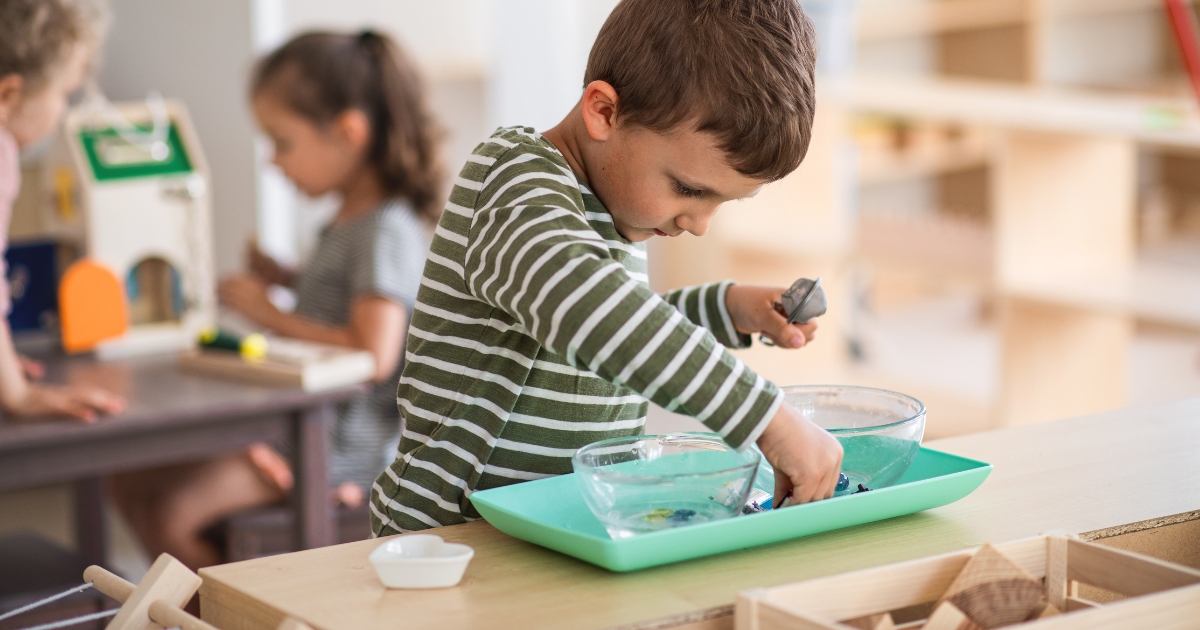
Boy pouring water into a row of small glasses on a wooden tray at home.

How To Set Up Your Home For Independence

Creating a Montessori-friendly home doesn’t require a full renovation. Instead, it’s about making small, intentional changes that allow your child to access what they need without constant help.

When children can reach their belongings, they’re far more likely to take responsibility for them. This simple shift can make a huge difference in daily routines.

Start by observing your home from your child’s perspective. Are everyday items within reach? Can your child complete basic tasks without asking for help every time?

Here are some simple ways to adjust your space:

  • Use low shelves for toys and learning materials 
  • Keep only a few items available at once to reduce overwhelm 
  • Store clothes in easy-to-access drawers or baskets 
  • Place step stools in the kitchen and bathroom 
  • Create simple stations (snack area, art space, reading corner) 

A well-prepared environment quietly encourages independence. You’ll start noticing your child taking initiative in ways that feel natural rather than forced.

Common Mistakes Parents Make (And How To Avoid Them)

Even with the best intentions, it’s easy to accidentally limit a child’s independence. Recognizing these common mistakes can help you adjust quickly and see better results.

Mistake #1: Doing Everything for Your Child
It may save time in the moment, but it prevents your child from learning essential skills.

Solution:
Build extra time into your routine so your child can try tasks independently.

Mistake #2: Expecting Perfect Results
Children are learning, and mistakes are part of the process.

Solution:
Focus on effort and progress instead of perfection.

Mistake #3: Offering Too Many Choices
While choice is important, too many options can overwhelm children.

Solution:
Limit choices to two or three options at a time.

Mistake #4: Interrupting Focused Work
When children are deeply engaged, interruptions can break concentration.

Solution:
Observe quietly and step in only when necessary.

Mistake #5: Choosing Activities That Are Too Advanced
If a task is too difficult, children may become frustrated and give up.

Solution:
Adjust activities to match your child’s current ability level.

Montessori + Homeschooling: A Natural Fit

When Montessori principles are combined with homeschooling, the results can be transformative. Instead of constantly directing your child, you begin to guide them. Instead of pushing motivation, you allow it to grow naturally.

This shift often leads to a calmer and more cooperative learning environment. Children who feel capable are less likely to resist and more likely to engage with their work. They develop a sense of ownership over their learning, which makes a lasting difference.

Another benefit is flexibility. Montessori works beautifully with mixed-age families, allowing younger children to learn by observing and older children to reinforce their knowledge by helping others. This dynamic creates a supportive and collaborative homeschool atmosphere.

Parents often find that their role becomes less about control and more about support. You’re still involved, but in a way that empowers rather than directs every step.

A Simple Weekly Plan To Build Independence

If you’re feeling overwhelmed, start small. You don’t need to implement everything at once to see progress.

Here’s a simple four-week plan to get started:

Week 1: Introduce One New Skill

  • Choose a simple activity like pouring or folding 
  • Demonstrate slowly and clearly 
  • Allow your child to practice daily 

Week 2: Add Responsibility

  • Assign a consistent daily task 
  • Keep expectations simple and achievable 

Week 3: Encourage Decision-Making

  • Offer limited choices throughout the day 
  • Allow your child to take ownership of small decisions 

Week 4: Step Back and Observe

  • Reduce how often you step in 
  • Let your child problem-solve independently 

Helpful Low-Cost Resource Ideas:

  • Dollar store trays, bowls, and containers 
  • Mason jars for pouring activities 
  • Old towels or cloths for folding practice 
  • Library books for inspiration and guidance 
  • Free printable Montessori activities available online 

Building Independence

Building independence in your child doesn’t require perfection, it requires consistency and patience. The small moments matter most. Each time your child tries something on their own, they’re building confidence that will carry into every area of life.

Montessori activities are not just about teaching tasks. They’re about shaping a mindset. A child who learns independence early becomes a learner who is curious, capable, and motivated from within.

If you’re just beginning your homeschool journey, start simple. Choose one activity this week and focus on it. Watch how your child responds, and build from there. Progress doesn’t have to be fast to be meaningful.

At DKM Homeschool Resource, we’re here to support you with practical strategies, encouragement, and real-life solutions that fit into your busy day. Be sure to explore more of our blog for ideas that make homeschooling easier and more effective.

FAQs About Montessori Homeschool

FAQ: What are the easiest Montessori activities to start with at home?
The easiest Montessori activities include pouring, sorting, folding, and simple cleaning tasks. These activities require minimal materials and help children build independence through everyday routines. They are ideal for beginners and fit naturally into a homeschool environment.

FAQ: How do Montessori activities improve independence in children?
Montessori activities encourage children to complete tasks on their own, which builds confidence and problem-solving skills. Over time, this independence carries into learning, helping children stay focused and motivated in a homeschool setting.

FAQ: Are Montessori methods effective for older homeschool children?
Yes, Montessori methods work for all ages by promoting independence and responsibility. For older children, this includes managing their time, setting goals, and taking ownership of their learning. These skills are essential for long-term homeschool success.

How to Teach Place Value the Montessori Way

Teaching place value the Montessori way means helping your child see and touch how numbers are built using hands-on materials like golden beads, number cards, and real-life counting experiences. Instead of memorizing that “10 ones equals 1 ten,” children physically exchange units for tens and truly understand how our base-ten system works.

If you’ve ever watched your child stare blankly at a worksheet full of regrouping problems, you’re not alone. Many homeschool parents feel stuck when math suddenly shifts from simple counting to bigger numbers. The good news? Montessori place value activities make this transition smooth, visual, and even fun.

Let’s walk through exactly how to do it — step by step — without overwhelming yourself.

What Are The 4 C’s Of Montessori?

The 4 C’s of Montessori are commonly described as:

  • Concentration
  • Coordination
  • Confidence
  • Competence

These four pillars show up beautifully when teaching place value.

When a child carefully counts 10 unit beads and exchanges them for a ten bar, they develop concentration. As they physically move and organize materials, coordination improves. When they successfully build 1,245 using concrete materials, confidence grows. And as understanding deepens, true mathematical competence develops.

Montessori education is not about rushing ahead. It’s about building a strong foundation that lasts.

When parents approach place value using this philosophy, the focus shifts from “getting through the lesson” to helping a child truly grasp how numbers work. And that shift changes everything.

Why Montessori Place Value Works So Well

Traditional math instruction often jumps too quickly into abstraction. Children are expected to understand that the digit “3” means 300 in one place and 3 in another — without physically experiencing what that means.

Montessori slows this down intentionally.

Children first handle real quantities. They:

  • Count individual unit beads (ones)
  • Bundle or exchange into ten bars
  • Stack ten bars into hundred squares
  • Combine hundred squares into thousand cubes

Instead of memorizing rules, they discover them.

Imagine your child physically building the number 2,347:

  • 2 thousand cubes
  • 3 hundred squares
  • 4 ten bars
  • 7 unit beads

That visual and tactile experience creates deep number sense that worksheets alone can’t provide.

Another reason this method works? It respects developmental stages. Young learners think concretely first. Montessori math honors that reality.

How To Teach Place Value The Montessori Way (Step-By-Step)

How To Teach Place Value The Montessori Way

Here’s the practical part — what you can actually do this week.

You don’t need a full Montessori classroom. You just need a few simple tools.

Step 1: Gather or Create Materials

If you can invest in materials, look for:

  • Montessori golden bead material (complete set)
  • Large number cards (1–9, 10–90, 100–900, 1000–9000)

On a budget? Try this:

  • Use dried beans or small objects for ones
  • Bundle popsicle sticks with rubber bands for tens
  • Tape together 10 bundled sticks for hundreds
  • Use small boxes to represent thousands

Low-cost Montessori homeschooling is absolutely possible.

Step 2: Introduce Quantities Before Symbols

Start with quantity only.

Let your child:

  • Count 10 units
  • Exchange them for one ten
  • Repeat the process multiple times

Don’t rush to the written number. Let the pattern emerge naturally.

Step 3: Introduce Number Cards

Once your child understands quantities, match them to number symbols.

Lay out:

  • 1,000 card
  • 200 card
  • 40 card
  • 7 card

Stack them to form 1,247.

This layering shows how numbers are composed — not just written.

Step 4: Practice the “Bank Game”

This is a Montessori favorite.

You act as the banker. Your child requests numbers like:

  • “Can I have 3 tens?”
  • “I need 2 hundreds.”

Then switch roles.

It builds:

  • Vocabulary
  • Understanding
  • Confidence
  • Fun

And yes — it works incredibly well in a homeschool math setting.

One of the biggest shifts parents experience when teaching place value the Montessori way is realizing that slowing down actually speeds learning up. When children physically exchange materials, they aren’t just performing steps. They are internalizing how our number system functions. That understanding prevents frustration later during subtraction with regrouping and long division.

In our experience at DKM Homeschool Resource, parents often say this is the moment math “clicks” for their child. And once it clicks, momentum builds naturally.

Common Mistakes To Avoid When Teaching Place Value

Even well-meaning homeschool parents sometimes run into roadblocks. Here’s what to watch for.

1. Moving to Worksheets Too Quickly

If your child hasn’t physically exchanged units for tens multiple times, they’re not ready for regrouping problems.

Stay concrete longer than you think you need to.

2. Skipping the Exchange Process

The exchange (10 ones = 1 ten) is the heart of place value.

Don’t just tell them — let them do it repeatedly.

3. Overcomplicating the Setup

You don’t need a Pinterest-perfect math shelf.

A simple basket with materials works beautifully.

4. Teaching Digit Names Without Context

Instead of saying, “This is the hundreds place,” show 3 hundred squares. Let them feel the weight difference between 3 hundreds and 3 tens.

That sensory experience matters.

Simple Montessori Place Value Activities You Can Try This Week

Ready for action steps? Here are easy wins.

Activity 1: Build the Year

Have your child build the current year using materials.

Example:
2,026 = 2 thousand cubes, 0 hundreds, 2 tens, 6 ones.

This makes numbers relevant.

Activity 2: Number Hunt Around the House

Find numbers on:

  • Mail
  • Cereal boxes
  • License plates

Then build those numbers with materials.

Activity 3: Exchange Challenge

Give your child:

  • 23 units
    Ask them to exchange properly.

Watch carefully — do they instinctively trade 10 units for 1 ten?

Activity 4: Montessori Addition with Place Value

Build two numbers physically.

Combine them.

Exchange when needed.

Now regrouping suddenly makes sense.

Place value isn’t just a math skill; it’s a foundational understanding that supports every advanced operation your child will encounter. When children truly grasp that 10 ones consistently become 1 ten, they begin to see patterns everywhere. Math stops feeling random and starts feeling logical.

This confidence carries over into multiplication, division, and even fractions later on. That’s why investing time here pays off in the long run.

How To Adapt Montessori Place Value For Different Ages

Not every child starts at the same point.

Here’s a simple breakdown:

Ages 4–5 (Early Introduction)

  • Focus only on quantities
  • Count to 10 repeatedly
  • Introduce exchanging slowly

Keep lessons 10–15 minutes.

Ages 6–7 (Full Place Value Work)

  • Introduce full golden bead system
  • Build 4-digit numbers
  • Begin simple addition with materials

Ages 8+ (Catch-Up or Reinforcement)

If your older child struggles with regrouping:

  • Go back to concrete materials
  • Rebuild understanding
  • Remove shame — this is common

Montessori math works at any age when introduced properly.

Another powerful aspect of Montessori homeschooling is that it removes pressure from the learning process. When children can manipulate materials freely, they experiment. They make mistakes. They correct themselves. That cycle builds independence and resilience — two traits that matter far beyond math lessons.

As homeschool parents, we often feel responsible for every outcome. Montessori reminds us that the environment does much of the teaching. Our job is to guide, observe, and step back at the right moments.

Montessori FAQs

FAQ: What age should I start teaching place value using Montessori methods?
Most children are ready around ages 4–6, depending on their number readiness. Begin with counting and simple exchanges before introducing the full golden bead material. In Montessori math, hands-on experience comes first, and abstraction follows naturally.

FAQ: Do I need official Montessori materials to teach place value at home?
No. While golden beads are helpful, you can use beans, sticks, or DIY bundles for effective Montessori homeschooling. The key is physically representing ones, tens, hundreds, and thousands so children understand the base-ten system.

FAQ: How long should we spend on place value activities each day?
Keep homeschool math lessons short and focused — typically 15–30 minutes. Montessori education emphasizes quality over quantity. If your child is engaged and understanding, you’re doing enough.

Keep Exploring Our Blogs

Teaching place value the Montessori way doesn’t require perfection. It requires patience, consistency, and a willingness to slow down. When you prioritize understanding over speed, your child builds true number sense that lasts for years.

Start small this week. Gather simple materials. Practice exchanges. Play the bank game. Watch for that lightbulb moment.

And remember — you don’t have to figure out homeschooling alone. At DKM Homeschool Resource, we’re here to offer practical homeschool advice, encouragement, and realistic strategies that fit real family life.

Keep exploring our blog for more Montessori math tips, Charlotte Mason ideas, and simple routines that help your homeschool thrive.

Montessori Homeschool: Best Ages + What to Avoid (So It Actually Works)

If you’ve been researching Montessori homeschool, you’ve probably noticed two things: it sounds peaceful and effective… and also a little intimidating. Tiny trays, perfect shelves, expensive materials, kids “choosing their work” without chaos—how does that translate to real life?

The good news: Montessori can be a fantastic fit for homeschool families. The even better news: you don’t need to do it perfectly for it to work. You just need to understand which ages Montessori supports best, how it changes as your child grows, and what to avoid so you don’t accidentally turn Montessori into “Pinterest pressure.”

Let’s break it down.

What Montessori Homeschool Really Means (In Plain English)

Montessori is a child-centered approach built around independence, hands-on learning, and a carefully prepared environment. In a homeschool setting, it usually means:

  • your child has meaningful choices (within clear limits)
  • learning is practical, tactile, and step-by-step
  • you focus on skills and mastery, not busywork
  • you protect attention spans by keeping lessons simple and uncluttered
  • the environment supports independence (so you’re not doing everything for them)

Montessori isn’t “no structure.” It’s structure that’s designed to help your child do more on their own.

Best Ages for Montessori Homeschool (and Why They Work)

Montessori works at many ages, but it shines in specific stages. Here’s what to expect.

Ages 2–6: The Montessori “sweet spot”

If you hear people say Montessori is “best for little kids,” this is why. This stage is all about movement, language, order, and independence. Kids naturally want to copy you and do “real work.”

What Montessori looks like at home:

  • practical life: pouring, spooning, folding, sweeping
  • sensorial play: sorting, matching, building, pattern work
  • early language: sound games, letter tracing, rich read-alouds
  • early math: counting with objects, number rods, simple quantity work

Why it works so well:

  • children learn through their hands
  • attention spans are supported by short, focused activities
  • independence can grow fast when the environment is set up right

If you’re new to Montessori homeschooling, this is the easiest place to start.

Best Ages for Montessori Homeschool

Ages 6–9: Montessori can be powerful (with the right shift)

This is when many families wonder if Montessori still “counts,” because the materials change and academics become more visible.

What Montessori looks like at home:

  • longer work periods (more time to focus)
  • project-based learning tied to real interests
  • hands-on math and grammar (still concrete, but more advanced)
  • lots of reading, storytelling, timelines, maps, and research

Why it works:

  • kids develop reasoning and curiosity
  • they love big questions and meaningful work
  • they can manage independence if routines are consistent

Key tip: At this age, Montessori is less about shelves and more about independence + deep learning.

Ages 9–12: Montessori can still work if you avoid “too much too soon.”

Upper elementary kids often want autonomy, but they still need guidance and accountability.

What works well:

  • weekly plans with daily check-ins
  • projects and presentations (even informal)
  • real-life math and writing connected to goals
  • responsibility in the home (which supports executive function)

Potential challenge:

  • if “choice” becomes “no expectations,” progress can stall

If you’re homeschooling Montessori-style at this age, the goal is freedom within structure.

Ages 12+: Montessori-inspired is often the best approach

True Montessori adolescent programs are typically community-based (farm work, apprenticeships, group projects). At home, most families do best with Montessori principles rather than trying to replicate the full model.

Montessori-inspired homeschool can look like:

  • independent study + mentorship (you as a guide)
  • real-world skills: budgeting, cooking, volunteering, entrepreneurship
  • strong literacy and math habits with clear benchmarks
  • interest-led electives with consistent work expectations

At this age, the biggest win is teaching teens how to learn, not just what to learn.

What to Avoid in Montessori Homeschool (Common Mistakes That Backfire)

Let’s save you time, money, and frustration. These are the mistakes that usually make parents say “Montessori didn’t work for us.”

1) Buying all the materials before you understand the method

You don’t need a full Montessori classroom in your house. Start with a few core activities and build slowly based on what your child uses.

Better approach:

  • choose 5–10 activities max
  • rotate weekly
  • prioritize practical life + language + basic math

2) Confusing Montessori with “letting kids do whatever.”

Montessori is built on limits, routines, and purposeful work. If your child is bouncing from one thing to another, they don’t need more freedom—they need a simpler setup.

Try this:

  • offer 2–4 choices at a time
  • use short lessons, then independent practice
  • keep a predictable work block (even 45–90 minutes)

3) Correcting too much (or rescuing too fast)

A huge Montessori goal is building capability. If you jump in every time something spills or feels slow, your child learns that you don’t trust them to figure things out.

Instead:

  • model once, then step back
  • allow “productive struggle.”
  • teach cleanup as part of the activity

4) Over-focusing on aesthetics

A beautiful shelf isn’t the goal. A functional shelf is.

Montessori-friendly beats Montessori-perfect:

  • materials accessible and uncluttered
  • clear spots for each item
  • child-sized tools when possible
  • simple routines that your child can follow

5) Expecting Montessori to replace explicit teaching forever

Even in Montessori schools, lessons are taught. The difference is that lessons are usually short, precise, and followed by independent work.

If you want to avoid frustration, remember:
You still teach. Your child still practices. Montessori simply changes the “how.”

Do Montessori Kids Do Better Later?

Do Montessori Kids Do Better Later?

This is one of the most common questions parents ask, and the honest answer is: often, yes, especially in certain areas, but it depends on quality and consistency.

Many families notice Montessori kids tend to develop strong:

  • independence and self-management
  • focus and persistence
  • intrinsic motivation (they do work because it matters, not for prizes)
  • problem-solving skills
  • confidence in learning

However, Montessori isn’t a magic label. Outcomes depend on things like:

  • whether the environment supports independence (not overwhelming)
  • whether learning is consistent and progressive
  • whether your child gets the right level of guidance

If Montessori at home becomes “no structure,” kids may struggle later with deadlines and expectations. However, when Montessori is implemented through clear routines and real skill-building, many children transition well because they’ve practiced working independently for years.

Bottom line: Montessori kids can do very well later, especially when the approach builds both freedom and responsibility.

A Simple Montessori Homeschool Setup You Can Start This Week

If you want a realistic starting point, try this:

  1. Choose one workspace (table + small shelf or bin)
  2. Pick 8 activities total
    • 3 practical life
    • 2 language
    • 2 math
    • 1 art/sensory
  3. Set a daily work block
    • Ages 3–6: 30–60 minutes
    • Ages 6–9: 60–120 minutes
    • Ages 9–12: 90–180 minutes (broken into chunks)
  4. Teach one short lesson per day
  5. Rotate materials weekly based on what gets used

This keeps Montessori simple, affordable, and sustainable—without losing what makes it effective.

Montessori at Home: Simple Tips for Every Stage

Montessori homeschool works best when you match it to your child’s developmental stage. Ages 2–6 are the easiest and most naturally aligned, but Montessori principles can support learning well beyond that—especially when you keep routines strong and expectations clear.

Start small. Focus on independence. Avoid overbuying and under-structuring. And remember: your goal isn’t to copy a classroom, it’s to build a home environment where your child can learn confidently and steadily.

How To Combine Montessori And Unschooling Without Chaos

Homeschooling with both Montessori and unschooling is absolutely possible — and it doesn’t have to feel chaotic. The key is creating gentle structure while protecting your child’s natural curiosity and freedom. When done well, Montessori provides the prepared environment, and unschooling brings the child-led exploration.

To combine Montessori and unschooling without chaos, create a prepared environment with structured materials (Montessori) while allowing your child to choose what and how they learn (unschooling). Keep simple daily rhythms, limit materials to avoid overwhelm, and observe your child closely so freedom stays purposeful — not messy.

At DKM Homeschool Resource, we’ve helped countless overwhelmed parents blend methods successfully. If you love the calm beauty of Montessori but also crave the freedom of unschooling, you’re not alone. Let’s break this down in a way that feels doable — even if your homeschool currently feels like a pile of books and half-finished projects.

What Is The Biggest Criticism Of Montessori?

The biggest criticism of Montessori is that it can feel too rigid, too structured, or too dependent on specific (often expensive) materials. Some parents worry it limits creativity or feels overly controlled compared to more relaxed approaches like unschooling.

That concern is understandable.

If you’ve ever scrolled through pictures of pristine Montessori classrooms — perfectly aligned trays, neutral colors, wooden materials lined up just so — it can feel intimidating. Some parents assume they must recreate that exact environment at home or they’re “doing it wrong.” Others worry their energetic, imaginative child won’t thrive in something that looks so orderly.

Montessori emphasizes order, routine, and carefully designed materials. Lessons are often presented in a specific sequence. Activities are demonstrated in a particular way. There’s a clear beginning, middle, and end to many tasks. For families who lean toward relaxed homeschooling, that structure can feel restrictive or even stiff.

Another common criticism is cost.

Authentic Montessori materials can be pricey. Pink towers, golden beads, moveable alphabets — they add up quickly. This creates the impression that Montessori homeschooling requires a large budget. For many families, especially those just beginning their homeschool journey, that feels unrealistic.

There’s also the perception that Montessori limits imagination.

Because traditional Montessori environments prioritize real-life activities and realistic toys (instead of fantasy-based play), some critics believe it stifles creativity. Parents sometimes ask us, “If everything has a specific purpose, where does pretend play fit in?”

These concerns don’t come out of nowhere. They usually come from surface-level impressions.

On the flip side, unschooling is often criticized for the opposite reasons. It’s described as too loose, too hands-off, or lacking academic direction. Critics worry children might miss foundational skills or fall behind traditional grade-level expectations.

So here’s the honest truth:

Both methods get misunderstood.

Montessori isn’t about control — it’s about independence within structure.

The structure exists so the child can function independently without constant adult direction. The organized shelf, the defined workspace, and the clear routine are not there to restrict the child. They’re there to remove chaos so the child can focus deeply and build self-discipline.

In fact, a well-run Montessori environment gives children tremendous freedom. They choose their work. They move at their own pace. They repeat activities as often as they like. The adult’s role is guide, not lecturer.

Unschooling isn’t about no learning — it’s about interest-driven learning.

It doesn’t mean abandoning math or reading. It means those subjects grow out of real curiosity instead of imposed worksheets. When done intentionally, unschooling can produce highly motivated, self-directed learners.

The tension between these two approaches often comes from misunderstanding the purpose behind each one.

Montessori structure without freedom can feel rigid.
Unschooling freedom without structure can feel chaotic.

But when you combine them intentionally, they actually balance each other beautifully.

Balanced Learning

Together, they create something many homeschooling parents are secretly looking for: freedom with foundation.

Here’s a practical example.

Imagine a child who loves drawing comics.

A rigid Montessori-only mindset might focus strictly on handwriting practice and language materials.
A pure unschooling approach might allow endless drawing without skill development.

A blended approach looks like this:

  • Provide high-quality paper, sharpened pencils, and organized supplies (Montessori environment).
  • Allow the child to choose comic creation daily (unschooling interest).
  • Introduce spelling tools or grammar mini-lessons when needed for their stories (intentional guidance).

The result? Skill growth driven by passion.

When parents hear criticism about Montessori being too strict, we encourage them to ask: “Strict compared to what?” Compared to traditional school, Montessori is remarkably child-centered. Compared to unschooling, yes — it has more visible structure.

But structure isn’t the enemy of creativity. Chaos is.

Children often flourish when they know:

  • Where materials belong
  • What their options are
  • How to work independently

That predictability builds confidence. And confidence fuels creativity.

It’s also important to remember that Montessori was designed to cultivate self-discipline over time. The goal isn’t compliance. It’s internal motivation. When children repeatedly complete purposeful work in an orderly environment, they develop focus that carries into their passions.

For homeschooling families, this can be incredibly helpful.

Many overwhelmed parents come to us saying:
“I tried unschooling, and my house feels wild.”
or
“I tried strict curriculum, and my child shut down.”

The criticism of Montessori often highlights its structure. But that structure, when softened with flexibility and child-led exploration, becomes the stabilizing force many families need.

Instead of asking whether Montessori is too rigid, a better question might be:

How much structure does my child need to thrive?

Some children crave clear routines. Others need wide-open exploration. Most fall somewhere in between.

That’s why combining Montessori and unschooling works so well for modern homeschoolers. You can adjust the dial. Add more structure when things drift. Add more freedom when motivation dips.

The criticism, in many ways, opens the door to innovation.

You don’t have to replicate a Montessori classroom perfectly. You don’t have to abandon structure completely to embrace child-led learning. You can design a homeschool that keeps order without crushing curiosity.

And that’s where the magic happens.

Montessori classroom perfectly
#image_title

Montessori Vs. Unschooling: What’s The Real Difference?

Before we combine them, let’s simplify what each one really offers.

Montessori focuses on:

  • Prepared environments
  • Hands-on learning materials
  • Independence and responsibility
  • Calm, predictable routines
  • Practical life skills

Unschooling focuses on:

  • Child-led interests
  • Real-life learning
  • Flexible schedules
  • Curiosity as the driver
  • Learning through everyday experiences

At first glance, they seem opposite. One looks structured; the other looks free-flowing.

But here’s the powerful connection:
Both respect the child.

Both trust that children are capable.
Both prioritize intrinsic motivation over worksheets.

The difference is how much structure the parent builds around that freedom.

This is where many homeschooling parents get stuck. They think they must choose one camp or the other. In reality, most successful homeschoolers blend approaches naturally over time.

How To Combine Montessori And Unschooling Without Chaos

Here’s the practical part you’ve been waiting for.

Blending Montessori homeschooling with unschooling works best when you use Montessori as the framework and unschooling as the fuel.

Step 1: Create a Prepared (But Flexible) Environment

Montessori teaches us that environment matters.

You don’t need expensive wooden materials to start. You do need:

  • Low shelves with limited options
  • Clearly organized materials
  • Rotated activities (not all at once)
  • Accessible supplies (paper, pencils, scissors, books)

Chaos often comes from too much stuff, not too much freedom.

Quick tip:
Limit available activities to 8–12 options at a time. Rotate weekly or biweekly.

When children can see and reach materials independently, unschooling becomes intentional instead of random.

Step 2: Keep a Gentle Daily Rhythm

Unschooling does not mean no rhythm.

Try something like:

  1. Morning reset (chores, tidying shelves)
  2. Independent exploration time
  3. Outdoor play
  4. Quiet reading or creative hour

No strict timetable. Just flow.

Rhythm reduces chaos more than rigid schedules ever will.

Step 3: Observe Before You Intervene

Montessori encourages observation.
Unschooling requires trust.

Instead of jumping in to “teach,” try this:

  • Watch what your child chooses.
  • Notice patterns.
  • Provide materials that extend their interest.

Example:
If your child loves baking, you can:

  • Add measuring cups (math)
  • Print simple recipe cards (reading)
  • Discuss fractions naturally

That’s Montessori structure supporting unschooling interest.

Montessori structure supporting unschooling interest

Step 4: Use Montessori Materials as “Interest Boosters”

Instead of forcing materials, connect them to interests.

If your child:

  • Loves animals → Add classification cards and nonfiction books.
  • Loves building → Introduce geometry shapes and measurement tools.
  • Loves stories → Provide moveable alphabet work.

Montessori materials become tools, not assignments.

Step 5: Avoid These Common Mistakes

Blending approaches fails when:

  • You overschedule like traditional school.
  • You remove all structure in the name of freedom.
  • You introduce too many materials at once.
  • You panic when learning doesn’t look “academic.”

Remember: chaos is usually a sign of unclear boundaries, not too much curiosity.

What Does A Blended Montessori–Unschooling Day Look Like?

Here’s a realistic example for a 7-year-old:

Morning:

  • Make bed and feed pet (practical life)
  • Choose independent shelf work (math beads or reading cards)

Late Morning:

  • Child chooses to research volcanoes
  • Parent provides library books and simple science experiment

Afternoon:

  • Outdoor play
  • Drawing volcano diagram
  • Baking soda experiment

No formal “lesson plan,” but plenty of learning.

Another example for a teen:

  • Interest in photography
  • Parent helps organize a workspace
  • Introduce budgeting (business math)
  • Explore editing software tutorials
  • Visit a local exhibit

That’s unschooling interest supported by Montessori-style environment and independence.

One of the most beautiful outcomes of combining Montessori and unschooling is watching confidence grow. Children begin to manage their own time, care for their environment, and pursue ideas deeply. When parents stop micromanaging and start preparing the space thoughtfully, kids rise to the occasion. It’s not instant, but the shift is powerful and lasting.

Simple Steps You Can Take This Week

Let’s make this practical.

Here’s what you can do in the next seven days:

1. Declutter Learning Spaces

Remove half the visible materials. Store the rest.

2. Create a “Yes Shelf”

Fill it with:

  • Paper and art tools
  • One math option
  • One reading option
  • One practical life activity

3. Set a 2-Hour Exploration Block

No screens. No interruptions. Just choice.

4. Start an Observation Notebook

Write down:

  • What they choose
  • How long they stick with it
  • What questions they ask

This becomes your guide for future materials.

5. Visit the Library

Free resources are gold for blended homeschooling.

Look for:

  • Interest-based nonfiction
  • Audiobooks
  • Activity guides
  • STEM kits (many libraries offer these now)

Low-cost homeschooling resources make Montessori–unschooling much more sustainable.

When This Approach Works Best (And When It Doesn’t)

Blending Montessori and child-led learning works especially well for:

  • Curious, independent kids
  • Families who dislike strict schedules
  • Parents willing to observe more than lecture

If you have a child who naturally asks questions, starts projects on their own, or disappears into deep focus while building, drawing, or reading — this approach will likely feel like a breath of fresh air. Montessori gives those children tools and order, while unschooling gives them space to explore their ideas fully.

It also works beautifully for families who don’t thrive under rigid timetables. If hourly schedules stress you out, but total chaos stresses you out too, this middle ground offers structure without suffocation. A gentle rhythm replaces bells and timers.

And perhaps most importantly, it works well for parents who are willing to step back.

That doesn’t mean you’re uninvolved. It means you’re intentional. You observe patterns. You adjust the environment. You introduce materials strategically instead of delivering constant lectures. If you’re open to becoming a guide rather than the center of instruction, this blend becomes powerful.

Now let’s talk honestly about when it can feel harder.

It may feel more challenging if:

  • You need tight control to feel secure
  • Your home environment is highly cluttered
  • You expect traditional grade-level pacing

If you feel anxious without clear lesson plans, textbooks, and measurable benchmarks, combining Montessori and unschooling can initially feel uncomfortable. This model requires trust — both in your child and in the long game of learning.

A cluttered home environment can also sabotage this approach quickly. When everything is accessible but nothing is organized, “freedom” turns into overwhelm. Montessori principles depend heavily on order. If shelves are overflowing or supplies are scattered, you may see frustration instead of focus.

Another sticking point is grade-level expectations. If you’re constantly comparing your child’s progress to public school benchmarks, you may feel like they’re “behind” during interest-driven seasons. Unschooling especially doesn’t always move in a straight line. Growth often happens in leaps, not steady increments.

Let’s pause here for something important.

Mindset matters more than materials.

Parents who succeed with this blend usually shift from asking, “Are we covering enough?” to asking, “Is my child engaged and growing?” That subtle change reduces pressure dramatically. You start measuring progress by depth of understanding instead of page numbers completed.

This doesn’t mean academics disappear. It means they are integrated more naturally. A child who spends three weeks immersed in building a cardboard city is practicing math, engineering, planning, writing, and creativity — even if no workbook page was assigned.

There’s also a personality component for parents.

If you thrive on spreadsheets and strict pacing guides, you don’t have to abandon that strength. But you may need to loosen your grip slightly. Consider using planning as a support tool rather than a control mechanism. Keep goals in the background while allowing your child’s interests to lead the foreground.

On the flip side, if you lean extremely relaxed, you may need to intentionally build more visible structure into your home. Montessori-style shelves, clear workspaces, and daily reset routines are not optional in this blend. They are what keep unschooling from drifting into distraction.

Here’s a practical self-check you can use this week:

Ask yourself:

Your honest answers will show you where small adjustments are needed.

Remember, difficulty doesn’t equal impossibility.

If you need more control, start with a stronger daily rhythm.
If clutter is the problem, declutter one shelf at a time.
If pacing worries you, set quarterly goals instead of daily quotas.

Small shifts make this blend sustainable.

And here’s the encouragement every parent needs to hear:

Homeschooling is not about recreating school at home. It’s about building a lifestyle of learning.

When learning becomes part of everyday life — cooking, building, reading, exploring, questioning — it stops feeling forced. Montessori provides the scaffolding. Unschooling supplies the spark. Together, they create something steady, flexible, and deeply personal.

If it feels messy at first, that’s okay. Most meaningful transitions do. Stay observant. Stay patient. Adjust gently.

You’re not trying to copy a classroom. You’re building a home where learning lives naturally.

Common FAQs About Montessori and Unschooling

FAQ: Can Montessori and unschooling really work together in homeschool?
Yes, Montessori homeschooling and unschooling complement each other when you balance structure with freedom. Montessori provides the prepared environment and independence skills, while unschooling encourages curiosity and interest-led exploration. Together, they create focused but flexible learning.

FAQ: How do I prevent chaos in relaxed homeschooling?
Prevent chaos by keeping a simple daily rhythm, limiting visible materials, and observing your child’s interests. Relaxed homeschooling works best when the environment is organized and expectations are clear, even if the schedule isn’t rigid.

FAQ: Do I need expensive Montessori materials to combine these methods?
No. You can create a Montessori-inspired homeschool using everyday items, library books, and DIY resources. Focus on accessibility, independence, and purposeful materials rather than brand-name products.

Keep Learning With DKM Homeschool Resource

Combining Montessori and unschooling without chaos isn’t about perfection. It’s about thoughtful balance. Create a prepared environment. Protect your child’s curiosity. Keep your rhythm simple. Observe more than you control.

If you’re feeling overwhelmed, start small this week. Declutter one shelf. Protect one exploration block. Visit the library. Small shifts lead to big calm.

At DKM Homeschool Resource, we’re here to walk this journey with you. Explore more of our homeschool advice, practical guides, and encouragement for parents who want freedom without frustration. Your homeschool doesn’t have to look like anyone else’s — it just needs to work for your family.

Why Montessori Math Builds Strong Number Sense

If math has ever felt stressful or confusing in your homeschool, focusing on math number sense can completely change the experience. Before children can confidently add, subtract, or solve problems on paper, they need to understand what numbers actually represent. Montessori math begins with this understanding, building meaning first instead of rushing into worksheets or memorization. For many families, this shift alone transforms math from a daily struggle into something calmer and more enjoyable.

Traditional math approaches often introduce abstract symbols before children are developmentally ready. Kids may learn procedures or chants without understanding what those numbers actually mean. Montessori math takes a slower, more intentional path that honors how young children naturally learn. Instead of memorizing steps, children explore numbers with their hands, eyes, and movement.

This hands-on foundation makes math feel logical instead of arbitrary. Children aren’t guessing or hoping they remember the “right” way to do something. They understand why numbers work the way they do. That understanding builds confidence, which is especially important in early math when attitudes toward learning are being formed.

What Math Number Sense Is And Why It Matters

Math number sense is a child’s intuitive understanding of numbers, quantities, and how they relate to one another. It goes far beyond counting or recognizing numerals. Number sense includes knowing which numbers are larger or smaller, understanding that numbers can be grouped and separated, and recognizing patterns and relationships. These skills allow children to think flexibly instead of relying on memorized rules.

In early math, number sense matters far more than speed or accuracy. A child who understands that eight is made up of two groups of four has a stronger foundation than a child who can recite addition facts without understanding them. Number sense allows children to estimate, reason, and solve problems logically. It also helps them catch mistakes because they can tell when an answer doesn’t make sense.

Children with strong number sense tend to approach math with confidence. They’re willing to try, adjust, and experiment because numbers feel familiar instead of intimidating. When children lack number sense, math often feels confusing and frustrating. They may rely heavily on counting fingers or memorized steps, which can slow progress later on.

Montessori math activities are designed specifically to support this foundational understanding. Children consistently work with materials where quantity and number are visually and physically connected. Over time, numbers stop being abstract symbols and become meaningful concepts. This deep understanding supports everything that comes next in math.

Strong number sense also supports learning beyond math. It strengthens problem-solving, logical thinking, and even language development as children explain their reasoning. When children understand numbers deeply, they gain confidence in their ability to think and reason independently.

How Montessori Math Builds Math Number Sense

Montessori math begins with the idea that children learn best through their senses. Instead of starting with numbers on paper, children start with physical materials they can see, touch, and move. These materials are carefully designed so that quantity, size, and number are always aligned. A larger number is physically larger, which helps children internalize the concept naturally.

One of the most important Montessori principles is moving from concrete to abstract. Children first experience numbers through hands-on materials, then through visual representations, and finally through written symbols. This progression ensures that children don’t memorize symbols without understanding their meaning. Each step builds on the one before it.

How Montessori Math Builds Math Number Sense

Another key element of Montessori math is built-in error control. Many materials allow children to see or feel when something doesn’t work. For example, if quantities don’t match or pieces don’t fit correctly, the child knows something needs adjusting. This encourages independent thinking and reduces reliance on adult correction.

Montessori math also respects the child’s pace. Children are encouraged to repeat activities as often as they like. This repetition isn’t boring—it’s comforting and confidence-building. Each repetition strengthens understanding and makes numbers feel familiar and safe.

This approach is especially powerful in early math because it aligns with how young children naturally think. Numbers are explored through movement, repetition, and play rather than pressure. Math becomes something children understand and enjoy instead of something they fear.

Over time, children who learn math this way develop a strong internal sense of how numbers work together. When they later encounter more abstract math, they already have a mental framework to support it. This often leads to greater success and less frustration in later years.

Montessori Math Activities That Support Number Sense In Early Math

Montessori math activities are intentionally designed to make numbers concrete and meaningful. Many of these activities can be used directly at home or adapted using simple household materials, making them accessible for homeschool families.

Here are Montessori-inspired math activities that strongly support number sense in early math:

  • Counting with concrete objects
    Children count real items such as beads, blocks, or stones, reinforcing that numbers represent actual quantities rather than abstract ideas.
  • Quantity before symbols
    Children work with sets of objects before being introduced to written numbers, ensuring they understand quantity before memorizing symbols.
  • Number rods
    These rods increase in length as numbers increase, allowing children to see and feel numerical differences clearly and consistently.
  • Sandpaper numbers
    Tracing textured numbers combines touch and sight, helping children internalize number shapes and prepare for writing.
  • Hands-on addition and subtraction
    Children physically combine or separate quantities, allowing them to see exactly what happens when numbers are added or taken away.
  • Everyday math experiences
    Counting snacks, measuring ingredients, and sorting household items reinforce number sense naturally throughout the day.

These activities emphasize understanding rather than performance. Children are encouraged to explore, repeat, and experiment without pressure to get quick answers. Over time, this leads to deeper comprehension and stronger confidence.

Parents often notice that children who learn math this way talk about numbers more comfortably. They explain their thinking more clearly and are less afraid of making mistakes. Math becomes something they feel capable of understanding rather than something they try to avoid.

Why Montessori Math Works So Well For Homeschool Families

Montessori math fits beautifully into the homeschool environment because it is flexible, child-centered, and adaptable. Lessons don’t need to be long or rigid. Children can explore math in short, focused sessions that feel engaging rather than draining. This flexibility helps families maintain consistency without burnout.

Homeschool families often teach multiple ages at once, and Montessori math supports that naturally. Younger children may work on basic counting while older siblings explore larger quantities or early operations using similar materials. This shared learning environment feels cohesive and supportive rather than divided by grade level.

Montessori math also builds confidence in both children and parents. Children learn that mistakes are part of the learning process, not something to fear. Parents don’t need advanced math knowledge because the materials and sequence guide the learning. The parent’s role becomes one of observation, encouragement, and gentle guidance.

Another important benefit is emotional regulation. When children understand what they’re doing, math lessons tend to be calmer and more peaceful. Frustration decreases because children aren’t pushed ahead before they’re ready. This creates a more positive homeschool rhythm overall.

Some parents worry that Montessori math is too slow or that children won’t “keep up.” In reality, children who develop strong number sense often progress more quickly later because they truly understand concepts. Speed without understanding can create gaps, while deep understanding builds flexibility and confidence.

You also don’t need a full Montessori classroom to use this approach. Many Montessori principles can be applied using everyday materials and intentional conversation. What matters most is respecting the learning sequence and allowing children time to explore.

Supporting number sense doesn’t stop when lessons end. Talking about numbers throughout the day strengthens understanding in meaningful ways. Asking children how they know something, encouraging estimation, and letting them explain their thinking all reinforce learning naturally.

When children develop strong math number sense early, math becomes something they trust themselves to understand. That trust carries forward into higher-level math, problem-solving, and even other academic subjects.

Read More Homeschool Math Tips and Resources at DKM Homeschool Resource

Montessori math builds strong number sense by honoring how children naturally learn—through hands-on exploration, repetition, and meaningful understanding. When numbers make sense early on, math becomes logical instead of intimidating. That foundation supports confidence, independence, and long-term academic success.

If you’d like more homeschool guidance like this, be sure to explore more blogs here at DKM Homeschool Resource. We share practical math strategies, gentle learning approaches, and real-life homeschool support to help you build confident learners—one meaningful lesson at a time.

Teaching Geography the Montessori Way

When I first started homeschooling, the idea of teaching geography brought up dusty memories of memorizing state capitals and frantically coloring maps before the bell rang. But then I stumbled upon the Montessori method, and honestly, it changed everything. Instead of dry textbooks, we were suddenly talking about sandpaper globes and puzzle maps. If you are looking for Montessori geography activities that will actually make your kids excited to learn about the world, you have come to the right place. It’s hands-on, it’s intuitive, and best of all, it makes sense to a child’s developing brain.

Let’s dive into how you can bring this magic into your home classroom without needing a PhD in cartography.

Why Montessori Geography Just Works

Before we get into the nitty-gritty of lesson plans, we need to chat about the philosophy. It’s not just about knowing where Brazil is on a map; it’s about understanding our place in the universe. In a traditional setting, geography often starts small—my house, my street, my town—and expands outward. Montessori flips the script entirely.

We start with the whole. The universe. The big bang. It sounds intense for a six-year-old, right? But it’s incredibly grounding.

By introducing the “whole” first, we give children context. When they learn about a continent, they know it’s part of the Earth, which is part of the solar system. This “top-down” approach satisfies a child’s natural curiosity about big questions like “Where did we come from?” and “What is out there?”

It fosters a deep sense of connection. Children learn that they are citizens of the universe first. It builds a foundation of respect for other cultures and the physical environment because everything is presented as interconnected. When you hold a globe in your hands, you aren’t just looking at a ball; you’re holding a representation of our shared home. This perspective shift is what makes the geography curriculum in Montessori so unique and powerful.

The Essential Tools Of The Trade

You might think you need an expensive classroom setup to do this right, but you really don’t. The beauty of these materials is that many can be DIY-ed or bought second-hand. The focus is on sensory learning—touching, feeling, and manipulating objects to understand abstract concepts.

Here are the heavy hitters you’ll want to introduce:

  • Sandpaper Globe: This is usually the very first introduction. It’s a globe where the land is rough (sandpaper) and the water is smooth (painted blue). It teaches the most basic distinction: land versus water.
  • Colored Globe: Once the tactile difference is mastered, we move to the colored globe. Here, the continents are painted in specific Montessori color codes (North America is orange, Europe is red, etc.). This visual cue helps them start identifying distinct landmasses.
  • Puzzle Maps: These are iconic. Each continent is a puzzle piece. Eventually, you get puzzle maps for each individual continent where the countries are the pieces. The little knobs on the pieces even help prep their fingers for writing!
  • Land and Water Forms: These are trays that show physical geographical features. For example, one tray has a model of an island, and another has a lake. By pouring water into them, kids see exactly how land and water interact.

You don’t need to buy all of these at once. Start with a globe. Just having a physical representation of the Earth that isn’t a flat screen is a huge step up from standard learning.

Bringing Montessori Geography Activities To Life

Bringing Montessori Geography Activities To Life

Okay, now that we have our tools, how do we actually teach? We aren’t lecturing here. We are presenting. The goal is to spark interest and then step back to let the child explore.

One of my favorite ways to start is with the “Land, Air, and Water” activity. It’s simple, practically free, and kids love it. You essentially gather jars or containers representing the three elements. Maybe a jar of dirt, a jar of water, and an empty jar for air.

Then, you go on a sorting spree:

  1. Gather objects: Collect small toys, pictures, or figurines of animals and vehicles.
  2. Sort them: Have your child decide where each item belongs. Does the boat go on land? No, it goes in the water. Does the bird go in the air? You get the idea.
  3. Expand the conversation: Talk about why the fish needs water or why the car needs land.

This builds a classification system in their mind. Once they grasp the elements, you can move to the Sandpaper Globe.

Sit on the floor with the globe. Feel the rough parts. Say, “This is land.” Feel the smooth parts. Say, “This is water.” Let them touch it. Close your eyes and feel the difference together. It’s a sensory experience that anchors the vocabulary.

Later, when you introduce the colored globe, you can sing a simple continent song. There are tons of them online, usually set to easy nursery rhyme tunes. Pointing to the orange patch and singing “North America” connects the visual, the auditory, and the kinetic. It sticks.

And don’t forget the cultural connection! Geography isn’t just physical terrain. When you study Africa (the green continent in Montessori color-coding), bring it to life.

  • Cook a recipe: Make a simple dish from an African country.
  • Listen to music: Put on traditional music while you do art projects.
  • Look at photos: Show pictures of real kids, real houses, and real animals.

The goal is to make the map feel like a place where real life happens, not just a shape on a puzzle board.

Moving Beyond The Map: Advanced Exploration

As your children get older, the lessons naturally become more complex, but the hands-on philosophy remains. We move from identifying continents to understanding how the earth works and how humans interact with it.

We start looking at flags. Flag matching is a classic activity. You can make simple 3-part cards (a Montessori staple) where one card has the picture and name, one has just the picture, and one has just the name. The child matches them up. It’s a great reading exercise disguised as a geography lesson.

Then there is the concept of Pin Maps. Once a child has mastered the puzzle maps, they can move to maps where they stick labeled pins into the correct countries or cities. It requires precision and tests their recall without the pressure of a written exam.

We also dive deeper into physical geography:

  • Volcanoes: Build one! It’s messy, it’s classic, and it teaches about the Earth’s crust.
  • Layers of the Earth: Use colored playdough to create a sphere with a core, mantle, and crust. Cutting it open is always a “wow” moment.
  • Biomes: Create dioramas for different biomes—rainforest, desert, tundra. What animals live there? What is the weather like?

The beauty here is that you follow the child’s lead. If they are obsessed with sharks, spend a month on the oceans. If they love knights and castles, dive deep into European geography and history. The curriculum serves the child, not the other way around.

Keep Exploring With Us

Teaching geography the Montessori way doesn’t have to be intimidating. It’s really about shifting from memorization to exploration. It’s about letting your child hold the world in their hands—literally—and discover its wonders at their own pace.

Whether you are building mountains out of dirt in the backyard or carefully tracing a puzzle piece of South America, you are laying a foundation for a global citizen. You are teaching them that the world is big, beautiful, and understandable.

If you loved these ideas and want to keep your homeschool journey fresh and exciting, we have plenty more where this came from. Check out our other blog posts for more homeschool advice, resource reviews, and activity guides. We are here to help you make every lesson an adventure.

Montessori Elementary at Home: What Changes

So, you’ve survived the toddler years. You’ve navigated the “I do it myself!” phase, you’ve probably tripped over one too many wooden puzzles, and now you’re staring down the barrel of the next big adventure: elementary school. If you are planning a Montessori elementary homeschool journey, you might be wondering if it’s just more of the same. Do we just buy bigger trays? More complex pouring activities? Not exactly. While the philosophy remains the same—respect for the child, following their lead—the implementation changes drastically because your child is changing drastically.

The transition from the Primary years (ages 3-6) to the Elementary years (ages 6-12) is often called the “Second Plane of Development.” Maria Montessori had a lot to say about this phase, mostly noting that these kids suddenly turn into social butterflies with a fierce desire for intellectual independence. They move from “help me do it myself” to “help me think for myself.” It’s a wild, wonderful ride, and setting up your home environment to match this new energy is key. Let’s dive into what actually shifts when you level up to the big kid years.

The Big Shift: From Concrete To Abstract

Remember those preschool years? Everything was about the senses. Touching the sandpaper letters, carrying the heavy tower, scrubbing the table. It was all very physical. The Primary child is building themselves through their environment. But once they hit around age six, something clicks. The Montessori elementary homeschool environment needs to pivot because their minds are suddenly capable of intense imagination and abstract thought.

This doesn’t mean we toss out all the materials. The materials are still the anchor. However, the goal is now to use those materials as a launching pad for the imagination. In the younger years, if you talked about a mountain, you needed a picture or a model of a mountain. Now? You can tell a story about how mountains are formed, and their minds can visualize tectonic plates crashing together without needing to physically smash playdough (though that’s still fun).

Here is how this shift looks practically in your day-to-day:

  • The Great Stories: Instead of just isolated lessons, you start with the “Five Great Stories.” These are grand, sweeping narratives about the universe, life, humans, writing, and numbers. They are meant to spark curiosity, not just deliver facts.
  • Big Work: Elementary kids love “Big Work.” This isn’t just a worksheet; it’s a project that might take days or weeks. They might decide to map the entire Nile river on a giant roll of butcher paper or bake bread from scratch to understand chemistry.
  • Going Out: The classroom (or your living room) is no longer enough. The elementary child needs to go out into the world. This means field trips planned by them, interviews with local experts, or trips to the library to find answers you don’t have.

This is the age of “why” and “how.” You don’t need to be the expert who knows everything. In fact, it’s better if you aren’t. When they ask why the sky is blue, don’t just tell them. Say, “I have no idea. Let’s find out.” That is the heart of the elementary spirit.

Social Creatures: Managing The Herd

If the Primary child is a solitary worker bee, the Elementary child is a herd animal. Suddenly, friends are everything. They want to work together, eat together, and yes, argue together. This is a feature, not a bug. They are learning how society works, and that involves a lot of negotiation.

In a traditional school, chatting is often discouraged during “work time.” In a Montessori setting, collaboration is the point. You might find that your homeschool day feels a lot louder than it used to. If you have siblings, they will likely want to pair up. If you are homeschooling an only child or children with large age gaps, you might need to get creative to fulfill this social need.

Montessori Elementary at Home

Here are a few ways to support their social development at home:

  1. Group Projects: Encourage them to work on things together. If siblings aren’t an option, this is where co-ops or regular meetups with other homeschooling families become vital.
  2. Moral Dilemmas: This age group is obsessed with fairness. You will hear “That’s not fair!” approximately 4,000 times a day. Lean into it. Discuss rules, hold family meetings, and let them help draft the “laws” of the house.
  3. Community Service: Since they are looking outward, connect them with the community. Volunteering at a food bank or cleaning up a local park feeds their need to belong to a larger society.

It can be exhausting as a parent because the conflicts are more complex. It’s no longer just about sharing a toy; it’s about who said what and the nuances of exclusion. But guiding them through this is some of the most important work you will do. You are essentially coaching them on how to be a decent human being in a community.

The Guide On The Side, Not The Sage On The Stage

One of the hardest adjustments for parents moving into the elementary years is changing their own role. We are so used to micromanaging the toddlers—keeping them safe, showing them exactly how to hold the spoon, correcting their grip. The elementary child finds this hovering suffocating. They need you to back off, but they still need you present. It’s a tricky balance.

Your role shifts to that of a mentor or a research assistant. You are there to provide the resources and the structure, but the intellectual heavy lifting is on them. If they want to learn about Ancient Egypt, you don’t lecture them. You drive them to the library. You help them find a documentary. You buy the supplies for the pyramid model. You facilitate the learning rather than delivering it.

This also means you have to be comfortable with messier learning. The linear path of “learn A, then B, then C” often disappears. An elementary child might dive deep into geometry for three weeks and ignore biology, then switch gears completely. Trusting this rhythm is terrifying but necessary. As long as you are keeping a general eye on the big picture to ensure they aren’t missing major skills (like, you know, reading and basic math), it’s okay to let them obsess. Their obsessions are where the deepest learning happens.

Freedom And Responsibility: The Balancing Act

Let’s talk about the dreaded “F” word in homeschooling: Follow-through. It is easy to hear “follow the child” and assume it means let them do whatever they want all day. If they want to play Minecraft for six hours, is that Montessori? Well, not exactly. The counterpart to Freedom is Responsibility. You cannot have one without the other.

In the elementary years, we introduce tools to help them manage this freedom. The goal is executive function—teaching them how to manage their time and tasks. We don’t just assign work and check it; we teach them to plan their own week. This is often done through a work plan or a journal.

At the beginning of the week, sit down with your child and discuss what needs to happen.

  • The Must-Dos: Maybe there are non-negotiables like math practice or daily reading.
  • The Want-To-Dos: This is where their projects and interests live. “I want to finish my report on sharks.”
  • The Schedule: Look at the calendar together. Do we have soccer practice? A dentist appointment? Block those out.

By the end of the week, you review it together. Did they do what they said they would? If not, why? Maybe they underestimated how long the shark report would take. That’s a learning moment, not a failure. Next week, they’ll plan better. This process is slow. They will fail at managing their time often. But letting them fail at time management when they are 8 is infinitely better than them failing at it when they are 18 in college.

You are building the scaffolding for adulthood here. You are handing over the keys to their own education, slowly but surely. It requires patience, a lot of deep breaths, and a willingness to let the process be messy. But when you see that spark in their eyes—the moment they connect a historical fact to a current event or solve a math problem with a strategy they invented—you realize the chaos is absolutely worth it.

Need More Homeschool Help?

If you found this helpful, don’t stop here! We have a treasure trove of articles designed to keep you sane and inspired. Check out the rest of our blog for more tips, curriculum reviews, and encouragement for your homeschooling journey. You’ve got this!

How Montessori Supports Independence and Confidence

We have all been there. You are trying to rush out the door to a co-op meet-up or a grocery run, and your four-year-old insists—loudly—that they must tie their own shoes. Never mind that they don’t actually know how to tie a knot yet. While it might test your patience in the moment, that fierce desire to “do it myself” is actually a golden nugget of development. This is exactly where Montessori independence shines. It takes that raw, sometimes frustrating impulse for autonomy and channels it into genuine skill-building.

When we talk about bringing Montessori methods into our homeschool environments, we aren’t just talking about buying beautiful wooden toys or setting up low shelves (though those are nice!). We are talking about a fundamental shift in how we view our children. Instead of empty vessels waiting to be filled with facts, we see them as capable little humans who are hardwired to learn by doing.

This approach changes everything. It transforms your home from a place where you are constantly directing traffic into a space where your child learns to navigate their own road. Let’s dig into how this philosophy builds not just capability, but deep-seated confidence that will serve your kids for the rest of their lives.

Why Montessori Independence Matters For Development

At its core, the Montessori method respects the child’s natural psychological and physical development. Maria Montessori observed that children pass through “sensitive periods” where they are intensely interested in learning specific skills. Often, these skills revolve around functional independence.

When a toddler wants to pour their own water, they aren’t just being difficult or messy; they are practicing fine motor skills, hand-eye coordination, and cause-and-effect reasoning. If we constantly intervene because it’s faster or cleaner for us to do it, we inadvertently send a message: “You aren’t capable of this.” Over time, this erodes the very confidence we want to build.

By preparing an environment that allows them to succeed—like having a small pitcher they can actually lift or a rag handy for the inevitable spills—we align with their developmental needs. We step back and let them struggle a little bit. That struggle is where the magic happens. It is in the gap between “I can’t do this” and “I just did this” that true self-esteem is born.

Practical Ways To Foster Autonomy At Home

So, how do we actually make this happen without our houses turning into chaos? It starts with “The Prepared Environment.” This sounds fancy, but it really just means setting up your home so your child can succeed without constantly asking for help. It is about removing barriers to their success.

Here are some practical, actionable ways to set up your home for independence:

  • Entryway Station:
    • Place a low hook for their coat and backpack.
    • Set up a designated spot or basket for shoes.
    • Provide a small stool so they can sit to put shoes on comfortably.
    • Hang a mirror at their height so they can check if their face is clean or their hat is on straight.
  • Kitchen Accessibility:
    • Dedicate a low drawer or shelf for their plates, cups, and bowls.
    • Keep healthy snacks on a low shelf in the fridge or pantry so they can grab a bite when hungry.
    • Provide child-sized cleaning tools, like a small broom and dustpan or a spray bottle with water for wiping tables.
  • Bathroom Setup:
    • Use a sturdy step stool for the sink and toilet.
    • Keep soap, toothpaste, and towels within easy reach.
    • Have a hamper accessible so they can put their own dirty clothes away.
  • Bedroom Organization:
    • Install a low closet rod so they can choose their own clothes.
    • Use open baskets for toys rather than heavy bins with tight lids.
    • Keep a limited number of books on a low shelf for bedtime reading.

When you set up these stations, you aren’t just organizing your house; you are giving your child the tools to care for themselves. You are saying, “I trust you to handle your own needs.”

Building Confidence Through "Practical Life" Activities

Building Confidence Through “Practical Life” Activities

One of the pillars of Montessori education is “Practical Life.” These are activities that imitate the everyday work of adults. To us, folding laundry or scrubbing a potato might seem like chores we want to finish quickly. To a child, these are fascinating, meaningful tasks that make them feel like a valuable member of the family community.

When a child contributes to the household, their confidence skyrockets. They aren’t just playing; they are doing real work. This sense of contribution is vital for Montessori confidence building. It grounds them. It makes them feel capable.

Here is a progression of Practical Life activities you can introduce, depending on your child’s age and ability:

  1. For the Toddlers (Ages 1-3):
  • Washing Produce: Let them sit at the sink or a basin with a scrub brush and wash apples or potatoes. They love the water, and they are helping with dinner!
  • Matching Socks: Laundry time is a great time for pattern recognition. Ask them to find the matching pairs.
  • Watering Plants: Give them a small watering can. Show them how to check if the soil is dry. Yes, there will be water on the floor initially, but they will learn control.
  1. For the Preschoolers (Ages 3-6):
  • Setting the Table: Draw a map on a placemat if needed, showing where the fork, spoon, and plate go. This teaches spatial awareness and sequence.
  • Slicing Soft Foods: Using a child-safe nylon knife, they can slice bananas, strawberries, or hard-boiled eggs.
  • Sorting Recycling: Teach them the difference between paper, plastic, and glass. It’s a science lesson and a chore in one.
  1. For Elementary Age (Ages 6+):
  • Planning a Meal: Let them choose a dinner menu, write the grocery list, and help cook the meal.
  • Simple Sewing: Sewing a button or fixing a small tear teaches patience, fine motor precision, and self-reliance.
  • Managing Their Schedule: Give them a calendar. Let them mark their co-op days, library due dates, and playdates.

Remember, the goal here isn’t perfection. The goal is the process. If the napkins are folded crookedly or the water spills a bit, resist the urge to fix it immediately. Let them see the result of their work. If they spill, calmly point it out and ask, “What do we need to do now?” Then, let them get the cloth. This teaches them that mistakes are just problems to be solved, not failures to be ashamed of.

The Role Of Freedom Within Limits

It is a common misconception that Montessori means a free-for-all where kids do whatever they want. Actually, it’s quite the opposite. Montessori operates on the principle of “freedom within limits.” This means the child has the autonomy to choose, but their choices are limited to what is safe, respectful, and appropriate for the environment.

Think of it like a fenced-in backyard. Inside the fence, the child is totally free to run, jump, dig, or sit still. They have total agency. But the fence is there to keep them from running into traffic. Without the fence (the limits), the freedom is actually dangerous and overwhelming. With the fence, the freedom feels safe.

In your homeschool, this might look like offering choices. Instead of saying, “Do your math now,” you might say, “Would you like to do your math first or your reading?” The work still gets done—that’s the limit—but they have control over the order—that’s the freedom.

When children make choices, they practice decision-making. When they stick with a task they chose, they practice self-discipline. They learn to listen to their own internal guide rather than always relying on an adult to tell them what to do next. This internal locus of control is a massive factor in long-term confidence. They learn to trust themselves.

Navigating this balance can be tricky, but here are some tips for maintaining freedom within limits:

  • Limit the Choices: Don’t ask, “What do you want for lunch?” which is too broad. Ask, “Do you want a sandwich or soup?”
  • Rotate Toys and Materials: If a room is cluttered with 50 toys, a child becomes overwhelmed and often chooses nothing (or chooses to dump everything out). Keep only a few items available and rotate them. This makes the choices manageable.
  • Consistent Routines: A predictable rhythm to the day acts as a “limit.” If they know that after lunch is quiet time, you don’t have to fight about it every day. The routine is the boss, not you.
  • Natural Consequences: If a child chooses not to wear a coat, let them feel cold (within reason). If they choose to throw a toy, the toy goes away for a while. The consequence is related to the action, teaching them about the reality of their choices.

The Long-Term Impact On Child Development

When you commit to this style of parenting and homeschooling, you are playing the long game. You might not see the results on day one. In fact, day one might be messier and take twice as long as usual! But over months and years, you will see a profound difference in Montessori child development outcomes.

Children raised with this emphasis on independence tend to be more resilient. Because they have been allowed to struggle with zippers, math problems, and social conflicts without immediate rescue, they know they can handle difficulty. They don’t crumble when things get hard; they look for a solution.

Furthermore, they develop a strong sense of self. Because their interests were respected and they were allowed to choose their work, they know what they love. They know how they learn best. They aren’t just following the herd; they are following their own curiosity.

This confidence spills over into everything. A child who feels capable of caring for their environment feels capable of learning algebra. A child who trusts their ability to solve a spilled milk problem trusts their ability to navigate a friendship dispute. You are giving them a toolkit for life, filled not just with academic knowledge, but with the deep, unshakeable knowledge that they are competent, capable people.

Looking for More Homeschool Wisdom?

Incorporating Montessori principles into your homeschool journey can feel like a breath of fresh air, but we know it can also be overwhelming to figure out where to start. You don’t have to overhaul your entire life overnight. Start small. Pick one area, like the entryway or the snack drawer, and see how your child responds.

If you loved these tips and want to dive deeper into making your homeschool days smoother and more joyful, we have plenty more where this came from. Whether you need curriculum reviews, organization hacks, or just a little encouragement from parents who are in the trenches with you, check out more of our blogs on DKM Homeschool Resource. We are here to help you build a homeschool life that fits your family perfectly!

Montessori vs. Traditional Homeschooling: Key Differences

So, you’ve decided to take the plunge into home education. First off, high five! It’s a wild, wonderful ride, and you are going to learn just as much as your kids do. But almost immediately after the initial excitement wears off, the panic sets in. You start scrolling through Instagram or Pinterest, and suddenly you’re bombarded with terms that sound a bit like a foreign language. Charlotte Mason? Waldorf? Unschooling? And the big two that seem to constantly face off: Montessori vs traditional homeschooling. If you are scratching your head trying to figure out which camp you belong to, grab a cup of coffee (or wine, we don’t judge), and let’s break this down.

When we look at the landscape of education at home, it usually splits into two very distinct vibes. On one side, you have the comfort of the familiar—desks, textbooks, and a schedule that looks a lot like the school experience you probably grew up with. On the other side, you have floor beds, wooden toys, and a lot of talk about “following the child.” 

It can be overwhelming to choose, especially when you just want to make sure your kid learns how to read and maybe doesn’t turn into a feral creature. But understanding these core differences is the secret sauce to a peaceful homeschool year.

The Vibe Check: Understanding The Core Philosophies

Let’s start by stripping away the jargon and looking at the heart of these methods. Traditional homeschooling is exactly what it sounds like: it’s the “school-at-home” model. This approach relies heavily on the idea that education is a transfer of knowledge from the teacher (that’s you!) to the student. It is structured, sequential, and predictable. For many parents, this is incredibly reassuring. You have a curriculum that tells you exactly what to do on Day 42 of the school year. You have tests to prove that learning is happening. You have grade levels that align with the rest of the world. It feels safe because it mirrors the institutional model we all know, just with better snacks and no recess monitors.

In contrast, the Montessori method flips the script entirely. Developed by Dr. Maria Montessori over a century ago, this philosophy views the child not as an empty vessel to be filled, but as a naturally curious explorer capable of directing their own learning. The parent isn’t the “teacher” at the front of the room; you are the “guide on the side.” Your job isn’t to lecture but to observe and prepare an environment where your child can thrive. It is less about teaching facts and more about fostering independence. In a Montessori home, you won’t see a lot of gold stars or grades. Instead, you’ll see a focus on mastery—staying with a concept until it clicks, whether that takes two days or two weeks.

This fundamental difference in mindset changes everything about your daily life. If you are a Type-A parent who loves a good checklist and seeing concrete evidence of work completed every single day, the traditional route often feels like a warm hug. It provides clear metrics of success. But if you are someone who values autonomy, hates being the “enforcer” of arbitrary rules, and trusts that children will learn when they are ready, Montessori offers a freedom that can be incredibly liberating. Neither is wrong, but they are definitely different species of the same animal.

The Big Showdown: Montessori vs Traditional Homeschooling

The Big Showdown: Montessori vs Traditional Homeschooling

Now that we’ve got the vibes sorted, let’s get into the nitty-gritty. How do these two actually look when they go head-to-head in a living room? The primary keyword here is structure versus flow. The Montessori vs traditional homeschooling debate usually centers on who is in the driver’s seat: the curriculum or the child.

Here is a breakdown of how the traditional approach handles the heavy lifting:

  • Curriculum-Centered: The books dictate the pace. If the schedule says you are doing long division today, you are doing long division today, even if your child is crying about it.
  • Teacher-Led Lessons: You present the material, explain the concepts, and then assign work to practice what was just preached. You are the source of information.
  • Grade Levels: Kids are grouped strictly by age/grade. A second grader does second-grade math, regardless of whether they are ready for fourth-grade geometry or stuck on first-grade addition.
  • External Rewards: Grades, stickers, and praise are used to motivate. The goal is often to please the teacher or get a good score.
  • Compartmentalized Subjects: Math is from 9:00 to 9:45. History is from 10:00 to 10:45. Subjects rarely bleed into one another.

On the flip side, here is how the Montessori homeschool method tackles the same goals:

  • Child-Led Pacing: If a child is fascinated by bugs, you might spend three weeks studying nothing but bugs. If they aren’t ready for reading, you wait. The child’s interest drives the curriculum.
  • The Prepared Environment: The “teacher” is actually the room itself. You set up shelves with activities (works) that the child can choose from. They learn by interacting with materials, not listening to lectures.
  • Mixed Ages/Levels: There are no strict grade levels. A child moves as fast or as slow as they need. It’s common for a Montessori kid to be doing “advanced” math while taking their time with writing.
  • Internal Motivation: There are no grades or gold stars. The satisfaction comes from mastering the task itself (like finally tying that shoe or solving the puzzle).
  • Integrated Learning: Subjects are woven together. Baking bread involves math (measuring), science (yeast reactions), and culture (history of food). There are no bells ringing to switch subjects.

Practical Magic: What Your Day Will Actually Look Like

Okay, theory is great, but you need to know what your Tuesday morning is going to look like before you commit. The daily rhythm is where the rubber meets the road. If you choose the traditional route, your home is likely going to operate with a fair amount of predictability.

The Traditional Day:

  1. Morning Meeting: You might start with the Pledge of Allegiance or a calendar review.
  2. Seatwork: The kids sit at a table or desks. You work through a stack of workbooks—Math, Language Arts, Spelling.
  3. Instruction: You stand at a whiteboard or sit next to them explaining a new concept.
  4. Testing: Every Friday might be test day to ensure retention.
  5. Schedule: You likely finish by lunch if you are efficient, but the hours are focused on output.

This style is fantastic for families who need routine. You know exactly when you’ll be done, and you can plan your grocery runs accordingly. It’s also easier to hand off to a spouse or grandparent because the instructions are right there in the teacher’s manual.

The Montessori Day:

  • The Work Cycle: Instead of 45-minute blocks, Montessori relies on a long, uninterrupted block of time (usually 3 hours). This allows the child to get into a “flow state” where deep concentration happens.
  • Choice: The child walks to the shelves and chooses what they want to work on. They might choose the sandpaper letters, then move to a puzzle map, then decide to scrub the table.
  • Hands-On Materials: Instead of filling out a worksheet on fractions, they are playing with fraction skittles or cutting playdough. The learning is tactile.
  • Practical Life: A huge chunk of the day involves “real” work. Folding laundry, chopping vegetables for lunch, sweeping the floor. These aren’t chores; they are considered educational activities that build focus and coordination.

The Montessori day can feel a bit more chaotic to an outsider. It requires you to trust the process. You might panic thinking, “They haven’t done math in three days!” But then you realize they’ve been counting seeds in the garden and measuring water for plants, so they actually have done math.

Which requires more prep?

  • Traditional: High prep during the lesson (you have to teach it), but low prep beforehand if you buy a “box curriculum.” Open-and-go.
  • Montessori: High prep beforehand (creating materials, rotating toys on shelves), but low active teaching during the day. You are mostly observing and intervening only when necessary.

Keep Exploring Our Treasure Trove of Homeschool Advice

Choosing a homeschool style isn’t like getting a tattoo; it’s not permanent. Many families start with a traditional approach because it feels safe, only to slowly drift toward Montessori as they gain confidence. Others try Montessori, realize they hate the mess of all the materials, and happily switch to workbooks. The beauty of homeschooling is that you can pivot whenever you want. You can even mix and match! We call that “eclectic homeschooling,” and it’s a whole other blog post.

The most important thing to remember is that the “best” method is the one that keeps you sane and your kids happy. Don’t let the perfect Instagram photos fool you; everyone has days where the math book gets thrown across the room or the sensory bin ends up all over the rug. It’s part of the journey. If you found this comparison helpful and want to dive deeper into specific curriculum reviews, or maybe just need a laugh about the realities of parenting 24/7, be sure to check out the rest of our blog. We have got plenty more resources to help you navigate this wild adventure!