Planning a simple weekly Charlotte Mason science routine doesn’t have to be complicated. In fact, the beauty of Charlotte Mason homeschooling is its simplicity. With just a few intentional choices each week, you can create meaningful science lessons that spark curiosity without overwhelming your family.
At DKM Homeschool Resource, we encourage parents to keep science rich, living, and manageable. You don’t need a giant curriculum stack or hours at the table. You need a plan that works in real life.
Let’s break this down into something you can actually implement this week.
How Long Should Homeschool Lessons Be?
Charlotte Mason lessons are intentionally short. For elementary students, science lessons typically last 20–30 minutes. Older students may stretch to 30–45 minutes, but rarely longer. Short lessons protect attention spans and leave children wanting more instead of feeling drained.
The goal isn’t to “cover more.” It’s to go deeper with focus and interest.
When parents first begin homeschooling, they often assume science needs an hour-long block. That mindset usually comes from traditional school expectations. At home, shorter lessons work better because there’s less wasted time, fewer distractions, and more one-on-one interaction. Children retain more when they aren’t mentally exhausted.
If you’re new to Charlotte Mason science, here’s a simple weekly rhythm to consider:
2 formal science reading days (living book + narration)
Optional: a hands-on observation or experiment once every 1–2 weeks
That’s it. No daily worksheets required.
Quick Tip: If your child is restless at the 15-minute mark, stop there. A short, engaging lesson is more valuable than dragging it out.
Building Your Weekly Charlotte Mason Science Routine
A simple routine starts with consistency, not complexity. You don’t need elaborate lab setups or expensive kits. You need structure that repeats each week.
Here’s a basic weekly layout many DKM families use:
Monday – Living Science Reading
Read 1 short chapter or section from a living science book.
Ask your child to narrate back what they remember.
Observe one thing closely: a tree, bird, insect, cloud patterns.
Sketch in a nature journal.
Friday – Reinforcement or Extension
Another short reading OR
Watch a short documentary clip OR
Simple observation experiment
Notice what’s missing? Long lectures. Endless worksheets. Busywork.
Charlotte Mason science prioritizes:
Observation
Narration
Real books
Time outdoors
Parents often overcomplicate science because they’re afraid of “falling behind.” But science understanding builds gradually through repeated exposure and curiosity.
One of the biggest mindset shifts we see at DKM Homeschool Resource is this: science is not a performance subject. You’re not trying to impress anyone. You’re nurturing wonder.
Choosing Living Books For Science
Living books are the heart of Charlotte Mason science. These are well-written, engaging books written by authors passionate about their subject—not dry textbooks.
For younger children, picture-rich nature books work beautifully. For older students, biographies of scientists bring science to life.
One common mistake parents make is overloading. They buy five science books and try to use them all at once. Pick one main spine book. Add others only as interest grows.
You don’t need an entire science library to do this well.
Sometimes parents worry that Charlotte Mason science isn’t “rigorous enough.” They wonder if reading and narrating can really replace thick textbooks and daily quizzes. What we consistently see is that children who observe, narrate, and engage deeply actually retain far more than children who memorize facts for a test. Real understanding grows from meaningful encounters, not rushed coverage.
Making Nature Study The Anchor
Nature study isn’t an extra in Charlotte Mason homeschooling. It’s foundational.
You do not need a forest or a farm. A sidewalk crack with an ant trail works.
Here’s how to make it simple:
Pick a consistent day each week.
Go outside for 20–30 minutes.
Choose one focus.
Sketch and label what you observe.
Let your child narrate their findings.
That’s your lesson.
No complicated lesson plan required.
Simple Nature Study Ideas:
Track seasonal changes in one tree.
Observe birds and note patterns.
Study different leaf shapes.
Watch cloud types for a week.
Compare insects found in two locations.
If weather is extreme, use:
A nature documentary
A window observation session
Indoor plant study
Parents sometimes skip nature study because it feels unstructured. But that freedom is intentional. Observation trains attention and patience—skills that transfer to every subject.
There is something powerful about slowing down long enough to really see the world. When children are given permission to observe instead of rush, they begin noticing details adults often overlook. A tiny vein pattern in a leaf or the way ants organize their path can spark more meaningful learning than a page of fill-in-the-blank questions. Nature study builds habits of attention that shape how children approach science for years to come.
Common Mistakes To Avoid In Charlotte Mason Science
Let’s talk about what not to do.
1. Over-Scheduling If your weekly plan feels heavy, trim it. Science should feel rich, not rushed.
2. Adding Too Many Experiments Experiments are great—but not every week. Charlotte Mason science focuses more on observation and narration than flashy activities.
3. Skipping Narration Narration is where learning solidifies. After reading, ask:
“What stood out to you?”
“Tell me what you remember.”
“Why do you think that happens?”
4. Comparing to Traditional School Your homeschool doesn’t need to look like a classroom. Different is not deficient.
5. Abandoning the Routine Too Quickly Give your plan 4–6 weeks before changing it. Consistency matters.
Many new homeschool parents expect instant results. They want to see dramatic academic growth within weeks. Charlotte Mason methods build gradually through steady practice. When you commit to short lessons, regular narration, and weekly nature study, the growth shows up quietly over time. Trust the process long enough to see it work.
Simple Steps You Can Take This Week
If you’re feeling overwhelmed, start small. Here’s your action plan:
Step 1: Choose one living science book. Step 2: Schedule two 20-minute reading sessions this week. Step 3: Pick one day for nature study. Step 4: Buy a simple spiral notebook for nature journaling. Step 5: Stop there.
You do not need:
A new curriculum order
Laminated charts
Expensive science kits
A Pinterest-perfect nature journal
Free and low-cost resource ideas:
Local library science shelves
Free nature documentaries on PBS or YouTube
Printable bird identification charts
Free nature journaling prompts online
Remember, Charlotte Mason science is about cultivating attention and wonder—not checking boxes.
FAQs About Charlotte Mason
FAQ: How many days a week should I teach science in a Charlotte Mason homeschool? Most families schedule science 2–3 days per week with short lessons. This allows time for living books and nature study without overwhelming your homeschool schedule. Quality and consistency matter more than daily repetition.
FAQ: Is Charlotte Mason science enough for high school? Yes, when properly adapted. Older students can use advanced living books, detailed narrations, lab work added thoughtfully, and structured readings. Many families blend Charlotte Mason homeschooling with formal lab requirements in upper grades.
FAQ: What if my child hates narration? Keep it conversational and low-pressure. Start with oral narration during short science lessons, then gradually move toward written responses. In many homeschool routines, resistance fades when lessons are brief and engaging.
DKM Is Here To Support You
Planning a simple weekly Charlotte Mason science routine doesn’t require perfection. It requires intention. Short lessons, meaningful books, steady nature study, and space for curiosity will carry you further than any complicated system ever could.
At DKM Homeschool Resource, we believe homeschooling should feel doable. You don’t need to replicate school at home. You can build something better—calmer, richer, and more connected.
If this guide helped you, explore more of our homeschool advice, practical routines, and encouragement. We’re here to support you every step of your homeschooling journey.
Charlotte Mason science often sounds appealing to homeschool families, especially those who want learning to feel rich, natural, and meaningful. But it can also be unclear. Is it formal science? Does it include experiments? Do you need a special curriculum? And what is the Charlotte Mason theory, anyway?
The good news is that Charlotte Mason science is not complicated once you understand its core principles. It is less about rushing through facts and worksheets and more about helping children notice, wonder, observe, and form a relationship with the world around them.
If you have been curious about this method, here is what Charlotte Mason science is, what it is not, and how you can use it in your homeschool in a way that feels both practical and doable.
What Is the Charlotte Mason Theory?
A common question parents ask is: What is the Charlotte Mason theory?
The Charlotte Mason theory is a philosophy of education built on the idea that children are whole persons who deserve a rich education, not just dry information or endless drills. Charlotte Mason believed children learn best through living books, time in nature, careful observation, good habits, narration, and meaningful ideas instead of disconnected facts.
When it comes to science, this means children are not meant to simply memorize terms from a textbook and move on. They are meant to interact with the natural world, notice detail, ask questions, and grow in understanding over time.
In simple terms, Charlotte Mason science teaches that science starts with wonder, grows through observation, and deepens through relationship with nature and living ideas.
What Charlotte Mason Science Is
Charlotte Mason science is rooted in the real world. It invites children to study nature directly, read engaging science writing, and pay attention to the details of creation. It is thoughtful, gentle, and deeply connected to everyday life.
Here are some of the main features of this approach.
1. It begins with observation
In Charlotte Mason science, children are encouraged to look closely at the world around them. That may mean watching ants in the yard, noticing the shape of leaves on a walk, observing the weather, or studying birds at a feeder.
Observation is not extra. It is the starting point.
Before children label, classify, or explain, they learn to see.
2. It includes nature study
Nature study is one of the best-known parts of a Charlotte Mason education. This is not the same as formal lab science, although both can have a place. Nature study helps children build familiarity with plants, animals, seasons, insects, skies, and local habitats.
This can be as simple as a weekly nature walk, a notebook entry, or sketching something found outdoors.
3. It uses living books
Instead of relying only on dry textbooks, Charlotte Mason families often use living books for science. These are books written in an engaging, narrative style by authors who clearly care about the subject.
After reading or observing, children tell back what they noticed or learned in their own words. This is called narration.
Narration helps children process information, remember it, and express it clearly. In science, narration might sound like a child describing the stages of a butterfly’s life cycle, explaining what happened during an observation, or retelling what they learned from a chapter.
5. It grows gradually
Charlotte Mason science does not force children into too much abstraction too soon. Younger children often spend more time outdoors, observing and forming connections. As they grow, they can move into more structured science reading, notebooks, and experiments.
This gradual build helps science feel natural instead of overwhelming.
What Charlotte Mason Science Is Not
Understanding what Charlotte Mason science is not can be just as helpful.
It is not only textbooks and fill-in-the-blank work
While some structured materials may be used, Charlotte Mason science does not depend on endless worksheets, quizzes, or dry reading passages. The goal is not to push through pages. The goal is meaningful understanding.
It is not rushed
This approach values depth over speed. Children do not need to cover every topic quickly to have a good science education. Spending time observing birds, clouds, pond life, or wildflowers has real value.
It is not disconnected from daily life
Charlotte Mason science is not meant to live only at the kitchen table. It fits naturally into walks, gardening, seasonal changes, weather watching, animal care, and outdoor time.
It is not anti-experiment
Some parents assume Charlotte Mason science avoids hands-on work, but that is not really true. While the method does not usually revolve around flashy experiments for entertainment, it absolutely leaves room for hands-on discovery, simple demonstrations, and practical investigation.
It is not about doing less learning
Gentle does not mean shallow. Charlotte Mason science can be rich, detailed, and academically strong. It simply approaches science through attention, curiosity, and relationship instead of overload.
Why Homeschool Families Are Drawn to Charlotte Mason Science
Many homeschool parents love this method because it helps science feel less stressful. Instead of trying to force a rigid program that may not fit their child, they can build a meaningful science rhythm with books, outdoor time, and simple notebooking.
It also works well for mixed ages. A family can go on the same nature walk together, observe the same bird, or read the same living science book, while older children respond with more detailed narration or notebook entries.
For parents who want learning to feel calmer and more connected, Charlotte Mason science can be a refreshing option.
A Simple Look at Charlotte Mason Science
Here is a quick chart that shows the difference between a Charlotte Mason science approach and a more traditional workbook-heavy model:
Start by adding one weekly nature walk. Bring along a notebook or sketch page. Let your child observe one thing closely and describe it.
Next, choose one living science book that fits your child’s age and interests. Read a short section and ask for a narration instead of handing out a worksheet.
You can also keep a nature journal. Children might draw a leaf, record bird sightings, note weather patterns, or write one or two sentences about what they saw.
Over time, these small practices build scientific thinking in a natural way.
Can Charlotte Mason Science Work Alongside Other Methods?
Yes. Many homeschool families blend Charlotte Mason science with other approaches. You might use nature study and living books during the elementary years, then add more formal lab work later. Or you may keep the Charlotte Mason heart of observation and narration while still using a structured science spine.
It does not have to be all or nothing.
That flexibility is one reason this approach works so well for many families.
Is Charlotte Mason Science Right for You?
Charlotte Mason science is a gentle but meaningful way to explore the world. It is built on wonder, close observation, living ideas, and a steady relationship with nature. It is not shallow, outdated, or opposed to real science. Instead, it gives children a strong foundation for scientific thinking by teaching them to notice, question, and care.
If science has felt too heavy, too textbook-driven, or too disconnected from real life, Charlotte Mason science may offer a simpler and more life-giving path forward.
You fall in love with the idea of a Charlotte Mason homeschool. Living books. Nature walks. Poetry by the window. Children who actually think.
Then you see the book lists.
Suddenly it feels like you need 900 titles, three bookcases, and a second mortgage just to get started.
Here’s the truth: you don’t.
The heart of a Charlotte Mason education is not about owning massive stacks of books. It is about rich ideas, short lessons, habit training, and meaningful conversations. Yes, books matter. But it is the right books, not all the books, that make the difference.
If you’ve ever felt overwhelmed by curriculum lists or worried that you can’t “do it right” without buying everything, this guide is for you. Let’s talk about how to follow the Charlotte Mason method faithfully, simply, and affordably — without filling your home with 900 books.
What Is the Most Successful Homeschool Method?
It is one of the most common questions homeschooling parents ask: What is the most successful homeschool method?
The honest answer? It depends on what you mean by successful.
If success means high test scores, a traditional textbook approach might feel safest. If success means strong logic and debate skills, Classical education may stand out. If success means freedom and child-led exploration, unschooling often appeals to families who value autonomy above structure.
But if success means raising children who love learning, think deeply, speak well, build strong habits, and develop character alongside knowledge, many families are drawn to the philosophy of Charlotte Mason.
Charlotte Mason’s method is not built on volume. It is built on formation.
Instead of overwhelming children with worksheets and busywork, she emphasized living books, narration, short focused lessons, and habit training. Rather than separating academics from character, she believed education was about the whole person. Children were seen as capable thinkers, not empty containers to be filled.
That is why so many families find it sustainable long term.
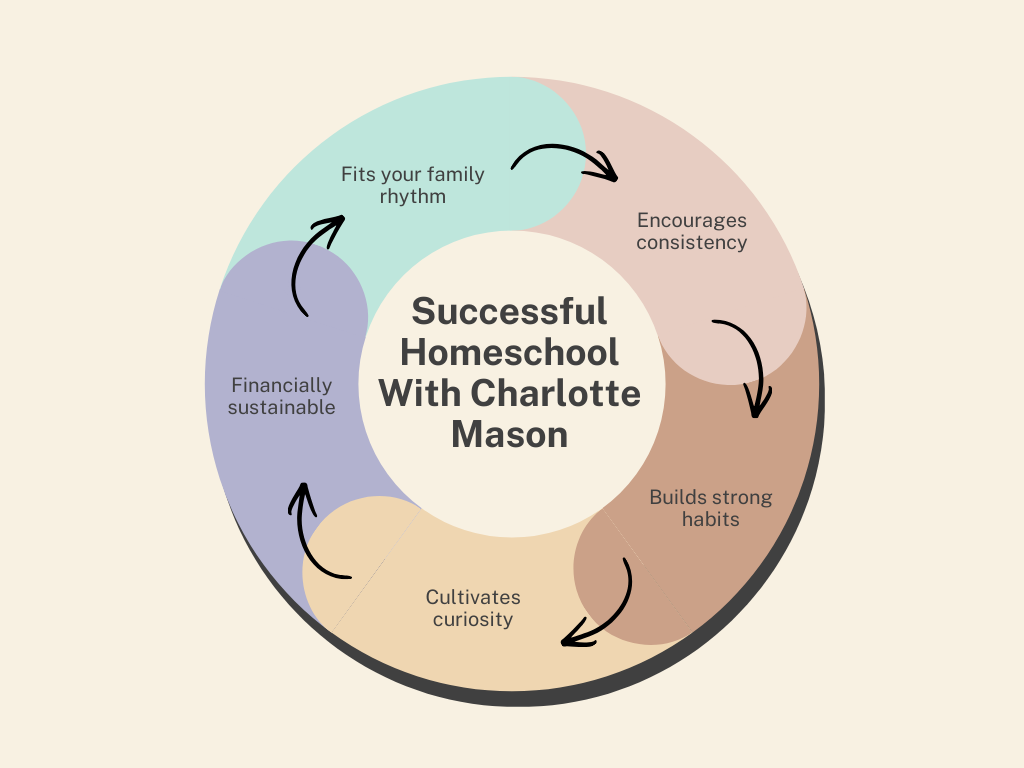
The most successful homeschool method is rarely the one with the biggest curriculum order. It is the one that:
Fits your family rhythm
Encourages consistency
Builds strong habits
Cultivates curiosity
Is financially sustainable
Here is something many new homeschoolers do not realize: success comes from clarity, not consumption.
When parents understand the why behind a method, they stop chasing every book list they see online. They start choosing intentionally. They simplify. They focus.
And that is where Charlotte Mason shines.
It offers structure without rigidity. Depth without overload. Rich literature without requiring hundreds of titles at once.
In other words, it can be both beautiful and practical.
What Charlotte Mason Actually Meant by “Living Books”
If you spend even five minutes in Charlotte Mason circles, you will hear the phrase living books.
It sounds lovely. It also sounds expensive.
Many parents assume “living books” means owning shelves and shelves of beautifully bound classics. But that is not what Charlotte Mason meant.
A living book is not about quantity. It is about vitality.
Charlotte Mason described living books as written by a single, passionate author who cares deeply about the subject. These books are rich in ideas, written in narrative form, and engaging enough that the reader feels drawn into the material. They are not dry compilations of facts. They are not watered-down summaries. They are not textbooks filled with disconnected information.
A living book makes a subject come alive.
For example, instead of a science workbook with fill-in-the-blank questions, a living book might be a beautifully written nature narrative. Instead of a history textbook listing dates and battles, it might be a story-driven account written by an author who truly understands the time period.
But here is where many homeschoolers get overwhelmed.
They see massive living book lists online and assume they must own every title to “do it right.” In reality, Charlotte Mason schools often used one strong book per subject at a time. Students read slowly. They narrated. They revisited ideas. Depth mattered more than speed.
You do not need twelve history books open at once.
You need one excellent one.
You do not need an entire poetry library.
You need a well-chosen collection that you return to consistently.
Living books are meant to be savored, not stockpiled.
When you understand this, everything shifts. Instead of chasing book hauls, you start asking better questions:
Does this book spark ideas?
Is it written by someone who loves the subject?
Will it invite narration and discussion?
If the answer is yes, you likely have a living book.
And if you have a handful of those, you are already well on your way.
You Don’t Need Every Book on Every List
One of the biggest obstacles parents face when starting Charlotte Mason homeschooling is the book lists. Scroll through social media or online homeschooling forums, and you’ll see lists that look more like small libraries than manageable classroom resources. It’s easy to feel like you’ll never “measure up” unless you buy every title.
Here’s the truth: you don’t need them all. Not even close. Charlotte Mason herself never suggested that families own hundreds of books. The goal was depth, not accumulation. A few carefully chosen, high-quality living books per subject will more than cover the curriculum. Your children’s education is about engaging with ideas, not hoarding resources.
To simplify, start by distinguishing between spines and supplemental books. A spine is the main book that structures a subject for the year, like a strong history narrative or a core science text. Supplemental books can enhance learning but are optional—like a seasonal poetry collection or a single biography that sparks interest. Focus on securing a strong spine first, then add supplements gradually.
Another strategy is rotation. You don’t need every book on your list at the same time. Borrow from the library, rotate books each term, or revisit favorites over multiple years. Children will benefit far more from repeated exposure to ideas in a few excellent books than from skimming dozens superficially.
Finally, learn to evaluate your book choices carefully. Ask yourself:
Does this book support narration or meaningful discussion?
Does it inspire curiosity or engagement with ideas?
Is it truly necessary, or is it just a nice-to-have?
When you answer yes to these questions, you’re choosing wisely. When the answer is no, let it go. Limiting your book collection doesn’t make you a “less committed” Charlotte Mason homeschooler—it makes your approach intentional and sustainable.
Remember, the beauty of Charlotte Mason homeschooling is in forming habits, fostering attention, and encouraging a love of learning. You do not need to buy every recommended title to achieve this. A focused, intentional library of living books is all you need to create a rich, engaging, and successful homeschool experience.
How to Build a Charlotte Mason Homeschool with 10–15 Core Books
Many parents assume that following Charlotte Mason means filling shelves with hundreds of titles. The reality is much simpler—and far less expensive. With just 10–15 core books, you can provide a rich, well-rounded education while staying true to the Charlotte Mason philosophy.
Start by choosing strong spines for each subject. For history, pick one engaging narrative that covers the year’s focus. For literature, select a classic read-aloud or a short story collection. Poetry can be introduced through one anthology that children can return to again and again. Science can be taught using a single narrative-style text that encourages observation and curiosity rather than memorization of facts. A nature guide or simple field guide is all you need to support nature study. One geography resource can introduce maps, countries, and cultural concepts without overwhelming your students.
You can also add one or two artist or composer studies to introduce the arts, but these don’t need to be exhaustive. Charlotte Mason valued exposure and appreciation over mastery at a young age. The goal is to spark curiosity, not check every box.
Once you have your core books, you can supplement selectively. Choose a biography that aligns with your current history study, or a single seasonal poetry collection to complement your morning time. These additions should enhance the living ideas in your core texts, not create an unmanageable workload or massive collection of books.
The key is intentionality. Each book should serve a clear purpose: to develop thought, foster attention, and encourage narration. Avoid buying books simply because they’re on a list or recommended online. By focusing on a few carefully chosen titles, you give your children time to absorb, reflect, and engage deeply with each idea.
In practice, a 10–15 book library can cover all core subjects and still leave room for creativity, nature study, and habit formation. Quality over quantity isn’t just a slogan—it’s the foundation of Charlotte Mason education. When your resources are streamlined, homeschooling becomes manageable, sustainable, and joyful for both you and your children.
This approach proves that you don’t need hundreds of books to do Charlotte Mason well—just a handful of living, idea-rich texts that inspire curiosity and critical thinking.
Use Your Library Like a Pro
One of the easiest ways to follow the Charlotte Mason method without buying hundreds of books is to make your local library your best friend. Libraries are full of living books, from history narratives to poetry anthologies, and they allow you to rotate titles without cluttering your home.
Start by getting familiar with your library’s catalog. Search for subjects you plan to teach, and check both physical and digital collections. Many libraries offer e-books, audiobooks, and inter-library loans, which can give you access to even more titles without leaving home. Audiobooks are particularly useful for narration practice or for reading while on a nature walk.
Next, create a simple system for rotating books. For example, you might borrow one spine per subject for a term and one or two supplemental titles. When that term is over, return the books and borrow new ones that align with the next topic or season. This keeps your homeschool fresh while keeping your shelves manageable.
Seasonal rotation works especially well with poetry, literature, and nature study. You can borrow a spring-themed poetry collection, a summer nature guide, or biographies of historical figures relevant to the current term. This approach lets your children experience a variety of living books without overwhelming your space—or your budget.
Finally, don’t forget the value of re-reading. A book doesn’t lose its impact after one reading. Children benefit from revisiting the same text multiple times, noticing new ideas, and practicing narration. Using the library strategically allows you to do this without needing to purchase multiple copies.
In short, the library transforms Charlotte Mason homeschooling from intimidating and expensive into practical, manageable, and rich with ideas. By borrowing, rotating, and revisiting books, you can give your children a full, engaging education while keeping your home clutter-free and your budget intact.
This simple habit proves one of Charlotte Mason’s central lessons: education is about ideas, not ownership.
The Role of Habits (Hint: They’re Free)
One of Charlotte Mason’s most powerful tools doesn’t cost a penny: habits. While many parents focus on curriculum and books, Charlotte Mason believed that forming good habits in children was just as important—if not more—than academic knowledge.
Habits shape character, attention, and self-discipline. By teaching children to manage small actions consistently, you lay the foundation for lifelong learning. The beauty? You don’t need fancy materials, worksheets, or extra purchases. Habits are free but incredibly effective.
Here are some key habits Charlotte Mason emphasized:
Attention – Training children to focus on one task at a time, whether it’s reading, observation, or listening.
Obedience – Practicing respect for instructions, boundaries, and routines in gentle, consistent ways.
Truthfulness – Encouraging honesty and integrity in speech and action.
Orderliness – Helping children keep their space and materials organized, fostering responsibility.
Perseverance – Teaching children to complete tasks, even when challenging, in short, manageable lessons.
Short lessons make habit training more effective. Charlotte Mason suggested 20–30 minute lessons for most subjects, keeping children engaged without fatigue. Within this structure, habits can be reinforced naturally. For example, a five-minute tidy-up at the end of a nature study walk builds orderliness, while narrating a reading lesson builds attention and memory.
The key is consistency, not perfection. Habits grow over time when modeled by parents and practiced daily. Even small steps, repeated, create remarkable results.
When you focus on habit formation alongside living books, narration, and short lessons, your homeschool becomes far more than a series of subjects. It becomes a holistic environment where children develop thought, character, and self-discipline naturally.
The best part? These lessons are free. They don’t require extra purchases or hundreds of books—just intentional parenting, patience, and a consistent daily rhythm. Habits are the foundation that make all your Charlotte Mason teaching truly stick.
Narration: The Secret Weapon
One of the most distinctive and effective aspects of Charlotte Mason homeschooling is narration. It’s simple, free, and incredibly powerful. Narration is the practice of having children retell, in their own words, what they have learned from a reading or lesson. This technique builds comprehension, attention, memory, and critical thinking—all without worksheets or busywork.
Narration can be adapted for all ages. Younger children can narrate orally, while older students may write or even illustrate their retellings. The key is that children actively process the material rather than passively absorbing it. By explaining what they’ve learned, children engage deeply with ideas and practice organizing their thoughts clearly.
Here are some practical ways to implement narration:
Oral Narration: Ask younger children to tell back what they remember from a story, poem, or science reading. Encourage them to use complete sentences and descriptive language.
Written Narration: For older students, have them summarize chapters, events, or scientific concepts in writing. This can be a paragraph or a few sentences—short lessons are enough.
Illustrated Narration: Children can draw a picture of a scene, process, or experiment, then explain it orally or in writing.
Dialogue Narration: Engage in discussion by asking questions: “What part did you find most interesting?” or “Why do you think this happened?”
Cumulative Narration: Over time, have children summarize multiple lessons or chapters in a single narration to reinforce memory and understanding.
The beauty of narration is that it replaces the need for worksheets, quizzes, or tests in the early years. It encourages active thinking, reflection, and personal engagement with ideas. Narration also helps parents assess understanding naturally, without formal evaluation.
By using narration consistently, you create a learning environment where children not only retain knowledge but develop confidence in expressing it. This simple, no-cost tool is one of Charlotte Mason’s most effective strategies and a secret weapon for any homeschooler who wants depth over volume.
It proves again that Charlotte Mason education is about ideas, not materials—children thrive when they are asked to think, reflect, and articulate, not just copy answers.
Nature Study Without Fancy Supplies
Nature study is one of the most beloved aspects of Charlotte Mason homeschooling—and the best part is that it doesn’t require expensive materials or elaborate programs. With just a notebook, pencil, and a willingness to explore, children can develop observation skills, curiosity, and a love for the natural world.
The goal of nature study is simple: engage children with living ideas and the world around them. Charlotte Mason encouraged frequent, short excursions where children observe, sketch, and reflect on plants, animals, weather, and landscapes. Lessons are meant to be hands-on, sensory-rich, and deeply connected to the season.
Here’s how to get started:
Nature Walks: Take weekly walks in your backyard, local park, or nearby trail. Encourage children to observe carefully and note what they see.
Nature Journals: Provide each child with a notebook for sketches, short notes, or pasted leaves and flowers. Journaling strengthens attention and memory.
Field Guides: One or two simple guides to local birds, trees, or wildflowers are sufficient. No need for an entire library of manuals.
Seasonal Focus: Rotate subjects with the seasons—spring flowers, summer insects, fall leaves, winter tracks. This keeps children engaged and observant year-round.
Discussion & Narration: Ask children to share their findings orally or in writing. This reinforces narration skills and deepens understanding.
Quick Reference Chart: Nature Study Essentials
Element
Minimal Supplies Needed
Purpose
Example Activity
Nature Walks
Shoes, outdoor space
Observation & curiosity
Identify plants, notice bird calls
Nature Journals
Notebook, pencil
Recording & reflection
Sketch a tree, note weather
Field Guides
1–2 guides
Reference & research
Identify birds, flowers, or insects
Seasonal Focus
None extra
Engagement & variety
Study migrating birds in fall
Narration
Oral or written
Comprehension & memory
Retell the day’s observations
Nature study proves that Charlotte Mason education thrives on simplicity. Children learn best when they interact directly with the world around them, reflect on their experiences, and practice narration—without the need for costly kits or exhaustive book collections. A simple, consistent approach creates wonder, understanding, and lifelong appreciation for nature.
Morning Time: The Minimalist Anchor
Morning Time is a cornerstone of Charlotte Mason homeschooling, and it doesn’t have to be complicated or expensive. This short, focused period at the start of the day brings the family together for shared learning, setting the tone for curiosity, reflection, and connection.
The beauty of Morning Time is that it relies on quality, not quantity. A few carefully chosen texts and activities can provide a rich experience that touches on literature, music, poetry, art, and spiritual formation. The goal is to nourish the mind and heart before moving into individual lessons.
Here’s a simple framework you can follow:
Poetry: Read a short poem aloud. Discuss imagery, meaning, or rhythm. One poetry anthology can last for months.
Music or Composer Study: Listen to a piece of classical music or study a composer briefly. Encourage children to notice patterns or moods.
Scripture or Inspirational Texts: Read and reflect on a passage from the Bible, or a moral story. Ask children to share their thoughts or narrate what stood out.
Memory Work: Include short verses, historical facts, or quotations. Rotate items slowly so children internalize them over time.
Art Appreciation: Display a piece of artwork and discuss elements like color, technique, or emotion. One collection of prints or online gallery can suffice.
Morning Time doesn’t need to be long—20–30 minutes is enough to make a meaningful impact. The key is consistency, not duration. By engaging with living ideas each morning, children start the day in a reflective, focused, and inspired mindset.
Bullet points make it simple, but the effect is cumulative. Over weeks and months, children absorb culture, history, and artistic appreciation naturally. They also practice attention, narration, and thoughtful observation—all without additional textbooks or extensive resources.
In essence, Morning Time anchors your homeschool day. It proves that Charlotte Mason education isn’t about owning every book or program. It’s about intentional rhythms, shared learning, and cultivating a love for ideas that lasts a lifetime.
Avoiding the “Curriculum Hoarding” Trap
One of the biggest misconceptions about Charlotte Mason homeschooling is that you need every recommended book, program, or kit to “do it right.” This can quickly lead to what some homeschoolers call curriculum hoarding: a house full of books and materials that overwhelm both parents and children. The truth is, accumulation does not equal quality education.
Charlotte Mason’s approach emphasizes ideas, habits, and relationships over materials. Focusing on fewer, high-quality resources ensures that your children engage deeply with what they read and study rather than skimming dozens of titles superficially.
Here’s how to avoid the trap:
Prioritize Purpose Over Popularity: Before buying a book or curriculum, ask: Does this resource support deep thinking, narration, or meaningful engagement with ideas?
Stick to Core Books First: Focus on your spines—one or two strong books per subject—before adding supplements.
Rotate Resources: Borrow from the library or rotate seasonal materials. You don’t need everything at once.
One-In, One-Out Rule: If you acquire a new resource, consider donating or returning an old one. This keeps your homeschool manageable and clutter-free.
Avoid FOMO (Fear of Missing Out): Just because a book is popular online doesn’t mean it’s essential for your family. Choose intentionally.
Plan Purchases Thoughtfully: Create a wishlist and evaluate items monthly or quarterly. Only acquire resources that truly enhance your teaching goals.
By implementing these strategies, you create a sustainable, focused learning environment. Children benefit from consistency and depth rather than quantity and distraction. Parents stay organized, confident, and intentional in their teaching choices.
Ultimately, avoiding curriculum hoarding is about reclaiming the heart of Charlotte Mason education: forming thoughtful, capable learners, nurturing habits, and fostering a love for living ideas. With focus and intentionality, a minimalist approach can provide just as rich an education as a library of hundreds of books—without the stress, expense, or clutter.
This approach demonstrates that homeschooling isn’t about how much you buy—it’s about how thoughtfully you use what you already have.
A Sample Minimal Charlotte Mason Week
Creating a Charlotte Mason homeschool doesn’t have to feel overwhelming. With a clear structure and a small selection of living books, a week can be simple, engaging, and full of learning without buying hundreds of resources. Here’s an example of how a minimalist week might look:
Monday–Friday Short Lessons:
Keep core subjects to 20–30 minutes per lesson.
Focus on spines for each subject, supplemented with one or two living books.
Short family discussions about character or habits
Library visit for additional living books
Tips for Success:
Rotate living books seasonally to keep material fresh.
Revisit the same spine over multiple weeks for deeper comprehension.
Keep lessons short, focused, and interactive to maximize attention and retention.
Emphasize narration and observation over worksheets or busywork.
This sample week demonstrates that Charlotte Mason homeschooling can be rich and full even with minimal resources. The key is rhythm, quality, and intentionality, not volume. By focusing on living books, narration, habit formation, and consistent short lessons, your children receive a well-rounded, thoughtful education without overwhelming schedules or massive book collections.
Minimalism here is not a limitation—it’s a way to create depth, focus, and joy in learning while staying true to Charlotte Mason’s philosophy.
Quality Over Quantity
Charlotte Mason homeschooling is not about how many books you own—it’s about the ideas your children engage with, the habits they develop, and the curiosity you nurture. A handful of carefully chosen living books, short focused lessons, and consistent narration can provide a rich, meaningful education without overwhelming your home or your budget.
By focusing on rhythm, intentional resources, and habit formation, you can give your children the full Charlotte Mason experience—without buying 900 books. Depth, not volume, is the secret, and with a thoughtful, minimalist approach, homeschooling can be joyful, manageable, and truly transformative.
Poetry is more than just pretty words on a page—it’s a way for children to explore language, emotions, and imagination. When taught thoughtfully, it can spark a lifelong love of reading, writing, and creative expression. For homeschool families, teaching poetry offers a unique opportunity to connect learning with everyday life, making verses come alive rather than staying stuck in a textbook.
Different educational philosophies approach poetry in very different ways, and understanding these methods can help you choose what works best for your child. Charlotte Mason emphasizes rich literature, narration, and thoughtful reflection, while Waldorf encourages creativity, rhythm, and artistic expression. Traditional approaches, on the other hand, often focus on literary devices, structure, and analysis. Each has its strengths, and knowing the differences can make your poetry lessons both fun and meaningful.
In this blog, we’ll dive into how Charlotte Mason, Waldorf, and Traditional methods teach poetry, including practical examples, age-appropriate strategies, and tips for parents. Whether you’re looking to inspire imagination, build analytical skills, or simply make poetry a joyful part of your homeschool day, this guide will help you find the approach—or combination of approaches—that fits your family best.
What is the Difference Between Waldorf and Charlotte Mason?
Charlotte Mason and Waldorf education both celebrate a child’s natural curiosity and love of learning, but they approach poetry in very different ways.
Charlotte Mason focuses on connecting children with “living books” and meaningful literature. Poetry lessons often include:
Reading short, carefully chosen poems aloud.
Having children narrate the poem in their own words.
Encouraging thoughtful reflection and discussion.
Using copywork to help children notice word choice and rhythm.
This method helps children internalize meaning, build comprehension skills, and develop a personal connection to the words. For example, a child might read Robert Louis Stevenson’s “The Swing”, then retell it in their own words, noticing the imagery and flow of the poem.
Waldorf education takes a more creative, hands-on approach. Poetry is often combined with art, music, and movement. Activities might include:
Reciting poems with rhythmic gestures or movement.
The goal in Waldorf is to make poetry a living, sensory experience that engages the mind, body, and emotions. A single poem can become a full creative project, turning reading into an imaginative experience.
Key differences at a glance:
Charlotte Mason: Emphasizes comprehension, reflection, narration, and discussion.
Waldorf: Emphasizes imagination, artistic expression, rhythm, and sensory engagement.
Charlotte Mason focuses on understanding the poem, while Waldorf focuses on experiencing it.
Understanding these differences can help you decide which method fits your child best—or even combine elements of both for a richer poetry experience.
Traditional Approach to Teaching Poetry
The traditional approach to teaching poetry is often what many people remember from their own school days. It emphasizes analysis, structure, and literary techniques, helping students understand the mechanics of language and the building blocks of a poem. Unlike Charlotte Mason, which focuses on living books, or Waldorf, which emphasizes creativity and sensory experiences, the traditional method tends to be more structured and academic.
In a traditional poetry lesson, students might focus on:
Memorization: Learning poems by heart to appreciate rhythm, rhyme, and sound patterns.
Literary devices: Identifying metaphors, similes, alliteration, imagery, and other poetic tools.
Analysis: Breaking down the poem’s structure, meaning, and themes.
Written responses: Answering questions about the poem’s content, style, or emotional impact.
This approach is particularly useful for older children who are ready to explore deeper literary concepts. It builds strong analytical skills and a clear understanding of how poetry works. For example, when reading William Wordsworth’s “I Wandered Lonely as a Cloud”, a student might:
Identify the rhyme scheme and meter.
Highlight literary devices, like similes and personification.
Write a short paragraph explaining how the imagery conveys the poet’s emotions.
While this method can sometimes feel rigid, it provides valuable skills that help students engage with poetry on a more technical level. It also complements other learning styles—for instance, a Charlotte Mason approach can be combined with traditional analysis for older students who are ready to reflect critically after enjoying a poem creatively.
Practical strategies for teaching poetry the traditional way include:
Start with short poems: Choose accessible poems before moving on to longer or more complex works.
Discuss vocabulary: Make sure students understand unusual words or phrases before analyzing.
Encourage comparison: Compare two poems to see how different poets approach similar themes.
Incorporate writing: Have students try writing their own poems using the same structure or literary devices.
Use guided questions: Ask questions like, “What feelings does this poem evoke?” or “Which words create imagery?”
The traditional method also helps students develop strong reading comprehension, critical thinking, and writing skills. When combined with more creative approaches, it can give children a well-rounded understanding of poetry—from appreciating its beauty to understanding its craft.
Ultimately, the traditional approach provides a solid foundation for analyzing and understanding poetry, while still allowing room for creativity. By balancing structure with imagination, parents can help their children not only enjoy poetry but also master its deeper meaning and technical artistry.
Age-Appropriate Poetry Teaching
One of the most important considerations when teaching poetry is choosing poems that fit your child’s age and developmental stage. Children experience language and imagination differently as they grow, and tailoring poetry lessons to their level helps them connect with the material without feeling frustrated or bored. Both Charlotte Mason and Waldorf approaches, as well as traditional methods, recognize the value of age-appropriate content—but they approach it in unique ways.
Examples: Robert Louis Stevenson’s “The Swing” or classic Mother Goose rhymes.
At this stage, Waldorf-inspired activities shine because young children learn best through sensory experiences. Acting out a poem, drawing scenes inspired by verses, or clapping to a rhythmic chant can make poetry exciting and memorable. Charlotte Mason’s narration may be introduced gently, such as asking the child to retell a short poem in their own words after hearing it read aloud.
Middle Childhood (Ages 8–12):
Introduce slightly longer poems with more complex imagery.
Encourage children to reflect on meaning and emotions, using narration or discussion.
Begin to point out simple literary devices, like alliteration or similes.
Examples: Emily Dickinson’s short poems or A.A. Milne’s “When We Were Very Young”.
Charlotte Mason’s method works well here, helping children analyze and reflect on poems while still enjoying the story or imagery. Traditional methods can also be incorporated, like identifying literary devices or practicing copywork, but it’s important to keep lessons engaging rather than overly technical.
Focus on literary analysis, symbolism, and style, alongside personal reflection.
Encourage creative responses, like writing original poems or performing dramatic readings.
Examples: William Wordsworth, Robert Frost, or Shakespeare’s sonnets.
At this age, combining approaches can be particularly effective. Waldorf activities keep creativity alive, Charlotte Mason methods build comprehension and reflection, and traditional approaches develop analytical skills and technical understanding.
Tips for All Ages:
Let the child’s interests guide poem selection.
Read aloud daily to build familiarity and enjoyment.
Mix methods—visual, auditory, and written activities keep lessons dynamic.
Celebrate effort, not just memorization or analysis, to foster a lifelong love of poetry.
By choosing age-appropriate poems and activities, parents can help children feel confident, inspired, and connected to poetry at every stage of their learning.
Methods of Engaging Students with Poetry
Teaching poetry isn’t just about reading words on a page—it’s about helping children experience the rhythm, meaning, and beauty of language. Different educational philosophies offer unique ways to make poetry engaging, and parents can mix and match methods to suit their child’s learning style. Charlotte Mason, Waldorf, and traditional approaches each provide tools to spark interest and deepen understanding.
Charlotte Mason: Reflection and Narration
Charlotte Mason’s approach emphasizes thoughtful engagement and comprehension. She believed that children learn best by interacting with “living books” and retelling ideas in their own words. Methods include:
Narration: After reading a poem aloud, ask your child to retell it in their own words. This encourages careful listening, attention to detail, and personal interpretation.
Copywork: Have children copy the poem neatly into a notebook. This helps them notice word choice, punctuation, and rhythm.
Discussion: Ask open-ended questions, like “What feelings does this poem give you?” or “Which words paint the clearest picture?”
Reading aloud: Regularly read poetry aloud together to model expression, tone, and pacing.
For example, after reading A.A. Milne’s “Now We Are Six”, your child might narrate the story of a favorite poem, then copy their favorite lines and explain why they like them. This method encourages comprehension and connection to the words.
Waldorf: Creativity and Sensory Experience
Waldorf education focuses on imagination, movement, and artistic expression. Poetry lessons are hands-on and multi-sensory, helping children experience the poem fully. Activities can include:
Dramatization: Act out the poem as a short skit or puppet play.
Art integration: Draw or paint scenes inspired by the poem’s imagery.
Rhythm and song: Recite poems with clapping, movement, or musical accompaniment to emphasize cadence.
Storytelling games: Transform the poem into a story to be acted out or illustrated in a creative notebook.
For example, after reading “The Swing” by Robert Louis Stevenson, a child could paint themselves swinging through the clouds, recite the poem while moving like a swing, or even create a short song inspired by the verses. This approach helps poetry feel alive and fun.
Traditional: Analysis and Structure
The traditional approach focuses on literary skills, encouraging children to understand the craft behind the poem. Methods include:
Identifying literary devices: Point out metaphors, similes, imagery, and rhyme.
Structural analysis: Examine stanza patterns, meter, or rhyme schemes.
Written responses: Have children answer questions or write short reflections on the poem.
Comparisons: Compare two poems to discuss theme, tone, or style.
For instance, while studying Robert Frost’s “Stopping by Woods on a Snowy Evening”, students might identify the ABAB rhyme scheme, discuss the symbolism of the woods, and write a short paragraph about how the poem’s imagery makes them feel.
Combining Approaches
Many parents find that blending methods works best. You might start with a Waldorf-style dramatization to spark excitement, then use Charlotte Mason narration to reflect on meaning, and finish with a brief traditional analysis to explore literary devices. The key is keeping lessons dynamic, interactive, and enjoyable, while encouraging a love of poetry alongside skill development.
By engaging students through multiple methods—creative, reflective, and analytical—parents can help children connect to poetry in a meaningful way, making it both enjoyable and educational.
Benefits of Each Approach
Teaching poetry can be both joyful and educational, but each method—Charlotte Mason, Waldorf, and traditional—offers unique benefits. Understanding what children gain from each approach can help parents decide which style, or combination of styles, works best for their homeschool.
Charlotte Mason: Thoughtful Reflection and Love of Literature
Charlotte Mason’s approach emphasizes comprehension, narration, and personal connection to poems. Key benefits include:
Deep understanding: Children learn to think critically about language, meaning, and imagery.
Retention and memory: Narration and copywork help internalize poems naturally.
Love of reading: Exposure to rich, “living” poems fosters a lifelong appreciation for literature.
Vocabulary development: Engaging with carefully chosen words helps expand language skills.
For example, a child narrating Emily Dickinson’s short poems not only recalls the story but also reflects on the emotions behind the words, making the lesson both intellectually and emotionally engaging.
Waldorf: Creativity, Imagination, and Sensory Learning
Waldorf’s creative approach makes poetry a multisensory experience, which benefits children in several ways:
Enhanced imagination: Acting, drawing, and movement allow children to connect with poetry in unique ways.
Emotional expression: Engaging with poetry through art or dramatization helps children express feelings safely.
Memory and rhythm: Repetition, songs, and gestures help children remember poems naturally.
Holistic learning: Combines mind, body, and emotions, making learning more immersive.
For instance, reciting a poem while creating a watercolor illustration helps a child see the words visually, hear them aloud, and feel the movement, reinforcing learning in multiple ways.
Traditional: Analytical Skills and Literary Knowledge
Traditional poetry instruction focuses on structure and literary analysis, which builds strong academic skills:
Critical thinking: Children learn to interpret meaning, identify symbols, and examine poetic techniques.
Understanding of literary devices: Helps children recognize metaphors, rhyme schemes, and meter.
Writing skills: Analyzing and responding to poetry improves composition and articulation.
Preparation for advanced studies: Builds a strong foundation for high school literature or standardized testing.
For example, analyzing Robert Frost’s “The Road Not Taken”teaches children about symbolism, metaphor, and the poet’s intention, giving them tools to discuss and write about literature confidently.
Combining the Approaches
Many homeschool parents find that a balanced mix of all three approaches offers the best results:
Start with a Waldorf activity to spark excitement.
Follow with Charlotte Mason narration to encourage reflection.
Finish with traditional analysis to explore structure and devices.
This combination allows children to enjoy poetry creatively, understand it deeply, and develop analytical skills—all while maintaining a love for language and literature.
By recognizing the unique benefits of each method, parents can create a poetry learning experience that is both educational and enjoyable, helping children develop a lifelong connection to the beauty and power of words.
Challenges and Considerations
While teaching poetry can be rewarding, each educational approach comes with its own set of challenges. Understanding these potential obstacles can help parents plan lessons that are engaging, effective, and appropriate for their child’s learning style.
Charlotte Mason: Potential Challenges
Charlotte Mason’s focus on narration, reflection, and living books has many benefits, but there are a few things to keep in mind:
Limited formal analysis: Children may not naturally learn about literary devices like rhyme, meter, or symbolism unless parents introduce them deliberately.
Short attention span required: Narration works best with shorter poems, so longer or more complex works may need extra support.
Preparation time: Choosing high-quality, meaningful poems and planning narration activities can require more preparation than just using a textbook.
Tip: Supplement Charlotte Mason poetry lessons with brief discussions about literary devices or occasional copywork exercises to strengthen technical understanding.
Waldorf: Potential Challenges
Waldorf education emphasizes creativity and sensory experiences, which can be incredibly engaging but also comes with considerations:
Less focus on analysis: Children may enjoy acting out or illustrating poems but might not always develop strong analytical skills.
Requires active involvement: Parents or teachers need to guide dramatizations, art projects, and movement activities, which can be time-consuming.
Limited exposure to written poetry skills: Without intentional instruction, children may have less experience with reading comprehension, copywork, or written responses.
Tip: Balance Waldorf-inspired lessons with short reflection questions or narration to ensure children connect the creative experience with comprehension.
Traditional: Potential Challenges
Traditional poetry teaching emphasizes structure, literary devices, and analysis. While academically strong, it can have some drawbacks:
Can feel rigid or boring: A focus on worksheets, memorization, and analysis may feel dry or overwhelming for younger learners.
Less imaginative engagement:Children may struggle to connect emotionally or creatively with poems if lessons are too structured.
May discourage reluctant readers: Some students may feel frustrated if they don’t enjoy analytical work or find it difficult.
Tip: Incorporate creative or playful elements alongside structured analysis, like acting out stanzas, drawing scenes, or using music to reinforce rhythm and imagery.
Finding the Right Balance
The key is flexibility. Parents can mix elements from different approaches to address challenges while keeping lessons engaging and meaningful. For example:
Combine Waldorf creativity with Charlotte Mason narration to encourage both imagination and reflection.
Add short traditional analysis exercises for older children to strengthen literary skills.
By being mindful of each approach’s challenges, parents can create a poetry learning experience that is both enjoyable and effective, helping children develop a lifelong appreciation for language, expression, and creativity.
Practical Tips for Parents
Teaching poetry at home can feel intimidating at first, but with a few simple strategies, you can make lessons enjoyable, meaningful, and tailored to your child’s learning style. Whether you follow Charlotte Mason, Waldorf, traditional methods, or a mix of all three, these tips will help you get the most out of your poetry time.
Choose Poems That Match Your Child’s Age and Interests
Young children (ages 3–7): Focus on rhymes, rhythm, and playful language. Nursery rhymes and short, lively poems work best.
Middle childhood (ages 8–12): Introduce slightly longer poems with clear imagery and gentle themes. Ask questions to spark reflection.
Adolescents (ages 13+): Explore more complex works with symbolism, emotion, and advanced literary techniques. Encourage independent reading and analysis.
Choosing poems your child finds interesting makes lessons feel natural, not forced.
Mix Learning Methods
Combine Charlotte Mason narration with Waldorf creative activities and traditional analysis.
For example, read a poem aloud, let your child act it out, then discuss its meaning and identify literary devices.
Mixing approaches keeps lessons dynamic and engages different learning styles.
Make Poetry Interactive
Use movement, such as acting out lines, clapping rhythms, or marching to meter.
Encourage artistic expression, like drawing scenes inspired by the poem or creating simple illustrations.
Incorporate music, singing, or chanting to reinforce rhythm and memory.
Interactive activities help children connect emotionally and physically with the poem, making it more memorable.
Incorporate Reflection and Discussion
Ask open-ended questions: “What do you picture when you read this?” or “How does this poem make you feel?”
Encourage children to narrate the poem in their own words or write a short reflection.
Reflection builds comprehension, empathy, and critical thinking.
Use Repetition and Memorization Strategically
Encourage short poems or favorite stanzas to be memorized gradually.
Recitation helps children internalize rhythm, rhyme, and language patterns.
Make memorization fun with games, contests, or performances for family members.
Celebrate Creativity and Effort
Focus on enjoyment and personal connection rather than just “getting it right.”
Praise creativity, expression, and thoughtful reflections.
Let children choose poems that speak to them and share their interpretations.
Keep a Poetry Journal
Collect poems, reflections, drawings, or memorized stanzas in one notebook.
Revisiting past entries allows children to see growth, remember favorites, and feel proud of their work.
By combining these practical tips, parents can create a poetry learning experience that is engaging, balanced, and effective. Children will not only develop literacy and analytical skills but also gain a lifelong love for the beauty and rhythm of words.
Examples of Lesson Plans
Sometimes the best way to understand different approaches to teaching poetry is to see them in action. Here are three sample lesson plans—Charlotte Mason, Waldorf, and Traditional—that you can adapt for different ages. You can also mix elements from each for a richer experience.
Charlotte Mason Poetry Lesson
Charlotte Mason emphasizes reflection and narration. A great poem to try is Robert Louis Stevenson’s “The Swing.” Start by reading the poem aloud slowly, paying attention to rhythm and tone.
Next, have your child retell the poem in their own words. Ask them to describe the images or emotions it brings to mind. You can follow up with a short discussion, such as “Which words make the swinging feel real?” or “What picture do you see in your mind?”
Finally, encourage copywork. Writing the poem carefully in a notebook helps your child notice punctuation, spelling, and rhythm. For an extra creative twist, they can draw a picture of the scene or write a sentence about what it feels like to swing like the child in the poem.
Waldorf Poetry Lesson
Waldorf lessons make poetry a sensory and imaginative experience. A.A. Milne’s “Now We Are Six” works perfectly. Begin by reading the poem aloud with gestures or expressive tone.
Next, have your child act out the verses, use simple props, or perform a puppet show. Then, invite them to illustrate the poem with drawings or watercolors, focusing on the mood and imagery.
To reinforce rhythm, try reciting the poem together with clapping, tapping, or gentle movement. For a creative extension, your child can write a short verse inspired by the poem. This approach engages imagination, movement, and emotion, making poetry fun and memorable.
Traditional Poetry Lesson
The traditional approach emphasizes structure, literary devices, and analysis. Robert Frost’s “Stopping by Woods on a Snowy Evening” is an ideal example. Start by reading the poem aloud and discussing its tone and imagery.
Help your child identify literary techniques, like metaphor, simile, and rhyme. Then, ask them to write a short reflection about how the poem makes them feel or what they think the poet means. Older students can compare this poem with another on a similar theme to explore differences in style, tone, and technique.
Combining Approaches
Blending these approaches often works best. For example, start with a Waldorf dramatization to spark creativity, follow with Charlotte Mason narration to reflect on meaning, and finish with a traditional analysis to explore structure.
This way, children experience poetry in multiple ways: creatively, thoughtfully, and analytically. They build a love for language while developing the skills to understand it deeply.
Bringing Poetry to Life in Your Homeschool
Teaching poetry at home can be both joyful and meaningful. Charlotte Mason, Waldorf, and traditional approaches each offer unique ways to help children connect with language, rhythm, and imagination. Charlotte Mason encourages reflection, narration, and careful attention to words. Waldorf brings poetry to life through movement, art, and creative expression. Traditional methods build analytical skills and a deeper understanding of literary structure.
The beauty of homeschooling is that you don’t have to stick to just one approach. Many parents find that blending methods works best. You might start with a playful, Waldorf-inspired dramatization, follow with a Charlotte Mason-style discussion, and finish with a traditional analysis of literary devices. This combination keeps lessons engaging, fun, and educational.
Remember, the goal isn’t just memorizing poems or completing worksheets—it’s helping your child experience poetry in ways that spark curiosity, creativity, and a love of language. Let their interests guide the lessons, celebrate their efforts, and keep the experience positive.
By thoughtfully choosing poems, adjusting activities for age and skill level, and mixing approaches, you can create a poetry-rich homeschool environment. Your child will not only enjoy the beauty of words but also develop skills in comprehension, imagination, and critical thinking.
Poetry doesn’t have to be intimidating or rigid. With the right balance of creativity, reflection, and structure, it can become a joyful part of your homeschool day—one that your child carries with them for a lifetime.
The Christmas season often brings a whirlwind of activity, but for homeschooling families, it also presents a beautiful opportunity to slow down and learn together. Adopting a Charlotte Mason approach to the holidays allows us to replace frantic energy with rich, living ideas. Instead of just another craft, we can engage in meaningful Charlotte Mason Christmas projects that connect us to the season’s true spirit, nature, and history. This philosophy transforms the weeks leading up to Christmas into a time of wonder, observation, and shared discovery, creating a festive atmosphere of learning that feels natural and joyous.
A Charlotte Mason education is built on the idea of creating a rich atmosphere for learning, presenting living ideas, and fostering good habits. During Christmas, this means stepping away from rote memorization and disconnected worksheets. Instead, we immerse our children in the season through great books, beautiful music, art, and time spent in nature. The goal is not to “do school” with a Christmas theme but to live and learn within the season itself, allowing curiosity to guide our studies. This approach nurtures a genuine love for the traditions, stories, and beauty that make this time of year so special, turning every activity into a memorable learning experience.
This season, learning can look like listening to Handel’s Messiah while baking cookies, reading a chapter of a classic Christmas story by the fire, or taking a winter nature walk to see how the world has changed. It’s about spreading a feast of ideas and letting children partake in what captures their imagination. The pressure to complete a specific curriculum fades, replaced by the delight of discovery. By intentionally curating a peaceful and stimulating environment, we give our children the gift of a truly living education, even amidst the holiday hustle.
Hands-On Charlotte Mason Christmas Projects
One of the best ways to bring learning to life is through hands-on work. These projects are not just about keeping little hands busy; they are about connecting with traditions, practicing skills, and creating beauty. Here are some ideas for Charlotte Mason Christmas projects that you can adapt for various ages.
Nature-Inspired Creations: The natural world is a cornerstone of a Charlotte Mason education. Bring the outdoors in with these simple yet beautiful projects.
Handmade Garlands: Take a nature walk to collect pinecones, evergreen sprigs, dried orange slices, and cinnamon sticks. String them together using twine to create a festive, fragrant garland for your mantel or doorway.
Beeswax Ornaments: Melting beeswax and pouring it into cookie cutters or silicone molds is a wonderful sensory activity. Add a bit of cinnamon or clove oil for a festive scent. These translucent ornaments look beautiful hanging on the tree with light shining through them.
Bird Feeder Ornaments: Mix birdseed with unflavored gelatin or a suet mixture and press it into cookie cutters. Once set, hang these on the trees outside. This project combines handicraft with nature study as you observe the birds that visit your yard.
Traditional Handicrafts: Charlotte Mason emphasized the importance of teaching children useful skills. The holidays are a perfect time to practice handicrafts that have been passed down through generations.
Pomanders: Studding oranges with whole cloves is a classic Christmas activity that delights the senses. It’s excellent for developing fine motor skills and results in a beautiful, aromatic decoration.
Hand-Dipped Candles: This timeless craft connects children to history and science. While it requires supervision, the process of dipping a wick into melted wax again and again until a candle forms is almost magical.
Needle-Felting or Simple Sewing: Create simple felt ornaments like stars, hearts, or trees. For younger children, use pre-punched felt shapes and a large plastic needle. Older children can try more complex needle-felting projects or sew small stuffed ornaments.
Living Books And Art For A Rich Christmas Atmosphere
Creating a festive atmosphere is about more than just decorations; it’s about filling your home with living ideas. Charlotte Mason believed that children should be nourished with high-quality literature, art, and music. During Christmas, we can intentionally spread a feast of seasonal treasures.
First, let’s talk about books. Swapping out your regular read-alouds for Christmas classics is a simple way to immerse your family in the spirit of the season. Choose stories that are rich in language and character, offering more than just a simple holiday plot. Think of books like A Christmas Carol by Charles Dickens for older children, which provides a profound look at redemption and social responsibility. For younger ones, beautifully illustrated picture books like The Polar Express by Chris Van Allsburg or the many versions of the Nativity story offer wonder and beauty. Make it a special tradition to read by candlelight or with a cup of hot cocoa to create a lasting, cozy memory.
Next, infuse your home with art and music. This doesn’t need to be a formal lesson. Simply displaying a beautiful piece of art or playing music in the background can enrich your home’s atmosphere.
Picture Study: Choose one or two classic art pieces depicting winter or the Nativity scene. A great example is “The Adoration of the Magi” by Gentile da Fabriano or a cozy winter landscape by Pieter Bruegel the Elder. Display a print where your family will see it often. Once a week, gather to look at it for a few minutes and then have your children narrate back what they saw.
Composer Study: Select a composer known for Christmas music, like Handel (for the Messiah) or Tchaikovsky (for The Nutcracker). Play their music during quiet times, while doing handicrafts, or while driving. Talk a little about the composer’s life, but mainly, just let the music fill your home.
Hymn and Carol Study: Choose one or two traditional carols to learn each week. Look up the history behind the song and discuss the meaning of the lyrics. Singing together is a powerful way to connect as a family and hide beautiful truths in your children’s hearts.
Weaving Narration And Nature Study Into Your Holiday
Even with all the festive fun, you can seamlessly continue core Charlotte Mason practices like narration and nature study. These habits don’t need to be put on pause for the holidays; they can be adapted to fit the season, making them even more engaging and relevant for your children.
Narration, the art of telling back a story or concept in one’s own words, can be applied to almost any holiday activity. After reading a chapter from a Christmas book, ask your child to narrate the events. When you attend a holiday concert or watch a performance of The Nutcracker, have them describe their favorite part the next day. You can even use narration to discuss a piece of art from your picture study or the story behind a favorite carol. This simple practice helps solidify their learning and understanding without the need for formal tests or quizzes. It encourages them to pay close attention and organize their thoughts, turning passive consumption into active engagement.
Nature study takes on a special magic in the winter. Instead of looking for flowers and insects, your focus can shift to the subtle beauty of the season.
Take walks to observe the bare branches of trees and learn to identify them by their bark and shape.
Look for animal tracks in the snow or mud and try to figure out who made them.
Keep a winter nature journal, sketching the frosty patterns on a windowpane, the shape of a holly leaf, or the birds that visit your feeder.
Study the winter sky. Note when the sun sets each day and identify winter constellations like Orion on clear nights.
These activities teach children to be observant and to appreciate the unique beauty of each season. It reminds them that even in the quiet of winter, the world is full of wonders to explore.
Explore More Homeschooling Resources
The Charlotte Mason method shows us that education is an atmosphere, a discipline, and a life. By embracing this philosophy during the Christmas season, you can cultivate a peaceful, joyful, and enriching environment for your entire family. The memories you make while learning and creating together will become cherished traditions for years to come.
If you are looking for more practical advice, curriculum reviews, or encouragement for your homeschooling journey, we invite you to explore the other articles on the DKM Homeschool Resource blog. We are dedicated to providing you with the tools and insights you need to homeschool with confidence and joy.
Geography can feel like one of those subjects that’s all about memorizing names, dates, and locations. Where is Timbuktu? What’s the capital of Kyrgyzstan? While those facts have their place, they don’t exactly spark a lifelong love for our incredible world. If you’re looking for a way to teach geography that feels more like a grand adventure than a dry textbook lesson, you’ve come to the right place. Charlotte Mason geography lessons transform the subject from a list of facts into a vibrant, living story about people, places, and the fascinating connections between them. This approach is all about building a personal relationship with the world, one story and one beautiful place at a time.
Charlotte Mason’s philosophy centers on the idea of education as an atmosphere, a discipline, and a life. When applied to geography, this means creating an environment rich with geographical ideas, building the habit of careful observation, and feeding the mind with living books and real-world experiences. It’s a gentle, yet deeply effective, method that nurtures a child’s natural curiosity. Instead of rote memorization, children learn about the world through engaging narratives, firsthand exploration of their local surroundings, and imaginative journeys to faraway lands. This method makes geography a delight rather than a chore.
The goal isn’t just to know where a country is on a map. It’s to understand its people, its climate, its history, and its unique character. It’s about picturing the bustling markets of Marrakech, feeling the icy winds of the Siberian tundra, or hearing the sounds of the Amazon rainforest. This living approach ensures that knowledge is not just stored in the brain but becomes part of a child’s imaginative and intellectual landscape. It’s about cultivating a sense of wonder and a global perspective that will stay with them for life.
The Foundation: Living Books And Narration
At the heart of any Charlotte Mason subject is the concept of “living books.” These are books written by passionate authors who bring their subjects to life through engaging, narrative-style writing. For geography, this means putting away the dry, fact-filled textbooks and picking up travelogues, biographies of explorers, well-written stories set in different cultures, and descriptive accounts of natural wonders. These books don’t just present information; they tell a story.
A living geography book will make your child feel like they are right there with the author, trekking through a jungle or sailing across an ocean. It paints a picture with words, engaging the imagination and creating an emotional connection to the place being described. This is where real learning happens. When a child is captivated by a story, the geographical details are absorbed naturally and effortlessly.
Here are some examples of what to look for in living geography books:
First-person narratives: Books written by explorers, travelers, or missionaries who share their personal experiences.
Engaging storytelling: The book should read like a novel, not a reference manual.
Rich descriptions: Look for vivid language that appeals to the senses, describing the sights, sounds, smells, and feel of a place.
Cultural context: The book should offer insights into the people, their customs, and their way of life, not just the physical landscape.
After reading a passage from a living book, the next step is narration. Simply ask your child to tell you back, in their own words, what they just read. This isn’t a test for perfect recall. It’s an exercise in mental processing. Narration requires the child to digest the information, organize their thoughts, and articulate the story or description. This simple act cements the knowledge in their minds far more effectively than any worksheet or quiz. It also helps you gauge their understanding and see which parts of the reading resonated most with them.
Practical Charlotte Mason Geography Lessons
So, how does this look on a day-to-day basis? Creating a rich and varied geography curriculum is simpler than you might think. It involves blending different activities that appeal to a child’s sense of wonder and adventure. You don’t need a fancy, expensive curriculum to get started. With a few quality resources and a bit of creativity, you can provide a feast of geographical ideas.
Remember, the key is variety and engagement. Some days might be focused on a long, cozy read-aloud, while others might be spent outdoors with a compass and a map. Here are some homeschool geography teaching tips inspired by Charlotte Mason’s methods:
Map Drills: This might sound a bit like rote work, but Charlotte Mason’s approach is gentle and brief. Spend just a few minutes a couple of times a week with a large world map or globe.
Start with your own country and continent. Have your child find your state, capital city, and major landmarks like rivers or mountain ranges.
As you read about new places in your living books, have your child find them on the map. This gives a physical location to the story they are hearing.
Keep it short and fun. You could say, “I’m thinking of a country in Africa that looks like a boot… oh wait, that’s in Europe!” Make it a game, not a drill.
Outdoor Geography and Observation: Charlotte Mason believed that geography begins at home. A child must first learn to observe and map their own surroundings before they can understand the wider world.
Take regular nature walks and encourage your child to notice everything: the direction the stream flows, the types of trees that grow on a hill, the position of the sun at different times of the day.
Start a nature journal where they can sketch what they see. This trains the eye for detail.
Teach basic map-making skills by having them draw a map of your backyard, your neighborhood, or a favorite park. Introduce concepts like scale and cardinal directions in a practical way.
Picture Study: Use beautiful paintings and photographs to explore different landscapes and cultures. Choose a high-quality image of a place—perhaps a print of a famous landscape painting or a stunning photo from a magazine.
Let your child look at the image for a few minutes, absorbing all the details.
Hide the picture and ask them to describe it from memory. What did they see? What was the weather like? What were the people doing?
This practice sharpens observation skills and exposes children to the beauty and diversity of the world’s geography.
Weaving It All Together
The beauty of the Charlotte Mason method is that it’s not about compartmentalizing subjects. Geography naturally weaves into history, science, art, and literature. When you are reading a historical account, you will inevitably discuss the geography of the region and how it influenced events. When you are studying an artist, you can explore the landscapes that inspired them. This interdisciplinary approach makes learning feel more connected and meaningful.
Don’t be afraid to follow your child’s interests. If a book about arctic explorers captures their imagination, lean into it. Find more books on the topic, watch a documentary about polar bears, look at maps of the Arctic Circle, and maybe even try to build an igloo out of sugar cubes. When learning is driven by curiosity, it becomes a joyful pursuit. This gentle geography learning method respects the child as a person with their own thoughts and interests, guiding them rather than forcing them.
The process is slow and steady, building layer upon layer of knowledge over many years. You won’t be cramming for a test or rushing through a textbook. Instead, you’ll be taking a leisurely and fascinating journey around the world with your child, right from the comfort of your home. You are lighting a fire of curiosity that will warm them for the rest of their lives, inspiring them to always remain interested in the wide, wonderful world and its people.
Explore More Homeschool Resources
Building a homeschool environment that is rich, engaging, and tailored to your child is a journey, not a destination. These ideas for teaching geography are just one piece of the puzzle. As you continue to craft your unique educational approach, remember that you are not alone. There is a whole community of parents and a wealth of information available to support you.
For more practical advice, curriculum reviews, and encouragement on your homeschooling adventure, we invite you to explore more of our blog posts. We cover everything from choosing math programs to fostering a love of reading, all designed to help you homeschool with confidence and joy.
Does the thought of teaching Shakespeare make you break out in a cold sweat? Do you have flashbacks to high school English class, trying to decipher what “wherefore art thou” actually means? You’re not alone. Many homeschooling parents feel intimidated by the Bard. But what if I told you it could be one of the most delightful parts of your homeschool journey? With the right approach, your Charlotte Mason Shakespeare lessons can be filled with laughter, drama, and wonder, creating memories that last a lifetime.
Teaching Shakespeare in a Charlotte Mason homeschool isn’t about dry analysis or memorizing sonnets (unless your kids are into that!). It’s about introducing your children to beautiful language, timeless stories, and profound human truths. It’s about treating Shakespeare as a feast for the mind and soul, not a chore to be completed. Let’s explore how you can bring the magic of Shakespeare’s plays into your home with joy and confidence.
Why Bother With Shakespeare, Anyway?
Before we dive into the “how,” let’s talk about the “why.” In a world full of amazing books, why dedicate precious time to a playwright from 400 years ago? Charlotte Mason herself was a huge advocate for introducing children to Shakespeare from a young age. She believed his works offered a unique window into human nature and a mastery of the English language that was unparalleled.
Here’s why it’s a worthy endeavor for your homeschool literature studies:
Enriches Vocabulary and Language Skills: Shakespeare’s use of language is simply brilliant. Exposing your children to his plays expands their vocabulary and deepens their understanding of literary devices like metaphors and similes in a natural, story-driven way.
Explores Complex Human Emotions: Love, jealousy, ambition, grief, joy—it’s all there. Shakespeare’s characters are deeply human, and their struggles are surprisingly relatable. These stories provide a safe space to discuss big feelings and moral questions.
Builds Cultural Literacy: Shakespeare’s influence is everywhere, from movies and modern phrases (“a wild goose chase,” “break the ice”) to other great works of literature. Understanding his plays gives your children a key that unlocks a deeper appreciation for Western culture.
Develops Critical Thinking: Following the intricate plots and character developments in plays like A Midsummer Night’s Dream or Macbeth is a great workout for the brain. It encourages kids to pay attention to detail, make connections, and predict outcomes.
The Charlotte Mason method is all about gentle beginnings and short, engaging lessons. This principle is your best friend when it comes to Shakespeare. The goal is not to have your child master Hamlet by age ten. The goal is to cultivate a love for the stories and the language. It’s about familiarity, not mastery. Forget the heavy literary criticism and daunting annotated editions for now. We are simply setting a rich and wonderful table for our children to feast upon.
Think of it as introducing a new type of food. You wouldn’t serve a five-course meal of unfamiliar cuisine to a picky eater. Instead, you’d offer a small, tasty bite. The same goes for Shakespeare. We start with the stories, told in a way that children can easily grasp. This prepares their minds and piques their interest, so when they encounter the original language, it feels like meeting an old friend rather than a complete stranger.
Your Guide To Charlotte Mason Shakespeare Lessons
Ready to get practical? A typical Charlotte Mason term focuses on one play. This slow and steady approach allows your family to become deeply familiar with the characters, plot, and language without feeling rushed. You might study three or four plays over the course of a school year. This relaxed pace is key to making the experience enjoyable for everyone, including the teacher!
Here is a simple, step-by-step plan for tackling a play:
Read a Narrative Version First: Before you even touch Shakespeare’s original words, read a well-written story version of the play. Charles and Mary Lamb’s Tales from Shakespeare is the classic choice for this and was recommended by Charlotte Mason herself. Reading the story first gives everyone a clear understanding of the plot, characters, and major events. This is the scaffolding that will support you when you move on to the real text.
Listen to the Play: Find a good quality audio performance of the play. LibriVox and other services offer free recordings, while professional productions from companies like Arkangel Shakespeare are fantastic investments. Listen to one or two scenes at a time. The goal is simply to let the language wash over you. Don’t worry if you don’t understand every word. The actors’ tones and emotions will convey much of the meaning.
Read the Scenes Aloud: After listening, take turns reading the scenes aloud as a family. Assign parts and have fun with it! Use silly voices, stand up, and act things out. This is where the play truly comes to life. Keep lessons short—maybe 15-20 minutes a few times a week. The point is to enjoy the process, not to race to the finish line.
Narrate, Don’t Quiz: After reading a scene, ask your child to narrate, or “tell back,” what happened in their own words. Narration is a cornerstone of the Charlotte Mason method. It requires the child to process the information, organize their thoughts, and articulate the story. It’s a powerful tool for building comprehension and retention without the pressure of a formal quiz. Ask simple questions like, “What do you think will happen next?” or “How do you think that character was feeling?”
Choosing The Right Plays
Not all of Shakespeare’s plays are created equal when it comes to introducing them to children. It’s wise to start with the comedies and romances before moving on to the more complex histories and tragedies. The lighter plays are often funnier, have happier endings, and are generally more accessible for younger minds.
Great Starter Plays:
A Midsummer Night’s Dream: Fairies, mistaken identities, and a man with a donkey’s head. What’s not to love? This is often the perfect first play.
The Comedy of Errors: Two sets of identical twins separated at birth lead to hilarious chaos. It’s fast-paced and full of slapstick humor.
Twelfth Night: A shipwreck, a girl disguised as a boy, and a fantastic cast of comical characters make this a family favorite.
As You Like It: Another story featuring a girl in disguise, this play is set in a charming forest and explores themes of love and forgiveness.
As your children get older and more comfortable with the language, you can gradually introduce the tragedies like Macbeth, Romeo and Juliet, and Julius Caesar. These plays offer incredible depth and powerful lessons about human nature, but their mature themes and tragic endings are often better suited for the middle and high school years.
Making Shakespeare A Living Study
The beauty of homeschooling is the ability to make learning a rich, multi-sensory experience. Don’t let Shakespeare stay on the page! Bring the plays to life by incorporating other activities that connect to the stories. This turns literature studies for homeschool from a simple subject into an immersive adventure.
Watch a Performance: Once you’ve finished studying a play, watch a movie version or, even better, a live performance if possible. Seeing the story acted out on a stage or screen solidifies understanding and brings a new level of appreciation. The Globe Theatre in London has many performances available to stream online.
Incorporate Art and Music: Study art that depicts scenes from the play you are reading. Listen to musical compositions inspired by Shakespeare’s works, like Mendelssohn’s overture for A Midsummer Night’s Dream. This connects the play to the wider world of arts and culture.
Get Crafty: Make simple puppets and put on a puppet show. Build a model of the Globe Theatre out of a shoebox. Draw or paint your favorite characters. These hands-on activities help children engage with the material on their own terms.
Memorize Short Passages:Charlotte Mason encouraged memorization of beautiful poetry and prose. Choose a few famous or funny lines from the play for your child to learn. This shouldn’t be a chore but an enjoyable way to hide beautiful language in their hearts. Pick lines that resonate with them, not just the most famous soliloquies.
You Can Do This!
Teaching Shakespeare in your homeschool doesn’t require you to be a literary scholar. It only requires a willingness to explore these wonderful stories alongside your children. Your enthusiasm (or lack thereof) will be contagious. If you approach it with a sense of adventure and fun, your children will too. Let go of the pressure to “get it right” and embrace the journey of discovery.
You will be amazed at how much you and your children absorb just by consistently and gently engaging with the plays. One day, you’ll overhear your son jokingly call his brother a “scurvy knave,” or your daughter will recognize a Shakespearean quote in a movie, and you’ll realize the feast is working its magic. You are giving your children a gift that will enrich their minds and spirits for the rest of their lives.
Keep Exploring with DKM Homeschool Resource
Feeling more confident about bringing the Bard into your home? We hope so! Teaching literature in a way that inspires a lifelong love of reading is one of the greatest joys of homeschooling. For more practical advice, curriculum reviews, and encouragement for your homeschool journey, be sure to explore our other blog posts. We’re here to help you every step of the way.
The rain is drumming against the window panes, the wind is howling a bit, and the sky is that perfect shade of cozy gray. While it might be tempting to declare it a movie day, these dreary autumn afternoons are golden opportunities for learning. Finding the right autumn homeschool activities that are both educational and engaging can feel like a challenge, but a Charlotte Mason approach makes it a joy. Instead of seeing the bad weather as a setback, we can see it as an invitation to lean into the gentle, enriching activities that are the hallmark of this beautiful educational philosophy.
The beauty of a Charlotte Mason education is its emphasis on “living books,” hands-on exploration, and appreciating the world around us. It’s about creating an atmosphere of learning, not just checking off subjects from a list. So, when you’re stuck indoors, you don’t have to resort to workbooks and drills. You can bring the richness of nature, art, and literature right into your living room.
What is the Charlotte Mason Method?
Before we dive into the fun projects, let’s have a quick chat about what it means to use a Charlotte Mason approach. Charlotte Mason was a British educator from the late 19th and early 20th centuries who believed that children are whole persons, capable of dealing with ideas and knowledge, not just empty vessels to be filled with facts. Her philosophy is built on the idea that education is an “atmosphere, a discipline, a life.”
What does this look like in practice?
Atmosphere: Creating a home environment where learning happens naturally. It’s about the attitudes and habits that surround the child.
Discipline: Cultivating good habits, like the habit of attention, observation, and excellence in their work.
Life: Providing the mind with living ideas, not just dry facts. This is where “living books” come in—narratives written by passionate authors, rather than dull textbooks.
This method also places a strong emphasis on spending time in nature, studying art and music, and mastering handicrafts. It’s a holistic approach that nurtures a child’s mind, body, and spirit. So, a rainy day doesn’t mean we abandon these principles; it just means we adapt them for the indoors.
Engaging Autumn Homeschool Activities for a Rainy Day
So, the rain has canceled your nature walk. Don’t despair! Here are three Charlotte Mason-inspired projects perfect for grades 3–6 that will turn a gloomy day into a memorable one.
1. Become an Autumn Poet
One of the core components of a Charlotte Mason education is copywork and narration. Copywork involves carefully transcribing a well-written passage, which helps children internalize grammar, spelling, and sentence structure. Narration is simply having the child tell back, in their own words, what they have just read or heard. This project combines both with a touch of creative writing.
First, you’ll need a “living book” of poetry. Find a poem about autumn that you think your child will connect with. Some great options include:
“October” by Robert Frost
“Fall, Leaves, Fall” by Emily Brontë
“A Vagabond Song” by Bliss Carman
“Something Told the Wild Geese” by Rachel Field
Read the poem aloud a few times. Let the words and rhythm sink in. Talk about the imagery. What does the poem make you see, hear, or feel? Ask your child to pick out their favorite lines and discuss why they like them. This simple discussion is a form of oral narration.
Next, it’s time for the hands-on part:
Copywork: Have your child choose a stanza or a few lines from the poem to copy onto a nice piece of paper. Encourage them to use their best handwriting. This isn’t just busywork; it’s the practice of paying close attention to detail.
Illustration: After completing the copywork, ask them to illustrate the poem around the words. They can draw the falling leaves, the gray skies, or the wild geese flying south. This connects the logical part of their brain (writing) with the creative part (art).
Create Your Own Poem: Now that they are immersed in the language of autumn, challenge them to write their own short poem. It doesn’t need to rhyme or have a complex structure. An acrostic poem using the word “AUTUMN” or “OCTOBER” is a great start. Or, they could simply write a few sentences describing what they see out the window. The goal is to express their own observations and feelings about the season.
This project beautifully integrates literature, art, and writing. It encourages careful observation and gives your child a meaningful way to engage with great language, all while cozied up indoors.
2. Kitchen Science: The Humble Apple
Autumn is the season of apples! Instead of just baking an apple pie (though that’s a great activity too!), you can turn this delicious fruit into a multi-faceted science and nature study lesson. The kitchen becomes your laboratory, and the apple becomes your specimen.
Start by gathering a few different varieties of apples. This allows for comparison, a key scientific skill. Then, guide your child through a series of observations and experiments. Have them record their findings in a nature journal or a simple notebook.
Here’s how you can structure the study:
Observation & Dissection:
Examine the outside of each apple. What are the differences in color, shape, and size?
Cut one apple horizontally (across the middle). What do you see? You should find a beautiful five-pointed star holding the seeds. This is a “wonder” moment!
Cut another apple vertically (from stem to bottom). Compare the internal structure.
Have your child draw and label the parts of the apple: the skin (exocarp), flesh (mesocarp), core (endocarp), stem, and seeds.
The Taste Test:
Cut slices of each apple variety for a blind taste test.
Use descriptive words to record the taste and texture of each one. Is it sweet, tart, crisp, mealy, juicy?
Create a simple chart to rank the apples from sweetest to most tart, or from favorite to least favorite.
A Simple Experiment:
Why do apples turn brown? Let’s find out! Cut a few slices from one apple.
Leave one slice exposed to the air.
Coat another slice with lemon juice.
Place a third slice in a small bowl of water.
Observe them every 15 minutes for an hour. What happens? This is a perfect introduction to oxidation and enzymes.
This hands-on study covers botany, scientific observation, and even a bit of chemistry. It’s a sensory experience that makes learning tangible and delicious. Your child isn’t just learning about an apple; they are experiencing it with all their senses.
3. Composer Study with a Rainy Day Soundtrack
Charlotte Mason believed that children should be exposed to the great artists and musicians of history. A composer study doesn’t have to be a formal, stuffy affair. A rainy day provides the perfect atmosphere for listening to and appreciating classical music. For autumn, Antonio Vivaldi’s “The Four Seasons” is an obvious and wonderful choice.
Focus specifically on the “Autumn” (L’autunno) concerto. This piece is divided into three movements, each telling a part of a story. Before you play the music, read the sonnet that Vivaldi wrote to accompany this section. It describes peasants celebrating the harvest with song and dance, the crisp air, and a hunt. Knowing the story behind the music gives your child something to listen for.
Here’s a step-by-step guide to this activity:
1. Set the Scene: Read the “Autumn” sonnet aloud. Talk about the scenes it describes: a village party, a sleeping drunkard, and a morning hunt.
2. Listen Actively: Play the “Autumn” concerto. Don’t just have it on as background noise. Lie on the floor, close your eyes, and really listen. Ask your child:
Can you hear the dancing peasants in the first movement? Is the music fast or slow? Loud or soft?
Can you hear the music get quiet and peaceful in the second movement, like someone falling asleep?
Can you hear the excitement of the hunt in the final movement, with the horns and the chase?
3. Narrate with Art: After listening, ask your child to “narrate” the music through art. They can paint or draw what the music made them imagine. Perhaps they’ll draw a lively dance, someone sleeping under a tree, or hunters chasing a fox. This is not about creating a masterpiece; it’s about translating the feeling of the music into a visual form.
This activity cultivates the habit of attention and teaches children to listen actively and critically. It demystifies classical music, making it accessible and narrative-driven. It shows them that music can tell a story and paint a picture in their minds, which is a powerful and beautiful concept.
Find More Homeschooling Inspiration
A rainy day doesn’t have to derail your homeschool rhythm. By embracing the principles of a Charlotte Mason education, you can transform an indoor day into a rich tapestry of learning, creativity, and connection. These activities are just a starting point. The real magic lies in fostering an atmosphere where your child’s natural curiosity can flourish, no matter the weather.
Are you looking for more practical tips, curriculum reviews, and encouragement for your homeschool journey? Keep exploring our blog at DKM Homeschool Resource. We are dedicated to providing you with the tools and ideas you need to make your homeschooling experience a success.
When you first dive into the world of homeschooling, the options can feel overwhelming. You hear about different philosophies, curricula, and styles, and one that often comes up is the Charlotte Mason method. It sounds lovely, doesn’t it? Nature walks, living books, art study… it’s a picture of a beautiful, gentle education. But then, a practical, nagging question often pops into your head: “This is great, but what can my child actually do with a Charlotte Mason education?” It’s a valid concern. We all want our children to grow into capable, successful adults, and we need to know that the path we choose will get them there.
The good news is that this educational approach does more than just create a peaceful homeschool; it builds a foundation for a rich, successful, and fulfilling life. A Charlotte Mason education is less about training for a specific job and more about cultivating a specific kind of person: one who is curious, engaged, and a lifelong learner. This philosophy fosters skills that are surprisingly in-demand in today’s world. Instead of just memorizing facts for a test, children learn to think critically, communicate effectively, and connect ideas across different subjects. This holistic development prepares them for a wide range of academic and professional pursuits.
The Skills That Set Them Apart
So, what are these magical skills? It’s not about learning to churn out perfect five-paragraph essays (though they’ll likely be great writers). It’s about developing the inner habits and intellectual muscles that serve them in any field they choose. A Charlotte Mason education focuses on building a person, not just a transcript. The outcomes are less about test scores and more about character and capability.
Children who grow up with this method often exhibit a unique set of strengths:
A Love for Learning: Because learning isn’t a chore but an exploration of fascinating ideas, they don’t stop being curious when the school day ends. This intrinsic motivation is invaluable for higher education and career development, where self-directed learning is key.
Exceptional Communication Skills: Through narration, the practice of retelling stories and information in their own words, children become articulate speakers and writers. They learn to organize their thoughts, identify key points, and express themselves clearly and engagingly.
Strong Observation and Attention to Detail: Nature study, picture study, and detailed readings train the eye and mind to notice things others might miss. This skill is critical for scientists, artists, doctors, engineers, and detectives alike.
Broad Knowledge Base: Charlotte Mason’s famous saying, “The mind can know nothing save what it is fed upon,” is at the core of this method. By feasting on a wide and generous curriculum of history, literature, science, and art, students build a rich mental library of ideas. This allows them to make unique connections and approach problems from multiple perspectives.
Self-Discipline and Good Habits: The emphasis on “the science of relations” and habit training means children learn to manage their time, apply themselves to tasks, and maintain a sense of order in their work. These executive functioning skills are a cornerstone of adult success.
What Does a Charlotte Mason Education Prepare You For?
Let’s get down to the brass tacks. What career paths do these skills lead to? You might be surprised by the versatility. The goal isn’t to funnel a child into one specific area but to open up a world of possibilities. The emphasis on broad knowledge and strong communication makes them adaptable and capable in a variety of fields. Think of it as creating a master key that can unlock many different doors rather than a single key for a single lock.
Many people assume that a literature-heavy education only prepares students for careers in the humanities, but that’s a common misconception. The analytical and critical thinking skills honed through studying complex texts are directly transferable to STEM fields. A scientist must be able to read dense research papers, communicate their findings clearly, and think creatively to solve problems. An engineer needs to be a meticulous observer and a clear communicator to bring a project to life. A Charlotte Mason education builds the person who can then choose to become the scientist, the engineer, the artist, or the entrepreneur.
Common Career Paths and Fields of Study
While a Charlotte Mason graduate can truly do anything, we do see trends where their unique skill sets shine. These aren’t limitations, but rather areas where their education gives them a natural advantage. Because they are taught to be interested in everything from poetry to physics, their passions can lead them down many different roads. They are not just prepared for college; they are prepared to excel in it because they already know how to learn and how to love learning.
Here are some fields where these students often find their footing:
Academia and Research: Their love of learning and ability to go deep into a subject make them natural researchers, professors, and scholars. They know how to live with a question and pursue it relentlessly.
The Arts: A deep appreciation for beauty, cultivated through picture and composer study, often leads to careers as artists, musicians, designers, and curators. They have been trained to see and create with a discerning eye.
Medicine and Law: The ability to absorb and synthesize large amounts of complex information, coupled with strong analytical skills, makes them excellent candidates for medical school and law school.
Entrepreneurship: A Charlotte Mason education fosters independence, creativity, and the ability to connect disparate ideas. This is the perfect recipe for an entrepreneur who can spot a need and build a solution from the ground up.
Education: Many who experience the joy of this learning style are inspired to pass it on. They become gifted teachers who understand how to spark curiosity and engage students on a personal level.
Beyond the Career: The Human Outcome
Perhaps the most important outcome of a Charlotte Mason education isn’t the job title or the university degree. It’s the person they become. This method is designed to educate the whole person—mind, body, and soul. The goal is a life well-lived, full of rich relationships with God, humanity, and the natural world. Graduates are often described as being interesting and interested people. They can hold a conversation on almost any topic, find joy in simple things, and continue to grow and learn throughout their lives.
They are the kind of people who visit art museums on vacation, read history for fun, and can identify the birds they see on a walk. They have hobbies, passions, and a sense of wonder that doesn’t fade with age. They are not just prepared for a career; they are prepared for a life of purpose, engagement, and joy. This, more than any specific professional achievement, is the true testament to the power of a living education. It proves that learning is not just about making a living, but about making a life.
Choosing a homeschool philosophy is a big decision, but you can feel confident that a Charlotte Mason approach equips your child with the tools they need to build a successful and meaningful future. It’s an education that serves them not just for four years of college or forty years in a career, but for a lifetime.
Feeling inspired? The journey is a rewarding one, and you don’t have to walk it alone. Keep exploring our blog for more practical homeschool advice, encouragement, and resources to help you on your way.
Many parents exploring the Charlotte Mason method find themselves drawn to its emphasis on living books, nature study, and art appreciation. These elements feel intuitive and enriching. Yet, one component often raises questions: poetry. In a packed homeschool schedule, dedicating daily time to verse can seem like a luxury. You might wonder, “What is the point of poetry in a Charlotte Mason education?” Is it truly essential, or just a quaint, old-fashioned suggestion?
The answer is that poetry is not an add-on; it is a cornerstone of this educational philosophy. Charlotte Mason believed that children are born persons, capable of understanding and appreciating complex, beautiful ideas. Poetry, in her view, is a direct line to these ideas. It trains the ear, enriches the soul, and cultivates a love for the power and beauty of language.
This post will explore the profound benefits of integrating poetry into your homeschool and offer practical ways to make it a joyful and seamless part of your daily rhythm. You will see how a few minutes spent with a poem each day can yield a rich harvest in your child’s intellectual and emotional development.
The Enduring Benefits Of A Poetic Education
Charlotte Mason advocated for a “liberal education for all,” meaning a wide and generous curriculum that feeds the mind and spirit. Poetry was a non-negotiable part of this feast. The benefits extend far beyond simply recognizing iambic pentameter or memorizing a famous stanza. A consistent diet of poetry shapes a child’s entire being, developing critical skills and a deep appreciation for beauty that lasts a lifetime.
The consistent, gentle exposure to poetry in a Charlotte Mason education provides a unique form of mental and emotional nourishment, distinct from any other subject. It is less about academic analysis and more about forming a personal relationship with the poet’s words and ideas. Through this relationship, children’s minds are stretched, their sympathies are broadened, and their own capacity for expression is unlocked.
This approach builds a strong foundation in language that serves students across all academic disciplines. When children regularly hear and read well-crafted verse, they internalize the rhythms and structures of sophisticated language. This makes them more adept readers and more articulate writers. They develop what Mason called a “seeing eye” and a “hearing ear”—the ability to observe the world with precision and to appreciate the music in words. This heightened sensitivity doesn’t remain confined to literature. It spills over into their scientific observations, their historical understanding, and their personal reflections.
They learn that language is not just a tool for conveying information but a powerful medium for capturing truth and beauty. The goal is not to produce literary critics, but to cultivate fully alive, observant, and articulate individuals who can engage thoughtfully with the world around them.
Building A Rich Inner World With Verse
One of Charlotte Mason’s core principles is that education is “an atmosphere, a discipline, a life.” Poetry touches on all three aspects. It helps create an atmosphere of beauty and wonder in the home. It is a discipline of attention and listening. Most importantly, it feeds the “life” of the mind with living ideas. The goal isn’t to dissect poems, but to let them live and breathe in a child’s imagination. A single poem can introduce a child to a historical event, a scientific wonder, a deep human emotion, or a new way of seeing a common object. This steady stream of ideas, presented in the most beautiful and memorable form, builds a rich inner world for your child to draw upon for the rest of their life.
The benefits of this approach are numerous and interconnected:
Develops a Love for Language: Children who grow up with poetry learn to love words. They appreciate the sound, rhythm, and imagery of language. This lays a foundation for strong literacy skills and a lifelong enjoyment of reading. They learn that words can paint pictures, sing songs, and evoke powerful feelings.
Cultivates Moral Imagination: Poems often deal with universal human experiences—joy, sorrow, courage, and wonder. By engaging with these themes through the safe distance of a poem, children develop empathy and a more nuanced understanding of the human condition. They learn to see the world from different perspectives.
Sharpens the Powers of Observation: Poets are master observers. They notice the small details of the natural world and human behavior that others might miss. Reading poetry trains a child’s “seeing eye,” encouraging them to look more closely and thoughtfully at the world around them.
Trains the Ear and Memory: The musicality of poetry makes it highly memorable. Reciting poems trains the ear to recognize patterns and cadence in language. This practice also strengthens a child’s memory in a natural, enjoyable way, without the drudgery of rote memorization drills.
Provides a Vocabulary for Emotions: Poetry gives children words for their feelings. When a child feels a surge of joy or a pang of sadness, a poem they have learned can provide a framework for understanding and expressing that emotion. It validates their inner experience and gives them tools to articulate it.
Introduces Noble Ideas: Mason believed children should be fed a diet of the best thoughts from the best minds. Poetry is a primary vehicle for these “living ideas.” It presents profound truths about life, nature, and humanity in a form that is both accessible and unforgettable.
Implementing Homeschool Poetry Lessons The Charlotte Mason Way
Bringing poetry into your homeschool should be a simple, life-giving practice, not another box to check. The Charlotte Mason method for poetry is beautifully straightforward and can be adapted for children of all ages. The key is consistency and enjoyment. The goal is not to “get through” a certain number of poems, but to savor them. You are not teaching a “unit on poetry”; you are simply living with poetry as a part of your daily life. This removes the pressure of performance and allows for genuine appreciation to grow. A typical “lesson” might only take five to ten minutes, making it easy to fit into even the busiest of days.
The focus is on one poet at a time. For a full term (around 12 weeks), your family will read poems primarily from a single poet. This allows your children to become familiar and comfortable with that poet’s unique voice, style, and recurring themes. It’s like getting to know a new friend. At the beginning of the week, you select one poem to focus on. Each day, you simply read that same poem aloud. That’s it.
There are no elaborate worksheets, no searching for hidden meanings, and no formal analysis, especially in the younger years. You read the poem with expression and feeling, letting the words do their work. After a few days of hearing the poem, your children will naturally start to chime in on familiar lines. By the end of the week, many will have memorized it effortlessly, simply through repeated, pleasant exposure. This gentle method of narration and repetition builds a storehouse of beautiful language in your child’s mind without the stress of formal memorization.
Practical Tips For A Joyful Poetry Time
Making poetry a beloved part of your homeschool day is less about curriculum and more about culture. It’s about creating moments of shared beauty and connection. The best approach is one that feels natural and enjoyable for your family. If you, the parent, approach it with a sense of delight and curiosity, your children will likely follow your lead. Remember, the primary aim of poetry in Charlotte Mason education is not academic achievement, but the enrichment of the soul. It is about feeding the mind with beautiful, powerful, and life-giving ideas.
Here are some practical ways to weave poetry into your family’s rhythm:
Keep it Short and Sweet: A poetry reading should take no more than 5-10 minutes. Read one poem a day. This consistency is more important than length.
Choose a “Poet of the Term”: Focus on one poet for a 6-12 week period. This helps children become familiar with a specific style. Start with poets who write narrative poems or focus on nature, like Robert Louis Stevenson, Christina Rossetti, or Walter de la Mare for younger children, and move to poets like William Wordsworth, Emily Dickinson, or Robert Frost for older students.
Read It Aloud, Beautifully: Your job is to be the conduit for the poem. Read it with feeling and expression, paying attention to the rhythm and flow of the lines. You don’t need to be a professional actor, just an engaged reader.
Let the Poem Do the Work: In the early years, resist the urge to explain the poem or quiz your child on its meaning. Just read it and let them absorb it. As they get older, you might ask a simple question like, “What picture did that poem put in your mind?” or “Is there a line that you particularly liked?” This invites narration, not analysis.
Memorize Naturally: Read the same poem each day for a week. Through this gentle repetition, children will often memorize it without any formal effort. This is far more effective and pleasant than rote drills.
Create a Poetry Anthology: Have your children keep a dedicated notebook. After they have learned a poem, they can copy it in their best handwriting and perhaps add an illustration. This creates a beautiful, personal collection of their favorite verses.
Connect Poetry to Life: When you are on a nature walk, recall a line from a Robert Frost poem about the woods. When you see the stars, recite a line from a poem by Sara Teasdale. This shows children that poetry is not confined to a book but is a living part of our world.
Ultimately, the point of poetry is to give your child a gift. It is the gift of beautiful language, of a sharpened imagination, of a deeper connection to the human experience, and of a storehouse of noble ideas to guide and comfort them throughout their lives. It’s a small investment of time that pays immeasurable dividends in the heart and mind of your child.
A Vital Thread
In the educational philosophy of Charlotte Mason, poetry is not merely an academic exercise but a vital thread in the tapestry of a child’s intellectual and emotional development. It nurtures imagination, cultivates a love for beauty, and connects us to the shared human experience.
By integrating poetry into daily life, we offer children a gift that transcends the classroom—a lifelong appreciation for the rhythm, depth, and wonder of words. In a world often consumed by the practical and the immediate, poetry reminds us to pause, reflect, and find meaning in the seemingly ordinary. And perhaps, that is the true point of poetry: to awaken our souls to the beauty that surrounds us and to inspire us to live more fully, more thoughtfully, and more joyfully.