
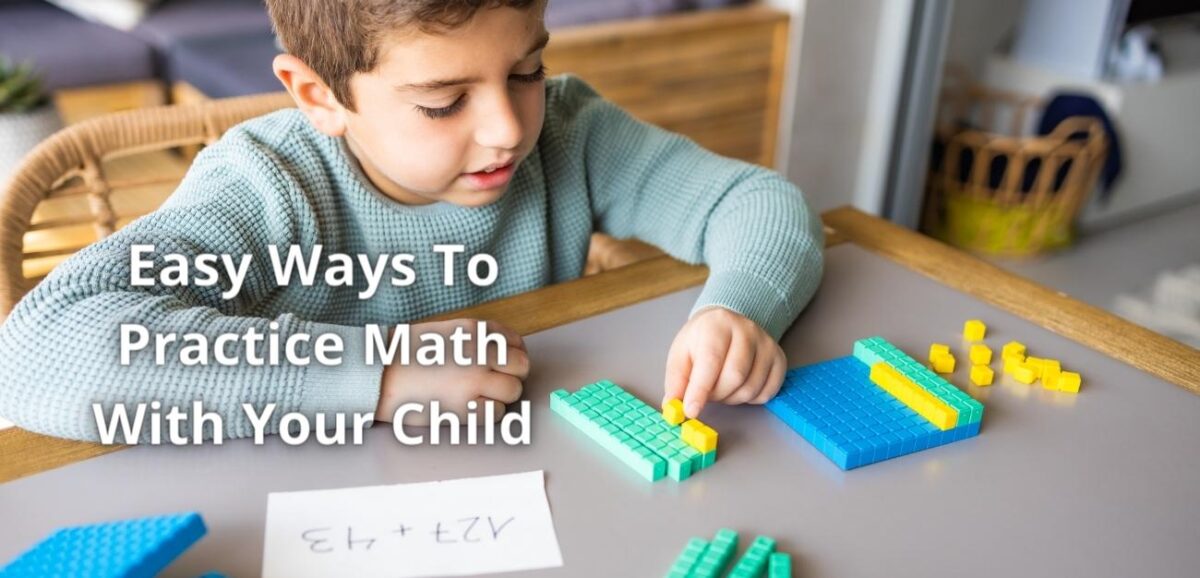
Easy Ways To Practice Math With Your Child

For many parents, the prospect of helping their children with math can seem daunting. Fear not if you were a far from a math wiz in school or couldn’t tell a fraction from a decimal. You have the capability to cultivate a love for numbers in your child and here’s how you can do it in an easy and stress-free way. However, let’s address something very crucial first. 

Practicing math with children is not just about calculations or solving problems, it’s about invoking a sense of curiosity, a knack for problem-solving, and ingraining the discipline to work persistently. To do this effectively, a parent’s role is more about encouragement, guidance, and making learning enjoyable.

This article aims to help you understand how to practice math with your child. At Dropkick Math Academy, we focus our online math help to grades 4 – 9, so our suggestions will be aimed at ages between these grades. We will provide simple, practical steps, and gives examples you can immediately put into use. Get ready to turn math from a ‘beast’ into a ‘best friend’ for your child by creating a math playground! 

  1. Make math a part of everyday activities: Going grocery shopping? Why not make it a math learning experience? How? Keep reading to find out more.
  2. Use educational games: There’s no better way to learn than to have fun while doing it. Choosing the right games can make math seem less intimidating and more enjoyable for your child.
  3. Relate math to real-life: The best way to make math seem less abstract is to relate it to real life scenarios. This not only enhances understanding, but also keeps kids interested.
  4. Practice regularly: The key to mastering any skill, including math, is consistent practice. But, how to make this practice less tedious and more fun? Stay tuned with us to find out.
  5. Use online resources: Want to take your math practice sessions to the next level? It’s time to tap into the treasure trove of online resources that can help your child excel in math. We’ll guide you on how to pick the right ones.

Remember, the goal is not to make your child a human calculator, but to foster an environment where they feel confident about working with numbers. Strap on for an enlightening journey to making math fun!

Introducing Math In Everyday Activities

As a parent, you’ll often find yourself searching for ways to make learning less mundane and more exciting for your kids. Math, in particular, has often been the unsuspecting culprit, feared and misunderstood by many. However, integrating math into your child’s daily routine can transform and demystify the subject. So, let’s dive into some practical ways to introduce math into everyday activities.

Using Games to Practice Math Skills

Think back to the games which spark your child’s interest and excitement and imagine if you could incorporate mathematical concepts into them. It’s feasible and not as hard as it sounds! Let’s delve into this innovative way of practicing math with your child. 

Board Games 

Among the simplest ways to turn fun into education is integrating math into board games. Counting spaces in games such as Monopoly or Snakes and Ladders will improve your child’s number skills. For older kids, games like Risk and Settlers of Catan can enhance their understanding of probability and strategic thinking, which are mathematical concepts. 

Puzzles 

Puzzles are yet another engaging way to hone math skills. With younger children, simple puzzles that involve shape recognition can help to boost their geometry knowledge. As they mature, puzzles like Sudoku or Rubik’s cube can challenge them to think logically and improve spatial reasoning skills. 

Card Games 

Card games can be math gold mines too. Games like “Blackjack” can encourage kids to use strategic thinking to add up or subtract numbers for a winning combination. Another card game, “UNO,” can aid in building skills in number identification and sequencing, while “Memory Match” promotes pattern recognition and simple addition or subtraction processes. 

Electronic Games 

In this digital age, don’t shy away from using technology for learning purposes. There are numerous interactive math games online or as apps, suitably designed for different age groups. From number sequencing to complex problem-solving, these games can provide a diverse range of math skills practice. 

Remember, your role is not just to introduce these games, but to actively engage in them with your child. This participation not only enhances their learning but also strengthens the bond between you and your child. As you play together, you might find yourselves lost in a world of fun and forget that you’re even practicing math! 

A Friendly Reminder 

Games are a wonderful way to practice math skills, but they should be balanced with traditional learning methods for best outcomes. Remember to tailor these activities according to your child’s age, skill level, and interest. 

Incorporating Math Into Cooking And Baking

There is an underestimated world of mathematics hiding in your kitchen. In fact, tasks like cooking and baking can provide a practical and fun environment for learning math. From measuring ingredients to determining the cooking time, you can introduce various math concepts like fractions, ratios, and times tables. 

Understanding Fractions and Measurements 

One of the most valuable math skills your child can learn from cooking and baking is understanding fractions. When you use measuring cups and spoons, it’s inevitable that you deal with fractions such as 1/2, 1/3, or 3/4. This can help your child visualize fractions in a practical setting, making them easier to understand. 

Try asking your child questions like “If we need 3/4 of a cup of sugar and we have a 1/2 cup and a 1/4 cup, how many of each should we use?” This inquiry stimulates their thought processes and helps reinforce their understanding of addition with fractions. 

Practicing Ratios 

Many recipes require ingredients to be mixed in certain ratios. This is an excellent opportunity to discuss and practice the concept of ratios with your child. For instance, you might explain that if a salad dressing recipe calls for 3 parts oil to 1 part vinegar, this means they’ll need to use three times as much oil as vinegar. 

This hands-on approach can significantly assist your child in visualizing and internalizing the concept of ratios, which may seem abstract when looked upon in textbooks. 

Using Times Tables 

Aside from understanding fractions and ratios, baking and cooking can also help your child practice their multiplication tables – a vital mathematical skill. Let’s say a recipe calls for 4 mini muffins, but you want to make 12. Here, your child will need to multiply all the quantities by 3 to get the correct measurements for 12 muffins. This reinforces the use of multiplication in everyday life

Grasping Time Management 

Baking and cooking also involve an understanding of time. If the recipe says to bake for 30 minutes and it took 10 minutes to preheat the oven, you could ask your child, “What time will we need to take the cake out of the oven?” By doing this, you’re honing their ability to add and subtract time—an essential everyday skill. Furthermore, it familiarizes them with the concept of time management. 

Nurturing Problem-Solving Abilities 

Cooking and baking are more than just procedures; they also involve problem-solving. For example, suppose your recipe is for a large cake, but you only have small tins. How will your child adjust the cooking time? Or if half the cake mix spills, how will they alter the ratios of the remaining ingredients? These problems can stimulate their analytical capacities, strengthening their abilities to solve real-world math problems. 

To conclude, it is crucial to remember that, while making math fun through cooking and baking, safety remains paramount. Always be with your child in the kitchen to supervise and guide them, particularly when handling sharp tools or dealing with heat.

Taking Math Outside: Nature-Based Math Activities

Every child loves spending time outside, and what better way to make the most of a sunny day than to incorporate a few math activities into your child’s outdoor routine? This method not only helps your child understand math concepts in a fun, hands-on way, but it also allows them to appreciate the natural world around them. Before you head outside with your child, let’s explore a few easy, nature-based math activities you can try. 

Counting with Nature 

Counting is one of the most fundamental math skills your child needs to learn. To make this activity more enjoyable, use nature’s bounty. Collect rocks, leaves, flowers, or twigs, and work with your child to group these items based on specific characteristics, such as color, size, or shape. By doing this, your child can practice counting, identifying patterns, and classifying items. 

Outdoor Geometry 

Did you know that geometry is all around us in nature? For example, you can explore symmetrical patterns on leaves or in flowers, measure angles in branches, or even look for various shapes in the clouds. Encourage your child to use a notebook to sketch and identify the different geometric shapes they find in the natural world. 

Graphing in the Garden 

Whether you have a flourishing backyard or a modest planter box, gardening can be an excellent math teaching tool. Ask your child to help you plant seeds, keep track of plant growth, or learn about the importance of different variables in plant development. They can use a graph paper to record their observations and draw conclusions based on these recordings. 

Nature Walk Measurement 

During a nature walk, you can incorporate math by measuring and recording different items found along the way. This could be the height of a tree, the size of a leaf, or the distance between two points. Understanding measurements and how to use them is an essential part of math learning. It helps your child develop spatial awareness and problem-solving skills.  

Math Scavenger Hunt 

Conduct a math scavenger hunt by creating a list of items your child needs to find outdoors. These items should involve some math-related tasks like finding a rock that is 5 inches in diameter or locating three different types of leaves with a particular shape. This interactive activity not only stimulates your child’s curiosity but also nurtures their problem-solving skills. 

A vital reminder while embarking on these nature-based math activities is to encourage your child to ask questions and make observations with each activity. This will foster their curiosity and make learning math feel like a fun adventure rather than a chore. So, let’s head outdoors and make math a memorable experience for your child!

A Rewarding And Educational Experience

Practicing math with your child can be a rewarding and educational experience when you choose the right approach. Now that we’ve seen how to incorporate math into everyday activities, there’s no excuse not to give it a try. Not only does this strategy align with your child’s learning pace, but it also nurtures an appreciation for the real-life applications of mathematics.

We hope that our tips and examples will inspire you to create math sessions that are as enjoyable as they are informative. Remember, the best way to enhance your child’s math skills is by creating a math playground that engages them with interactive exercises that stimulate their curiosity and passion for learning.

A math session doesn’t have to be intimidating or monotonous. Instead, it should inspire your child to explore, observe, and learn. And remember, don’t rush the process. The goal is to foster a genuine understanding of math principles and not memorization.  

In the end, it’s all about finding joy in learning. By guiding your child through the wonders of mathematics in a friendly and engaging manner, you are equipping them with a skill set that will prove invaluable in many aspects of life. 

Discovering the Hidden Algebra in Real Life Situations A Guide for Parents

If you are a parent, you might be thinking, “Why does my kid need to learn algebra? We never use it in real life!” The truth is, though, we always use algebra in everyday life. It’s not always as obvious as a formula scribbled on a blackboard. But algebra’s presence is undeniable and impressively fruitful in our daily tasks and experiences, from shopping to cooking, traveling to work or even home budgeting. 

The purpose of this article is to help you, the parents and guardians, pinpoint these instances of algebra in everyday life, aiding you in guiding and enlightening your children about the practical value of algebra outside the mathematics classroom. Through our math help services, we are constantly striving to offer assistance to parents who are looking for ways to help their children better understand math

Understanding algebra and its applications in daily life will automatically strengthen your child’s mathematical foundation. Our task is not to make them math gurus overnight but to help them understand why certain mathematical practices exist and how they can be applied in real-life scenarios.

The Importance of Understanding Algebra Beyond the Classroom

It may not seem apparent as we navigate our day-to-day life, but algebra is inherently interwoven into the fabric of our everyday activities. Most adults are unaware of how many everyday occurrences exemplify the principles of algebra. But wouldn’t life be so much richer if we had a better grasp of these concepts and could easily demystify them for our children? 

Drawing a clear connection between algebraic concepts taught in the classroom and their practical applications in daily life not only piques the interest of young learners but also reinforces their understanding, helping them see the subject as not just a pedantic chore but a powerful tool for problem-solving. 

Additionally, the importance of understanding and appreciating algebra extends beyond just helping your child with homework. Algebra drives technology, sustainability, financial planning, and many other areas that shape the world around us. Therefore, getting a firm handle on your algebra comprehension is not merely about better grades — it’s about unlocking a broader understanding of the world. 

So, fear not algebra! Embrace it and find ways to make it fun, engaging, and immediately relevant. Let’s embark on this exciting exploration together, unlocking the potential of algebra in the classroom and beyond.

Algebra in Cooking and Baking

Now that we’ve discussed how algebra comes into play in various parts of everyday life, let’s take a closer look at its role in the kitchen. Whether you are preparing a weekday dinner or baking a special treat for a birthday party, algebra subtly becomes your silent sous chef. 

Scaling Recipes 

Picture this: You’ve found an enticing dessert recipe online to bake for your nephew’s birthday party, but it only serves four, and you need it to serve twelve. You’re going to need to increase the quantities of the ingredients – this is algebra! Multiplication, division, and proportions become your best friends. For instance, if the recipe calls for 2 cups of sugar for 4 servings, to derive how much sugar you’d need for 12 servings, you divide 12 by 4 and multiply by 2, giving you 6 cups of sugar. Similarly, any reduction in the number of servings would require use of division. 

Temperature Conversion 

The world of baking can often become a complete unknown, especially when dealing with temperature conversions. Between Fahrenheit and Celsius, there can be a lot of confusion. But don’t worry, algebra comes to the rescue! Simple formulas allow you to convert between these measures. For instance, to convert Fahrenheit into Celsius, the formula is C=((F-32)/ 1.8 Hence, if you have a recipe stating to preheat the oven to 350 degrees Fahrenheit, and your oven uses Celsius, algebra helps you convert this to roughly 177 degrees Celsius. 

Substituting Ingredients 

Have you ever wanted to make a recipe, only to find you’re missing one crucial ingredient? Substituting ingredients is another area where a basic comprehension of algebra is handy. For instance, if you’re out of buttermilk, you can make your own by adding one tablespoon of vinegar or lemon juice to a cup of milk and letting it sit for around 10 minutes. This substitution is an example of an algebraic equation: one ingredient (the buttermilk) equals another recipe (the milk plus vinegar/lemon). 

Understanding algebra won’t only make you better in high school math, but it’ll make you a more flexible, effective home cook. Helping your children understand this ensures that they will not only ace their algebra test at school but also become potential culinary wizards at home. The kitchen transforms into a practical lab where they can apply algebraic principles, which we cannot ignore, is indeed the charm and beauty of mathematics.

Algebra in Sports and Games

Think about the various sports and games we partake in daily. Many of these actively utilize algebra, often without us realizing it. From strategizing in chess and managing a baseball team’s batting order, to figuring out the odds of certain cards in poker, or calculating the trajectory of a basketball, algebra pervades our leisure activities. Hence, incorporating these activities can certainly aid in the journey to helping your child grasp the concept. 

Baseball Statistics 

Algebra plays a pivotal role in baseball. Let’s say your child is tracking their favourite player’s batting average. Here, algebra comes into action. The batting average is calculated by dividing total hits by total at-bats (H / AB), an equation that requires an understanding of the relationship between numbers and how operations affect each other. This can be an excellent way to explain to your child how variables work in an equation. For coaches too, the game strategy involves algebraic thinking, choosing the batting order can be seen as solving a complex problem with variables and constraints. 

Chess Strategy 

Chess, a game of strategy and foresight, silently encapsulates algebra. Moves are calculated multiple steps ahead, with each piece representing a variable in a broad equation. Predicting your opponent’s moves means solving these complex ‘equations.’ By having your child actively participate in and analyze chess games, you may just find that you’re enhancing their algebraic thinking and problem-solving skills

Poker Odds 

It might not be an appropriate topic for younger children, but for older ones, poker offers a clear example of algebra at work. Calculating betting odds in poker equates to solving algebraic equations involving fractions and probabilities. However, remember, the goal isn’t to promote gambling but to help your child understand probability, an integral part of algebra. 

In conclusion, algebra is deeply rooted in the sports and games we play. Keep this in mind and try to incorporate algebra lessons into everyday sports and game activities with your child. Remember that learning isn’t restricted to classrooms. Everyday challenges, like sports and games, can be platforms for adaptive learning.

Algebra in Planning Travel Itineraries

We likely don’t realize it, but while planning travel itineraries, algebra frequently enters the picture. It aids us in many ways, from ensuring budget compliance and calculating travel times to finding the most efficient route. Understanding the algebraic principles behind these tasks can be incredibly helpful and enriching, especially if you’re explaining the process to your children. 

Managing Travel Budget 

Planning a trip requires a good handle on budgeting, and this is where algebra comes in handy. Consider this algebraic equation: Total budget = (hotel cost x number of nights) + (meal cost x number of meals) + transportation costs + other expenses. By inserting your estimates into the equation, you can calculate if your planned expenses align with your overall budget. Understanding this process offers a real-world way to portray how algebra operates and can assist your children in appreciating algebra’s practicality. 

Calculating Travel Time 

Understanding algebra can assist in estimating how long it will take to travel between destinations. For example, if one knows the distance and the speed of travel, an equation can be used to calculate travel time. Time = Distance ÷ Speed. If you are on a road trip, using these algebraic equations can help figure out the best time to leave, arrive, and prevent unwanted tardiness. Not only does this example make understanding algebra more engaging, but it can also teach your children valuable time management skills. 

Finding the Most Efficient Route 

In terms of mapping out a route, algebra can help you determine the shortest or most efficient path. Imagine you plan to visit several landmarks in a city. Instead of simply guessing which route would be best, you can use algebraic formulas to calculate the shortest path or quickest route taking into account the distance between each point and the speed of travel. This demonstrates to your kids that algebra isn’t just about finding ‘x’, but can also aid in successful navigation. 

By incorporating these algebraic principles during vacation planning, your children can gain a deeper understanding of algebra’s relevance. Moreover, it helps them establish connections between algebra and problem-solving in real-life situations.

Tips for Helping Children Embrace Algebra in Real Life

Helping your children understand and embrace the practical applications of algebra in everyday life can significantly enhance their interest and proficiency in the subject. Here are some effective strategies to facilitate this process: 

  • Relate Algebra to Real-life Situations: Expose your children to various real-life situations where algebra is applicable. For instance, share examples of grocery shopping, travel budgeting, or cooking where algebraic principles are useful. This will help them establish the connection between abstract algebraic concepts and concrete real-world scenarios, making algebra less intimidating and more relatable.
  • Encourage Problem-Solving: Challenging your children to solve real-world problems using algebra can help improve their analytical and problem-solving skills. Whether it’s finding the best deal while shopping, determining the quickest route to a location, or analyzing their favourite team’s statistics, using algebra in problem-solving can make the learning experience interactive and fun.
  • Assist Them in Homework: Show your interest and involvement in their studies by assisting them in their algebra homework. While you should refrain from doing their homework for them, guiding them through the process and explaining the relevance of algebraic concepts in everyday life can be highly beneficial.
  • Use Fun Learning Tools: Math is fun and using resources, such as educational board games or puzzles involving algebraic concepts can help your child embrace the subject and enjoy it. These tools not only aid in understanding but also foster a love for learning which, in turn, can improve your children’s engagement with the subject.
  • Demonstrate the Utility of Algebra in Different Fields: Show your children the importance of algebra in different fields of study, such as engineering, computer science, and physics, and how it plays a crucial role in various professions. This can help them appreciate the subject’s importance beyond their classroom studies.

In conclusion, fostering a positive attitude toward algebra and encouraging practical applications in diverse real-world situations can make the subject interesting and meaningful to your child. The understanding that algebra isn’t just an isolated school subject, but a tool allowing them to make informed decisions and solve problems in everyday life, can give them the motivation and perspective to master it. 

Drawing Attention To Everyday Activities

By drawing attention to these everyday instances, we can make children understand that algebra is not an obscure subject confined to the four corners of a classroom, but a practical tool that aids in solving real-life challenges.

The goal is to make children realize that algebra is not an alien concept, but – like many facets of their lives – a concept which they unknowingly already have some acquaintance with. 


Is Your Child Left Brained?

As parents, we all want our children to excel and reach their fullest potential. However, knowing how best to support them can be difficult when each child is unique and has different needs. One way you, as a parent, can better understand your child’s strengths is to recognize whether they are predominantly left-brained or right-brained. Learning more about your child’s learning styles and strengths can also help when looking for an online math tutor. 

In this blog post, we’ll provide insight into what makes someone left-brained, the benefits of being left-brained, and ways you can help your child nurture these characteristics in themself for maximum success in academics and beyond. Read on to find out how YOUR CHILD could be naturally gifted with certain traits!

What is Left-Brain Dominance?

The theory of left-brain dominance suggests that left-brained individuals are more analytical, logical, and sequential in their thinking. They tend to be good at math and science, enjoy problem-solving, and prefer structure and routine.

On the other hand, right-brained individuals are thought to be more creative, intuitive, and holistic in their thinking. They tend to be good at visual-spatial tasks, enjoy art and music, and prefer flexibility and spontaneity.

While this theory may seem straightforward, research has shown that it is not accurate to say that people are either left-brained or right-brained. The brain is a complex organ and both hemispheres work together in most tasks. However, some individuals may have a dominant hemisphere depending on their experiences and environment.

How Can You Tell if Your Child is Left-Brained?

Determining whether your child is left-brained or not can be challenging. While there are no definitive tests or assessments, some clues may suggest left-brain dominance. These include:

  • Strong logical thinking skills
  • A preference for math and science over art and music
  • A tendency to follow routines and rules
  • A love for structured activities, such as puzzles and games
  • An interest in problem-solving and critical-thinking exercises

It’s important to note that these traits are not exclusive to left-brain dominance and that every child is unique. As a parent, it’s essential to avoid labelling your child as left-brained or right-brained and instead focus on their individual strengths and interests.

How Can Left-Brain Dominance Impact Your Child?

If your child exhibits left-brain dominance traits, it’s important to understand how this may impact their development and learning. Some potential effects include:

  • Strong analytical and problem-solving skills: Children with left-brain dominance tend to excel in math and science and may enjoy puzzles and logic games. They may also be good at identifying patterns and making connections between different concepts.
  • Difficulty with creative tasks: Left-brained Children may struggle with creative tasks such as art and music. These activities require a more holistic, open-minded approach that may not come naturally to left-brain dominant individuals. It’s important to provide opportunities for creativity and encourage your child to explore different forms of self-expression.
  • A preference for routine and structure: Left-brain dominant children may appreciate routines and structure in their daily lives. However, balancing this with opportunities for flexibility and spontaneity is important to help them develop a well-rounded skill set.
  • Potential for overthinking and perfectionism: Left-brain dominant individuals tend to be analytical and detail-oriented, which can lead to overthinking and perfectionism. It’s crucial to help your child develop strategies to manage stress and anxiety and promote a healthy work-life balance.

How Can You Support Your Left-Brained Child?

As a parent, there are several things you can do to support your left-brained child. These include:

  • Providing opportunities for problem-solving and critical-thinking exercises
  • Encouraging your child to explore different areas of interest, including creative activities
  • Balancing structure and routine with opportunities for flexibility and spontaneity
  • Helping your child develop stress-management strategies and a healthy work-life balance

At the end of the day, it’s important to remember that every child is unique and that brain dominance is just one aspect of their individuality. By focusing on your child’s strengths and interests, you can help them develop a well-rounded skill set that prepares them for success in life.

Finding The Right Online Math Tutor

Finding the right math tutor near you can be overwhelming, especially when you consider your child’s unique learning style. If your child is more right-brained, they may benefit from a tutor who uses visuals and interactive techniques to teach math concepts. On the contrary, if your child is more left-brained, they may excel in a traditional online tutoring program. 

Identifying your child’s learning style can help you choose the right tutor who can provide an effective and engaging learning experience. By understanding your child’s learning style, you can find the perfect match for them and help them excel in their math studies.

Left-Brained Children in Dropkick Math Academy

At Dropkick Math Academy, we understand that every child is unique and learns differently. That’s why we have designed our programs to cater to the needs of both left-brained and right-brained learners. Our teaching methods are carefully structured to ensure that children who tend to think logically and analytically and those who lean towards creativity and intuition are given a chance to achieve their full potential. 

With our innovative approach, we help children enhance their natural talents and improve their weaknesses. At Dropkick Math Academy, we believe every child deserves the chance to excel, and we strive to ensure that our programs make that goal achievable for all learners.

Certified Ontario Teachers

At Dropkick Math Academy, we take pride in our certified Ontario teachers and their expertise in identifying the nuances of right-brained and left-brained learning styles. Rather than relying on one-size-fits-all approaches, our programs emphasize incorporating a range of teaching styles to meet the individual needs of every child. Our teachers understand that not everyone learns in the same way and are experienced in adapting their methods to help children succeed in their studies. Dropkick Math Academy is the right choice for you if you’re looking for a tutoring experience that caters to your child’s unique learning style.

Learn more about our math programs in Toronto and the surrounding areas, and get started with our FREE assessment to see how your child could benefit from our classes. 

3 Ways Parents Can Instill A Growth Mindset In Their Children

As parents, we all want our children to succeed and thrive in life. We want them to have the tools they need to achieve their goals and be resilient when faced with challenges. One of the key ways we can support our children in this journey is by instilling a growth mindset. A growth mindset is the understanding that our abilities and intelligence can be developed through hard work, dedication, and perseverance. 

Building A Strong Foundation

At Dropkick Math Academy, we understand how important it is for children to build a strong foundation in mathematics. That’s why we’ve created an online math tutor service that teaches math skills and instills a growth mindset in our young learners. 

We believe that by teaching children to embrace challenges, take initiative, and persist in the face of obstacles, we can help them become confident and successful math learners. With our expert tutors and engaging personalized lessons, we’re committed to guiding your child toward math mastery and a lifelong love of learning. So why settle for just any math program in Toronto? Trust Dropkick Math Academy to give your child the tools they need to succeed in math and beyond.

An Exciting Challenge

Children who have a growth mindset view learning as an exciting challenge rather than a daunting task. They understand that their abilities and intelligence are not fixed and that they can improve and grow if they put in enough effort. These children are motivated to learn and embrace their mistakes as opportunities for growth. They know that success isn’t always immediate and that setbacks are a natural part of learning. With a growth mindset, these children are equipped with the resilience and determination needed to reach their full potential. By instilling this mindset in our children, we can help them develop the tools they need to succeed and thrive in any situation.

While we are passionate about teaching a growth mindset in our programs at Dropkick Math Academy, we also hope to give parents the information they need to continue it at home. Our programs are designed for children and parents/caregivers to work together while strengthening their confidence in mathematics. 

3 Steps For Growth Mindset

To help foster a growth mindset in your child at home, three easy steps can be taken.

1. Praise Effort And Persistence, Not Just Achievement

As parents, focusing on our children’s achievements and successes can be tempting. We want to celebrate their accomplishments and show them how proud we are of them. However, this can inadvertently send a message that achievement is the most important thing. Instead, we should emphasize the effort and persistence our children demonstrate in working towards their goals.

For example, if your child brings home a good grade on a test, instead of simply saying, “Great job! You’re so smart!” try saying something like, “I’m so proud of you for working so hard on this test. You put in the time and effort to study, and it paid off.” By praising your child’s effort and persistence, you are helping them to understand that hard work and dedication are the keys to success.

2. Encourage Your Children To Embrace Challenges

It can be easy for children to become discouraged when faced with challenges or obstacles. However, challenges are an important part of the learning and growth process. As parents, we can help our children see challenges as opportunities for growth and learning.

One way to encourage this mindset is by modelling it ourselves. Share stories with your children about times when you faced challenges and how you persevered. Emphasize that mistakes and setbacks are a natural part of the learning process and that it’s important to keep trying even when things get tough.

Another way to encourage your children to embrace challenges is by helping them set goals that are just beyond their current abilities. For example, if your child struggles with fractions, set a goal to work on learning them together over the course of a month. Encourage your child to tackle each question, even if it’s difficult at first, and celebrate their progress along the way.

3. Focus On The Process, Not Just The Outcome

Finally, When parents work with their children to achieve a goal, it’s easy to get caught up in the end result. However, it’s crucial to focus on the process just as much as the outcome. While the end goal is important, it’s the steps along the way that truly build character and develop skills. Helping your child understand and value the process can lead to greater resilience, patience, and determination. Plus, celebrating each small milestone along the way can make the final achievement even sweeter. Whether it’s learning a new skill, completing a project, or reaching a personal milestone, focusing on the process can help set your child up for success both now and in the future.

Developing Crucial Skills

In conclusion, instilling a growth mindset in our children is crucial in helping them develop the skills they need to succeed in life. By praising effort and persistence, encouraging our children to embrace challenges, and focusing on the process rather than just the outcome, we can help our children understand that hard work and dedication are the keys to success. With these tips in mind, we can help our children develop a growth mindset that will serve them well throughout their lives.

At Dropkick Math Academy, we offer online math tutor services that go beyond just helping children with math questions. We focus on the four pillars of math (number sense, operational sense, algebraic reasoning, and proportional reasoning) to help children get to the root of their misunderstanding. 

Our tutors are all Ontario-certified teachers who understand how to help children overcome their fear of mathematics and get the confidence they need to succeed. By encouraging parents to learn alongside their children, we believe that children will achieve success and carry their newfound knowledge into the future. 

Before searching online for a “math tutor near me,” check out our programs and see how we can help your child build their confidence and excel in mathematics!

How Parents Can Help To Reduce Homework Stress

Are you a parent who is concerned about your child’s level of homework stress? It can be difficult for kids to stay motivated when it comes to completing school work, and this can lead to avoidance tactics that create additional stress. Fortunately, there are some simple steps parents can take to help their children manage the anxiety that comes with staying on top of their academic obligations. This blog post will explore tips for reducing homework stress and creating a positive learning environment. 

By being proactive in helping your child understand the importance of doing their homework and providing them with necessary guidance, you can give them an advantage as they tackle projects in class, at home and in their math tutoring sessions.

Your Child’s Workload

As a parent, it is important to be aware of your child’s academic workload to better understand their struggles and frustrations with homework. Familiarizing yourself with the syllabus and testing requirements can give you insight into what your child is expected to learn and the pace at which they are expected to learn it. This information can help you support your child in a more effective and targeted way. 

Additionally, a better understanding of your child’s workload can help you communicate with their teachers and identify areas where your child may need additional support. By gathering this information, you are setting yourself and your child up for success in the long run.

Setting Up A Workspace

Another important step is setting up a comfortable workspace for your child where they can focus on their studies without disruptions or distractions. Consider furnishing this area with notebooks, pens, highlighters and whatever else your child may need for studying. 

It is also wise for parents to limit computer or mobile phone use when children need to focus on homework to minimize digital distractions.

Creating a dedicated workspace for your child can be incredibly helpful in increasing their concentration and reducing frustration. Providing them with a space designated solely for their work gives them a sense of ownership and control over their educational experience. 

It is also essential to involve your child in the set-up process, allowing them to add personal touches and truly make the space their own. This not only helps them feel even more invested in their learning, but it also promotes creativity and individuality. So, whether it’s a small corner of their bedroom or a separate room entirely, a dedicated workspace can do wonders for your child’s productivity and overall satisfaction with their schoolwork.

Breaking Down Tasks

If your child is frustrated with their homework, it may help them break it down into smaller chunks. For example, if there’s an assignment due in two weeks, then break down the project into smaller goals, like outlining today, researching tomorrow and so on, until it’s ready to be submitted at the end of the two-week period. 

Breaking projects down into more manageable steps will help keep your children motivated and on track with their studies since they won’t have to feel overwhelmed by one massive task looming over them all day.

Encourage Healthy Habits

Encouraging healthy habits such as light exercise or meditation before doing their work can also encourage positive physical and mental states, which aid concentration while working on complex assignments or topics that don’t come easily. 

Allowing breaks throughout these sessions helps clear away any built-up tension and refreshes the mind. Adding slight changes in playground activity or going outside for fresh air are both excellent options here.

Acknowledge Small Steps

Acknowledging small successes is crucial regardless of whether completing a chapter faster than anticipated or having all questions answered correctly during tests. Praising kids along the way shows that parents believed in them even when things got tough, encouraging further motivation towards future challenges, no matter how big or small they may seem initially!

Offer Math Tutoring

Mathematics has long been recognized as one of the more challenging subjects that students can encounter, with its many numbers and calculations causing a lot of frustration and anxiety. The situation worsens when students are left to their own devices to solve complex math problems. 

Fortunately, math tutoring is an excellent way to help bridge that gap between students and math. By helping break down complex math operations and concepts, a tutor can build students’ confidence and skill levels, ensuring they’re better equipped to tackle math challenges independently. Ultimately, this can lead to increased understanding and a better appreciation for math as a whole. 

Offering Helpful Guidance

It’s quite normal for kids to run into difficulty trying out certain concepts during their studies. However, with these simple tips, parents can provide helpful guidance. Additionally, regular check-ins with teachers could be beneficial by finding out about overall grades or specific areas requiring extra focus from home.

Helping children manage heavy workloads isn’t easy, but there are several strategies parents can implement in order to lessen stress levels associated with schoolwork while also keeping kids motivated all year round!

How Dropkick Math Academy Can Help

Math can be a challenging subject for many students, but with Dropkick Math Academy, your child can receive the extra support they need to succeed. Our specialized programs are designed to approach math tutoring in a unique and effective way. We believe in creating a fun and engaging learning environment where your child can build their confidence in math and improve their skills. 

At Dropkick Math Academy, we understand that each child learns differently, which is why we use varied approaches in our math help services to meet the individual learning needs of each student. So if your child is struggling with math, let us help them unlock their full potential and excel in the subject!

Click to learn more about our programs and get your child’s FREE assessment today!

Decoding The Language Of Mathematics

Mathematics is often seen as a subject surrounded by mystery and complexity, with its own set of rules that are hard to understand. Parents and children alike often shy away from math because they don’t understand the language used. 

But what if we could crack the code and decode mathematical language? Let’s explore how understanding the language of mathematics can help make parents more informed during homework sessions with their child, help children think more critically, and help both parents and children become better problem-solvers.

Breaking Down The Basics

A strong grasp of vocabulary is essential in comprehending material in various subjects, especially in mathematics. Mathematical concepts are often presented through specialized vocabularies, such as integers, fractions, and geometric shapes. 

Without understanding these terms, students may struggle to comprehend equations and problem-solving techniques. By building a strong foundation of mathematical vocabulary, students can improve their overall comprehension and confidence in the subject. In turn, this can lead to better problem-solving skills and success in future math courses.

To decode the language of math, it’s important to start from the basics – develop an understanding of basic operations like addition, subtraction, division, multiplication and algebra. Once your child has a good grasp on these concepts, they can move on to calculus or other complex areas such as geometry, trigonometry and statistics. Having a firm foundation in math allows for a greater ability to interpret information quickly and accurately – something incredibly useful in everyday life!

As a parent, you want your child to have a strong foundation in mathematics. Understanding the language of math is crucial, but it is just the beginning. The symbols used in mathematics are also important for your child to comprehend. These symbols, such as +, -, x, ÷, and =, are the building blocks of mathematical equations. Your child may struggle to solve even the simplest problems without understanding the symbols. 

By teaching your child the language of math and the symbols used, you are setting them up for success in their future mathematical endeavours. So the next time your child comes home from school with a math worksheet, take the time to review the symbols with them. It could make all the difference in their understanding and love for math.

Of course, it is vital for parents also to understand the language of mathematics so they can help their child succeed in school. If your child comes to you asking for help with homework, it is essential that you know the mathematical language to help them. At Dropkick Math Academy, we involve the parent/guardian to ensure a collective learning experience. 

Thinking Critically About Problems

Math helps children look at problems from different angles; it allows them to go beyond surface-level observations into deeper layers of analysis. Math also teaches children how to think critically about data and analyze it objectively before making decisions. 

With this skill, they can quickly break down complicated problems into their component parts and then apply logical solutions step-by-step until the problem is solved. This process also develops children’s observational skills too!

Additionally, math encourages creativity. Children can create creative ways around tricky tasks by manipulating equations and formulas, just like how artists use colours and shapes when they paint pictures. So, being able to ‘crack’ the language of math means having access to both analytical & creative thinking simultaneously! This is a skill that will allow children to thrive in their future success. 

By understanding that math is the universal language, parents can help their children better understand the world around them. 

Improving Problem-Solving Skills

Deciphering the language of math can give children confidence when tackling difficult situations. It can provide structure and clarity when otherwise there may be chaos – making it easier for them to come up with meaningful answers and solutions that stand strong against criticism from others. 

Understanding mathematics language will not only help children solve problems quickly but also help their resulting solutions be more robust, leading to fewer errors and mistakes

This type of skill is highly sought after by employers today as businesses are always looking for staff members who possess efficient problem-solving capabilities as well as an eye for detail. 

Research shows that when a child understands the language of mathematics, they show improved problem-solving skills. This may be due to increased confidence and a better understanding of what is being asked of them. When children understand the language of math, they can start solving problems quickly and easily. When a child doesn’t understand what they are being asked, it could lead to math anxiety

Mathematical Literacy Is Essential In Our Everyday Lives

In conclusion, understanding the language of mathematics gives children access to analytical and creative thinking capabilities and provides structure when dealing with tough problems where chaos may otherwise reign supreme.

So, mastering the language of math is definitely worth putting time into. After all, mathematical literacy is essential in our everyday lives whether we acknowledge it or not – so why not show your child how to embrace it now?

One of the best ways to get your child interested and learning about mathematical language is by showing them how it is used in everyday life. Start by speaking with them about sales at their favourite stores and mention words such as percentages. Or have a baking day where you use math languages such as measurements and fractions. 

By showing children how math is a universal language used in daily activities, they will be more inclined to engage and be willing to learn more terms. 

How Dropkick Math Can Help Your Child

If your child is struggling with understanding the language of mathematics, Dropkick Math Academy can help! We start with a FREE assessment that allows us to understand where a child is with their learning. From this assessment, we can check on their math language comprehension and understanding of math fundamentals. From this information, we can place the child in an appropriate program where they will gain the confidence and lessons needed to catch up in their math education.  

At Dropkick Math Academy, we believe involving parents/guardians is crucial to a child’s success. So, we encourage all to participate in weekly math tutoring programs where they can create a partnership with their children in learning together. 

For more information about our math tutoring programs, check out our website today!

How Do Our Experiences With Math Affect Our Children?

It’s no secret that math is a cornerstone of modern society, but how does our experience with math affect our children? Children learn from their parents and other adults, so it stands to reason that how we relate to math can shape how our children understand and approach the subject.

In today’s post, we’ll explore how our experience with math might impact our children and discuss strategies for promoting a positive attitude towards mathematics within the home. Furthermore, we will take a look at how our math tutoring programs offer an innovative way for parents to learn alongside their children. 

Math Anxiety

Math anxiety is a real and challenging problem for many individuals who have had negative experiences with math in the past. As parents, we don’t often think about how our past experiences could affect our children’s learning, but studies show just how much of an impact it can have. 

While many factors can contribute to math anxiety, one that is often overlooked is a teacher’s engagement level. It’s easy to dismiss a teacher’s behaviour as irrelevant to student success, but studies show that a disengaged teacher can actually cause significant damage to a student’s mindset. 

When a teacher gives off signals that they don’t care about the subject matter or the students, it can lead to a lack of motivation, confusion, and ultimately poor performance. This is particularly true in math, which is already a challenging subject for many students.

Believe it or not, if you had a math teacher in your past that contributed to your math anxiety, it could now be affecting your child’s learning. If you find yourself unmotivated to figure out math concepts or shy away from doing chores that rely on math, such as personal taxes or finances, you are setting a scene for your child to think math may be too difficult for them to learn as well. 

Other than unengaging teachers, math anxiety can also be caused by a lack of resources or simply feeling overwhelmed with complex concepts and not getting the help needed. No matter what led to your math anxiety, it is essential to recognize the impact that math anxiety may have on one’s life and how it may be affecting your child’s relationship with math. 

The Good News

The good news is that math anxiety can be overcome with proper guidance and support, and individuals can develop a newfound confidence in their math abilities. With the right mindset, resources, and practice, anyone can easily become skilled at math and tackle any mathematical problem. This is where Dropkick Math Academy can help! 

Traditionally, math tutoring has been one-on-one sessions or group classes led by a tutor. But at Dropkick Math Academy, we believe learning should be collaborative between parents and children. 

Our approach involves teaching parents how to assist their children in mastering math concepts so that learning becomes a team effort. We provide online resources, including video tutorials and engaging games, to make learning enjoyable and engaging for both parents and children. By working together, we believe that children can achieve academic success, and parents can feel confident in their ability to support their children’s education.

Speaking Of Math…

First, it’s important to remember that when we talk about “math”, we’re talking about much more than just equations or numbers. Math involves problem-solving skills, logical reasoning, creative thinking, and the ability to make connections between different concepts. As such, having a positive attitude towards mathematics can help ensure that kids develop these important skills in a supportive environment.

Keeping in mind that math isn’t all about working out problems on paper, experiencing math can be done throughout our daily lives. By incorporating math learning into daily activities, you can show your child how much math is truly used every day. For example, when going to the grocery store, talk about the prices out loud. Explain discounts on items and have your child help you figure out the best choices of items that may be on sale. 

If you tend to shy away from math concepts and don’t feel that you have the confidence you should have, talking things through with your child may help you understand it more too! Just remember that you use math so much in your daily life that you probably don’t even think about it anymore. 

You use it when checking the change the cashier gives you at the gas station, when figuring out when you need to leave your house to get your kids to hockey on time, and even when whipping up a batch of chocolate chip cookies. Math is around us everywhere, and you use it more than you know!

As parents, we often forget that everything we say or do can have an impact on our children- and that involves how we speak about mathematics. So, next time you encounter a scenario with math, make it a learning experience and talk it through with your child!

Positive Reinforcement

One way to promote enthusiasm for learning math among children is by providing positive reinforcement. You may not have had the positive reinforcement you should have as a child, but it is never too late to start with your child. Whenever they solve a difficult problem or complete an assignment successfully, be sure to recognize their efforts and give them credit for trying. This will help them realize that even though math is sometimes challenging, they can still be successful if they apply themselves. 

Additionally, it’s important not to become frustrated with children if they are struggling with a concept; instead, offer patience and support as they work through more difficult topics. Understanding that mistakes are part of learning ––and nothing to be ashamed of––can go a long way in fostering self-confidence when approaching mathematical problems down the line.

Work On It Together

As parents, we all want to help our children succeed, but when math questions come into the picture, it can feel overwhelming. However, telling your children that you are not good at math is not the answer. Try making an effort to work through it with them. 

This not only shows our support for their learning, but it can also help you brush up on your own math skills. Encourage your child to explain the problem to you, and you can tackle it together. Math may not come naturally to everyone, but with practice and patience, both you and your child can improve.

As we mentioned earlier, our math programs in Toronto and the surrounding area offer an excellent way for you to learn alongside your child. At Dropkick Math, we believe relationships are the primary key to learning success. Our trained instructors offer a fun and engaging way to learn for both parent and child to understand the building blocks of mathematics.  

Show An Interest

Finally, it’s vital that parents show their own interest in mathematics so their kids can do the same! Modelling behaviour such as studying books related to mathematics subjects during spare time or listening attentively during parent-teacher conferences on progress made will demonstrate how seriously you take the importance of mathematical development in your children’s lives, which may encourage them to take more interest as well.

Understanding how our experiences with math shape our children’s attitudes is vital for ensuring lifelong success in this critical subject area. Positive reinforcement and engaging activities centered around mathematics are just two ways parents can foster excitement around mathematics from an early age while helping cultivate core problem-solving skills in preparation for upcoming years. 

Before hitting Google and searching for “math tutor near me,” check out our website and learn how we involve parents in their child’s learning. Our math tutoring programs offer an innovative and engaging way to get parents and children alike excited to learn mathematics!

Why Is It So Hard To Help With Your Child’s Math Homework?

Do you ever feel like a fish out of water when helping your child with their math homework? The pressures of parenting can make it difficult to help, especially if you have limited knowledge about what’s being asked on the assignment. No matter if it’s basic arithmetic or higher level algebra questions, supporting our kids in mastering this subject can seem daunting and overwhelming for any parent. But don’t worry–it doesn’t have to be so hard! Dropkick Math Academy offers online math help for both parent and child. 

Read on to learn why parents often struggle to assist their children with math homework. We will also provide strategies to help tackle tricky problems easier so you can become an effective facilitator who supports, rather than frustrates, your child’s learning journey.

Has Math Changed?

When your child asks for homework help, it can be an eye-opening experience. Technology has made its mark on the educational system, and math lessons are no exception. Despite many advances in technology, math has always retained its basic principles. So, in short, math hasn’t changed, but how it is being taught has. 

This may explain why it is so hard to help children with their homework. Parents have not been taught mathematics the same way that children today learn it.   

To ensure children remain competitive, math literacy is an important focus in their education. Teaching math skills is no longer just about solving equations and memorizing facts. It involves engaging them with higher-order math concepts such as problem-solving, critical thinking, data analysis, and algorithmic thinking to prepare them for the automated future of workflows and improved public services enabled by artificial intelligence. 

Math education should be seen as a gateway to drive innovation and help children understand the interplay between technology, automation and virtual collaboration so they can thrive in our interconnected digital world.

While this may sound intimidating to most parents, learning this new way of thinking about mathematics is vital to help your child along their educational journey. 

Finding Multiple Ways To A Solution

Math is no longer about memorizing formulas and crunching numbers. Today, math education focuses on teaching children the skills to be creative problem solvers. Rather than merely looking for one right answer, students must take a deep dive and think analytically to find multiple paths that lead to the same solution. 

They are encouraged and trained to recognize patterns, identify relationships between concepts, judge cause and effect, and use reason to connect math with real-world applications. By focusing on the process, math teaches students concepts and how to think more critically and effectively by using math in everyday situations.

“The highest achieving kids in the world are the ones who see math as a big web of interconnected ideas, and the lowest achieving students in the world are the kids who take a memorization approach to math,” said education author Dr. Jo Boaler

Unlike traditional math classes that used to rely solely on lecture-style teaching, modern math instruction focuses on encouraging hands-on activities in which students can explore math concepts and make connections between fundamental math theories. 

By combining visual aids like videos, models, and interactive software with textbooks, modern math instructors are able to provide more engaging educational experiences that help students better understand complex math concepts.  

Math manipulatives are also a great way to help children understand math concepts and for them to learn how to look at equations in various ways. By utilizing math manipulatives, children can start to understand that there are often many ways to find a solution. 

Asking Questions

When working with your child on their homework, there are some questions you can ask them that will help both of you understand the tasks at hand. By asking the right questions, children can find multiple paths that lead to the same solution, figure out the concepts behind math questions, and show they truly understand basic math foundations.  

“What if?” is an excellent question to ask your child when they are learning math. The question “What if?” is known to be at the root of innovation, experimentation, and play and allows children to contemplate questions beyond their immediate understanding. It can help to fuel curiosity, a deeper understanding, and intellectual breakthroughs. 

“What is going on here?” is another example of a question that can help children look for the underlying structure of a problem. This simple question is an excellent way to check if your child truly understands the concepts or if they have just memorized them. 

The illusion of learning can be a tempting trap for students to fall into. Recognizing information once it is presented can give the illusion that they have learned the material, but in reality, they can only recall it as long as they are given clues. This can create a false sense of confidence and lead to frustration down the road when the material must be recalled without any hints. 

By asking simple questions, parents can help their children better understand the root of mathematics and ensure they don’t just have an illusion of learning. 

An Education Grounded In STEM

Math has never been more important than it is today. We must provide our children with the math skills that will enable them to thrive in this rapidly changing world. Educators and parents must prioritize math learning and provide an education grounded in concepts of STEM (science, technology, engineering, and mathematics). 

Traditional teaching methods are no longer enough to prepare students for their future roles properly- math instruction needs to reflect the changing landscape of society and its reliance on math-centric occupations. 

By shifting math instruction away from traditional learning activities, math can be presented in a way that is applicable to students’ lives, resulting in increased motivation and success in math performance. As educators and parents, it is our duty to ensure that our children receive valuable math instruction so they can realize their potential and become fully prepared for what lies ahead. This includes becoming educated ourselves so we can effectively help our children. 

How You Can Help Your Child

It’s important to take a step back and realize that homework assistance doesn’t necessarily mean knowing the answers but instead being a resource for guidance as your child learns something new. With the help of Dropkick Math Academy (and a little patience and determination), homework doesn’t have to feel like a struggle for either of you.

Dropkick online math help is elevating the way parents and their children learn math. Dropkick Math Academy’s programs aim to put parents alongside kids so they can learn together with fun, engaging activities. With Dropkick Math Academy’s approach, parents develop an understanding of the math being taught and support their children in a hands-on way. Dropkick Math Academy believes involving parents in the learning process helps foster a positive relationship between parent and child while allowing both generations to gain confidence and skills.

By learning alongside your child, we will expose you to new learning strategies your child is experiencing in their classroom. We believe that by working together, you and your child can learn math fundamentals and gain skills that will translate for years to come. 

Focusing On Relationships

Dropkick Math is a tutoring company that provides support in learning key math skills by focusing on relationships and engaging the parent/guardian. All of our programs are focused on the four pillars of math (number sense, operational sense, proportional reasoning, and algebraic reasoning) to help parents and children understand the basic fundamentals of math. 

We believe relationships are the primary key to learning success. Our certified Ontario teachers offer a fun and engaging way to learn for both parent and child to understand the building blocks of mathematics.  

Get started today by learning more about our programs.

Encouraging Participation in Group Math Activities

Helping your child understand and enjoy mathematics can be challenging as a parent. However, learning mathematics does not have to be boring or intimidating for children! When it comes to introducing math topics to your kids, group activities can help make the process fun and engaging, especially in a math tutoring environment.  

Involving groups of peers in collaborative math exercises encourages children to better comprehend the material by actively participating in problem-solving activities with their peers. Additionally, it allows them an opportunity to bond over shared interests while developing valuable social skills along the way. 

In this blog post, we’ll discuss how Dropkick Math uses group activities as an effective teaching strategy for guiding your child’s understanding of mathematical concepts. We’ll also discuss why group math activities are important, and introduce some helpful tips on helping children who may be hesitant to participate in group learning.  

Motivation 

Motivating students to be enthusiastically receptive is fundamental when it comes to giving quality instruction in mathematics and is a vital ingredient of any curriculum. Our teachers at Dropkick Math engage our students in fun and engaging activities that help demonstrate the relevance of math and how it applies to real-world situations. Doing this helps spark student interest, motivating them to increase their enthusiasm for learning. 

Classroom learning can be enhanced tremendously when students are motivated by their peers. Group learning experiences allow abilities and strengths to be shared, motivating each individual to work toward the same goal together. Consequently, the group setting encourages active student participation while building relationships and forming a network of reliable mutual support from within the same classroom. 

When we foster motivating environments, learners are more likely to engage in activities with enthusiasm rather than dread and apathy. Motivating peers is a valuable tool for creating an entertaining yet challenging bond that helps students strive for personal improvement and educational success.

Making Learning Fun!

Working in a group setting can be an effective way to learn something new, and it’s especially beneficial in more challenging classes such as math. When students collaborate, group problem-solving can commence, and the learning process becomes more interactive. As a result, everyone can have fun and enjoy finding solutions to problems by working together instead of sulking over them alone. 

Group learning eliminates any solo struggles that may arise with such complex topics, and having peers by your side can help reduce the pressure associated with each task. Ultimately, group learning creates a sense of camaraderie and collaboration among the class while providing an enjoyable way to tackle even the most difficult concepts.

Learning From Each Other

Group learning in math classes can provide an opportunity for children to learn from each other’s mistakes. Working collaboratively with peers can help them identify errors and think of solutions together. It also helps foster a sense of community among group members and strengthens problem-solving skills. Through group work, students are more likely to ask questions, clarify understanding, and have a better overall grasp of math operations than when they work independently.

Offering Rewards

Each student is different, and what motivates them to join group learning may differ. However, at Dropkick Math Academy, we have found that rewarding students helps encourage them to participate.  

Rewarding students for participating in group class is an increasingly popular practice as educators recognize the value of students engaging with the material, even if they don’t always get the answer right. Understanding that students need to be acknowledged for their efforts and that their contributions can often lead to unexpected learning opportunities, rewards for participation become valuable incentives. This kind of encouragement helps students build confidence and encourages them to keep participating and growing. In the classroom setting, rewarding students for stepping forward and developing ideas or solutions provides an opportunity for self-discovery and exploration.

At Dropkick Math Academy, we offer students rewards that include Amazon gift cards, Pokemon cards, wireless earbuds and more!

How To Help Your Child Participate

While the theory behind group learning sounds great, I often have parents asking how to get their children to start participating. We can often put children together in a group, but some are still shy and need encouragement to participate. 

Assisting your child in overcoming the apprehension of participating in a group class setting can be daunting. However, there are several things you can do as a parent to help your child become comfortable with the idea. 

Before enrolling them, make sure to explain why it is beneficial for them to participate and emphasize that the best way to learn is by engaging directly with their peers. Additionally, let them know that joining group activities will allow them to have fun and make new friends. Allow your child to observe one session before expecting them to start participating. Finally, offer words of encouragement and remind them how brave they are for trying something new and different!

Maximum Class Size

At Dropkick Math Academy, we understand how it can be helpful for students to form a collaborative environment free from any distractions. That’s why we have taken note of limiting each class size to no more than four students. It creates an intimate learning atmosphere and helps students engage in meaningful discussions without anyone getting lost in the background. Having a maximum class size of four students allows students to access more personalized instruction and maximize their potential while working together.

Parental Involvement

At Dropkick Math Academy, we extend our commitment to active learning experiences to parents by inviting them to attend classes with their child and actively participate in the group exercises provided by the school. This helps create an atmosphere of mutual support, as parents can work alongside their child in solving mathematical problems while also providing the child with recognition and confidence that their home environment provides a safe place for learning. Parents are essential in making math tutoring more effective, especially at an early age, so we value their involvement in our student’s educational journey.

Get started with our math help services today by having your child take our FREE assessment!

Tips for Setting up a Home Math Learning Environment

Are you looking for the perfect math learning environment for your kiddo? While there’s no one-size-fits-all formula, having an intentional plan and organized structure in place can vastly improve your child’s ability to succeed. Whether your child is attending virtual math tutoring classes or just wants a place to study at home, it is vital they have a dedicated space to work. Read on for some tried and tested tips on creating a learning space for your child in your home.  

Creating A Classroom At Home

Since the pandemic shook up the entire world and many classrooms turned virtual, many parents were suddenly faced with the challenge of using an area of their home as a makeshift classroom. Remote education certainly put home learning into a new perspective, and parents became quickly aware of just how important it is to have a designated study area for their children. However, creating a space where children can feel comfortable and have minimal distractions while studying can be difficult.  Most parents didn’t perceive study areas as important as they are today. Before the pandemic, most children would study at home to practice what they had learned during school. However, since both children and parents spent numerous hours doing homework or listening to lectures from their houses during the pandemic, it suddenly became more clear that having a designated study area is vital for successful education

The Age Of Your Child

The first thing to take into consideration when choosing the right study area for your child is their age. If they are at an age when they need constant supervision, you will want to select a space that allows you to keep an eye on them easily. If they are old enough to study independently, you can give them privacy in a quiet area of the house or in their bedroom. 

Meeting Criteria

When creating a space for your child to work in, it is important to ensure the area meets three key criteria. First, natural light is essential for successful learning and while very dark days may require artificial lighting, take measures to ensure adequate access to as much natural light as possible.  Secondly, the temperature is also a key factor in creating an inviting work environment—the room should be neither too hot nor too cold. Finally, low levels of noise are also necessary for optimum work production; background noise can be disruptive and if possible aim for silent workspaces. In addition to lighting and temperature, ensure your child has both a comfortable chair and desk at their workstation: far better conditions than trying to work while sitting on the bed or sofa!

Less Clutter

Clutter can have a substantial adverse effect on education and can be incredibly disruptive when it comes to studying at home. As clutter accumulates, it starts taking up physical space in the learning environment and becomes a distraction for children. To ensure efficient learning at home, creating an area free from clutter is vital, as this encourages the child to stay focused on their studies.  Keeping clutter away does not necessarily mean having a sterile desk and room, but rather organizing items around the workspace into tidy categories that maximize efficiency. This can create a more productive home study atmosphere and make it easier for the child to concentrate as they work through their daily assignments.

Keep Supplies Nearby

The easiness and organization of a child’s study space will determine how well they can independently access the materials they need to accomplish a task. Providing easy access to the appropriate supplies necessary for their studies, such as markers and paper, will help keep them motivated while allowing them to complete tasks without getting frustrated or discouraged.  Moreover, having these items easily accessible helps them maintain concentration during remote learning classes or tutoring so that any disruptions are kept to a minimum. Ultimately, parents need to ensure their child’s study space has an adequate supply of materials in order to promote effective learning experiences at home. Don’t forget supplies often go beyond just notebooks and pens. Always have a kit ready that includes things like markers, a calculator, ruler, and even a water bottle.

Think About Functionality

Creating the ideal home learning environment for a child is not easy if you don’t have the right things in place. Functionality should be at the forefront of your mind when selecting elements like school supplies and furniture, as they form an integral part of a child’s study space. The desk and chair should be chosen to provide comfort, support, and accessibility in equal measure; while paperwork and stationery should be organized together to make it easy for the child to find everything they need without getting distracted. Ultimately, successful home learning starts with creating the perfect environment that allows a child the opportunity to explore their studies most efficiently and comfortably. Learning new math operations and equations can be frustrating, so we want children to be in a place where they feel comfortable and where they can focus on their learning. At Dropkick Math Academy, all our programs are virtual, so children will work from home. Having a place where they can study without distractions is vital to their success.  To learn more about our programs visit our website today!