
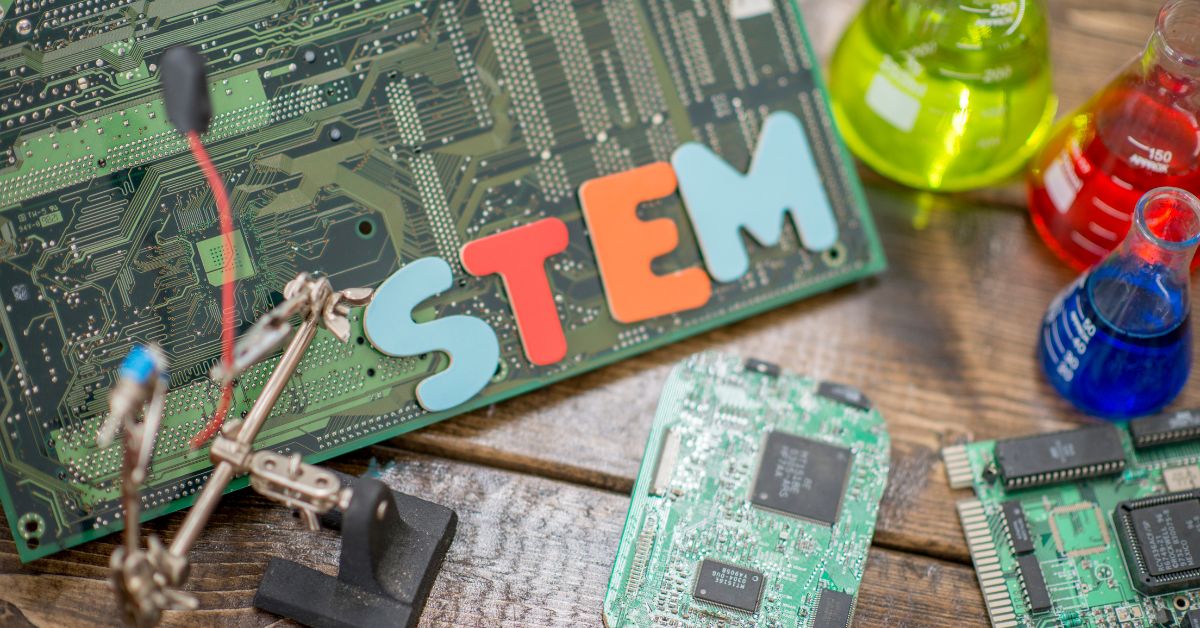
Incorporating STEM Activities Across the Curriculum

In today’s rapidly evolving world, the importance of STEM—Science, Technology, Engineering, and Mathematics—cannot be overstated. These fields form the backbone of countless innovations and industries, making STEM education essential for preparing students for future challenges and opportunities. For parents, incorporating STEM activities into the homeschool curriculum can be a game-changer, offering unique opportunities to engage children in hands-on learning and real-world problem-solving.

Homeschooling provides flexibility and the freedom to tailor educational experiences to a child’s pace and interests. This makes it an ideal environment to integrate STEM activities naturally and seamlessly across different subjects. By doing so, homeschooling parents can create a rich, interdisciplinary learning experience that not only covers traditional academic bases but also ignites curiosity and passion for discovery. Through this blog post, we’ll explore the numerous benefits of integrating STEM across the curriculum, practical strategies for implementation, and how reading plays a pivotal role in supporting STEM education at home.

Benefits Of STEM Across The Curriculum

Incorporating STEM across the curriculum offers numerous advantages that extend beyond traditional educational boundaries. First and foremost, it significantly enhances critical thinking and problem-solving skills. When students engage in STEM activities, they learn to approach problems methodically, evaluate evidence, and develop solutions. This process encourages a mindset of inquiry and analysis, crucial competencies in both academic and real-world contexts. Furthermore, STEM education fosters improved literacy and numeracy skills. Engaging with STEM subjects requires students to interpret data, comprehend technical texts, and communicate their findings effectively.

These activities naturally enhance their reading and writing abilities while reinforcing mathematical concepts in an applied setting. By incorporating STEM into daily routines, homeschooling parents can help their children make meaningful connections between abstract concepts and practical applications, resulting in a well-rounded education.

Finally, integrating STEM across the curriculum prepares students for the future. With technology advancing at an unprecedented rate, STEM-related skills are in high demand. By nurturing these skills early on, homeschooling parents equip their children with the tools needed to thrive in a dynamic world. This educational approach not only opens doors to diverse career paths but also instills confidence and adaptability in learners, empowering them to pursue lifelong learning and innovation.

Practical Ways To Incorporate STEM In Homeschooling

Incorporating STEM into a homeschool curriculum can be both exciting and rewarding for parents and students alike. One effective strategy is to integrate STEM into daily routines and traditional subjects. For example, math lessons can be made more engaging by incorporating real-life scenarios where students apply mathematical concepts to solve problems. Similarly, homeschool science activities can be conducted using everyday household items, sparking curiosity and demonstrating scientific principles in action. Additionally, homeschooling parents can explore a wide range of engaging STEM activities tailored to different age groups. Younger children might enjoy building simple machines with LEGO bricks, while older students can experiment with coding through online platforms designed for beginners. By offering age-appropriate activities, parents can maintain their children’s interests and gradually increase the complexity of tasks as their skills develop.

Homeschooling parents can also leverage the power of technology to enhance STEM learning at home. There are numerous online resources, apps, and virtual labs available that facilitate interactive and immersive learning experiences. Virtual reality (VR) and augmented reality (AR) tools, for instance, can transport students to faraway places, allowing them to explore ecosystems, architecture, and more without leaving their homes. These technologies not only make learning fun but also offer unique perspectives and insights that traditional classroom settings might not provide. Moreover, collaborative projects can be a great way to integrate STEM into homeschooling.

Encouraging students to work together on group projects, either with siblings or through virtual partnerships with other homeschooling families, helps build teamwork and collaborative skills. Projects can range from creating a simple robot to tackling environmental challenges in a local community. Collaboration allows students to share ideas, learn from one another, and achieve more complex objectives than they might individually, all while reinforcing STEM principles and practices.
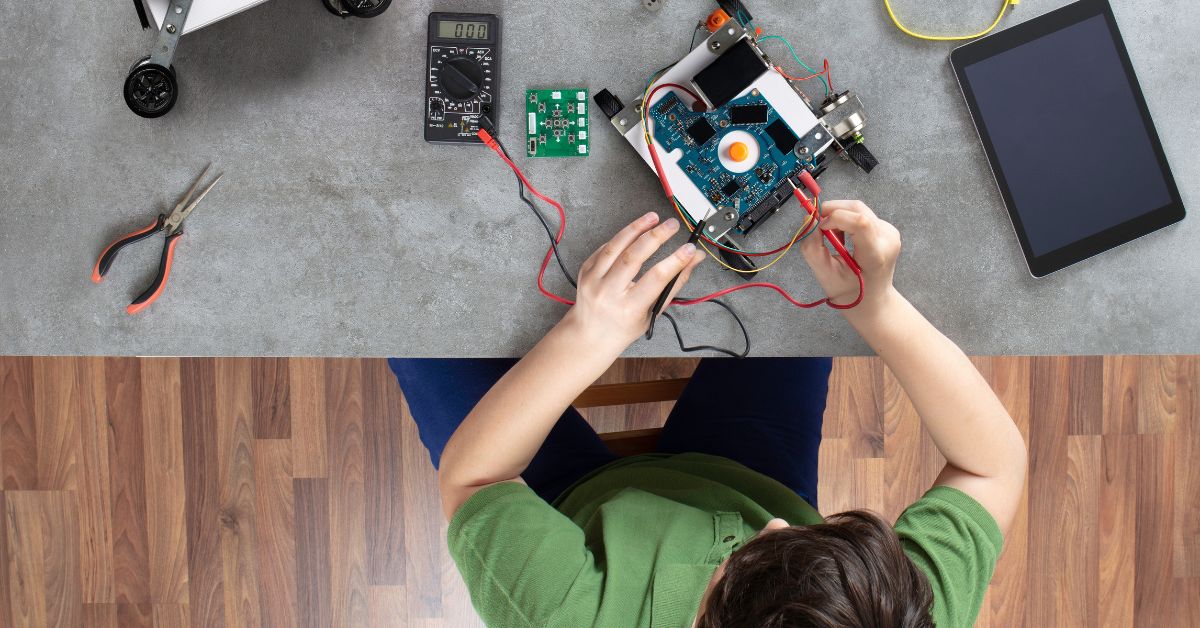
A young student wearing a green shirt working on an electronics project at a table, using a multimeter to test circuits on a robotics or engineering board. Various tools, wires, and a tablet are also on the table, representing hands-on STEM learning.

Finally, encouraging a growth mindset in children can significantly enhance their STEM learning journey. By teaching students to view challenges as opportunities for growth and learning, homeschooling parents can nurture resilience and persistence. Celebrating small victories and embracing failures as part of the learning process helps students develop a positive attitude toward STEM and learning in general. This mindset is crucial not only for mastering STEM subjects but also for thriving in an ever-evolving world filled with constant innovation and change.

To further enhance the learning experience, parents can create interdisciplinary projects that combine multiple STEM elements. For instance, designing and constructing a model bridge can involve engineering principles, mathematical calculations, and scientific experimentation. These projects encourage collaboration, creativity, and problem-solving, providing a comprehensive approach to learning that mirrors real-world challenges.

The Role Of Reading In A STEM-Integrated Curriculum

While STEM subjects often involve hands-on activities and technical exploration, reading remains a crucial component of a well-rounded education. Reading enhances comprehension, vocabulary, and critical thinking skills, all of which are essential for success in STEM fields. By incorporating reading materials that support STEM learning, homeschooling parents can reinforce their children’s understanding of complex concepts and foster a deeper appreciation for the subjects. There are numerous resources available that cater to different age groups and interests. For younger children, picture books that introduce scientific concepts and technological wonders can be both entertaining and educational. For older students, biographies of influential scientists, engineers, and mathematicians offer inspiration and valuable insights into the world of STEM.

Additionally, parents can encourage students to explore non-fiction texts related to current scientific discoveries, technological advancements, and engineering marvels. Reading such materials broadens their horizons and helps them connect classroom learning to real-world applications, fostering a lifelong passion for exploration and innovation. Incorporating fiction into a STEM-integrated curriculum also holds value. Well-crafted science fiction novels can ignite a student’s imagination, prompting them to think creatively about the possibilities of future technologies and advancements. These stories not only entertain but also challenge students to consider ethical implications, societal impacts, and the boundaries of scientific exploration.

Discussions following such readings can deepen understanding and lead to thought-provoking debates, encouraging students to articulate their perspectives and refine their critical thinking skills.

Furthermore, reading and writing go hand in hand. Encouraging students to articulate their thoughts through writing allows them to process information more thoroughly and express their understanding of STEM subjects. Creative writing assignments that ask students to invent and describe new technologies or scientific concepts enhance their ability to convey complex ideas clearly and effectively. This practice strengthens communication skills, an essential competence in any field, particularly in STEM, where collaboration and information sharing are crucial.

Ultimately, blending reading and writing with STEM education creates a holistic learning experience. By broadening the scope beyond mere technical skills, homeschooling parents can nurture well-rounded individuals who are prepared to tackle the multifaceted challenges of the future. This integrated approach not only cultivates a passion for learning but also equips students with the skills and mindset necessary to thrive in a rapidly evolving world.

The Benefits Of STEM Are Far-Reaching

Incorporating STEM activities across the curriculum offers homeschooling parents a powerful tool to cultivate curiosity, critical thinking, and problem-solving skills in their children. By seamlessly blending STEM into daily routines and traditional subjects, parents can create an engaging and flexible learning environment that adapts to their children’s unique needs and interests. The benefits of a STEM-integrated curriculum are far-reaching, enhancing literacy, numeracy, and future preparedness. By encouraging students to explore interdisciplinary projects and providing access to quality reading materials, parents can nurture well-rounded learners who are equipped for the challenges and opportunities of tomorrow. We invite homeschooling parents to explore the exciting world of STEM activities and consider incorporating them into their teaching strategies. By doing so, they can provide their children with a holistic and enriching educational experience that fosters a lifelong love of learning and innovation. For those interested in deepening their understanding of STEM integration, numerous resources and communities are available to support this rewarding educational journey.

Incorporating Art into Math Lessons: Drawing and Design for Better Understanding

In the realm of homeschooling, parents constantly seek innovative ways to make learning both engaging and effective for their children. One compelling method gaining traction is the blending of art with traditional math lessons. This approach not only meets educational standards but also sparks the imagination and curiosity of young minds. By incorporating drawing and design, math becomes more than just numbers and equations; it transforms into a vibrant experience that fosters a deeper understanding of mathematical concepts.

For homeschooling parents, the challenge often lies in keeping their children motivated and interested in subjects that might otherwise seem tedious. Utilizing art as a teaching tool offers an exciting opportunity to bridge this gap. It turns abstract mathematical ideas into tangible creations that children can touch, see, and manipulate. This blog post will explore how art and math are intertwined, the benefits of integrating these disciplines in a homeschooling setting, and provide practical math-art projects to try at home.

By the end of this article, homeschooling parents will gain a comprehensive understanding of why this innovative method is increasingly popular. They’ll learn about the significant advantages it offers in enhancing children’s creativity, problem-solving abilities, and overall personal growth. We’ll also share some hands-on projects that will inspire both parents and children to explore the creative side of math.

Is There Math In Art? The Interconnected World Of Math And Art

At first glance, math and art may appear to belong to entirely different worlds. However, their relationship is far closer than one might think. Both disciplines rely on patterns, structures, and transformations; they just express these concepts in different ways. For instance, geometry is foundational in both fields. Artists use geometric shapes to create perspective and symmetry in their work, while mathematicians employ these shapes to understand spatial relationships and solve problems. One famous example illustrating the connection between math and art is the work of Dutch artist M.C. Escher. Escher masterfully used mathematical principles like tessellation and symmetry to create intricate and mesmerizing artworks. His piece “Relativity” showcases how multiple perspectives and geometric shapes can coexist, challenging our perception and understanding of space. Another example is Leonardo da Vinci’s “Vitruvian Man,” which demonstrates the harmonious proportions found in the human body, echoing the mathematical concept of the golden ratio.

Incorporating Art into Math Lessons_ Drawing and Design for Better Understanding

Understanding the intersection of these two disciplines can enrich the homeschooling experience by providing cross-curricular links that deepen learning. When children see how mathematical principles underpin artistic creations, they begin to appreciate the relevance and application of math in everyday life. It becomes a language through which they can express their ideas creatively, fostering a love for both subjects.

Benefits Of Integrating Art And Math In Homeschooling

Integrating art into math lessons offers numerous benefits that extend beyond mere academic achievement. Firstly, it aids in visualizing complex mathematical concepts that might otherwise be difficult to grasp. For instance, when children draw patterns or create models, they can see and understand relationships between numbers and shapes in a concrete manner. This hands-on approach solidifies their understanding and encourages them to experiment and explore further. Moreover, combining art with math enhances creativity and problem-solving skills. Children learn to approach problems from different angles and develop innovative solutions. This creative thinking extends beyond math and art, equipping them with the ability to tackle challenges across various subjects and life situations. Encouraging children to explore and express themselves through art empowers them to become independent thinkers and lifelong learners.

Personal development is another significant advantage of integrating art and math. Through self-expression, children build confidence and improve their communication skills. They learn to articulate their thoughts and ideas using visual mediums, which can be particularly beneficial for those who find verbal communication challenging. The process of creating art also promotes patience and perseverance as children learn to work through mistakes and refine their creations.

Practical Math Art Projects For Homeschooling

To fully harness the benefits of this multidisciplinary approach, consider incorporating practical math related art projects into your homeschooling curriculum. These projects not only reinforce mathematical concepts but also allow children to engage with them creatively.

  1. Tessellation Art: Inspired by M.C. Escher, this project involves creating repeating patterns using geometric shapes. Provide children with templates of shapes like triangles, squares, and hexagons. Encourage them to arrange these shapes on paper to form intricate patterns. This activity helps children understand symmetry, transformation, and spatial relationships while allowing them to create visually appealing designs.
  2. Geometric Sculpture: Using materials like clay or cardboard, children can create three-dimensional sculptures based on geometric shapes. Guide them in constructing pyramids, cubes, and spheres, exploring concepts like volume and surface area. This hands-on project enhances spatial awareness and provides a tactile learning experience.
  3. Fibonacci Sequence Collage: Introduce children to the Fibonacci sequence and its natural occurrences, such as in sunflowers and pinecones. Then, challenge them to create a collage using Fibonacci spirals. This project combines math and art by illustrating how mathematical patterns manifest in nature, encouraging observation and connection-building.
  4. Fractal Tree Drawing: Fractals are complex patterns that are self-similar across different scales. Introduce children to the concept of fractals by guiding them to draw a simple fractal tree. Start with a straight line to serve as the trunk, then branch it out into smaller lines, repeatedly forking each branch into smaller segments. This exercise helps visualize the concept of infinity and self-similarity, crucial aspects of fractals, while also developing children’s fine motor skills and patience.
  5. Mandala Geometry: Mandalas are intricate circular designs that often feature balanced, repetitive patterns. Teach children about symmetry by creating mandalas using a compass and a protractor. Have them draw concentric circles and divide the circle into equal segments, then fill each section with geometric designs. This activity not only reinforces concepts such as symmetry and radial balance but also offers a calming and meditative creative outlet.
  6. Mathematical Mobiles: This project combines art, balance, and math to create hanging mobiles. Children can construct mobiles using paper or lightweight materials cut into various geometric shapes. Teach them to balance the shapes by attaching them to dowels or straws with string, exploring the principles of equilibrium and center of mass. This kinetic art piece encourages experimentation and problem-solving in achieving balance.
  7. Origami and Geometry: Origami, the Japanese art of paper folding, provides an excellent way to explore geometric concepts. Encourage children to create various origami shapes like cranes, flowers, or polyhedra. Discuss the geometric principles involved, such as angles, shapes, and symmetry, as they transform a flat piece of paper into a three-dimensional object. This activity improves spatial reasoning and promotes understanding of geometric transformations.

By encouraging creativity and innovation in these projects, parents can help children develop a deeper appreciation for both math and art. Additionally, involving children in the planning and execution of these projects fosters a sense of ownership and pride in their work.

Integrating art into math education offers a dynamic and multifaceted approach that enriches children’s learning experiences. By engaging in creative projects such as tessellation art, geometric sculpture, and mandala geometry, children not only reinforce mathematical concepts but also foster critical thinking and problem-solving skills. These activities empower children to visualize mathematical patterns and relationships in tangible ways, making abstract concepts more accessible and enjoyable. The interdisciplinary nature of these projects nurtures both artistic and intellectual growth, encouraging students to explore the world with curiosity and confidence. As parents and educators, it’s essential to support this holistic learning model, as it cultivates independent thinkers and lifelong learners poised to thrive in an increasingly complex world. Through the union of art and math, children are equipped with the tools to innovate, adapt, and express themselves in a myriad of contexts.

Learning Styles in Science: Tailoring Lessons for Visual, Auditory, and Kinesthetic Learners

In the vibrant world of homeschooling, tapping into each child’s unique learning style can be the key to unlocking their potential. With science as a core subject, it’s crucial that lessons are engaging, accessible, and tailored to meet the needs of visual, auditory, and kinesthetic learners. This comprehensive guide will help homeschooling parents recognize and adapt to these varied learning styles, ensuring that each child can thrive in their scientific explorations.

Homeschool Styles Explained: Understanding Learning Style Diversity 

Learning styles refer to the different ways individuals process information. While some children grasp concepts better with images, others may prefer listening or hands-on activities. By understanding these styles, parents can effectively tailor lessons for optimal absorption and retention. Visual learners absorb information best when it’s presented in a format they can see. This could be through diagrams, charts, and videos. They tend to love color-coding and often visualize concepts in their mind’s eye. Recognizing a visual learner can be as simple as noticing their penchant for doodling during lessons or their ability to recall information they’ve seen written down.

Auditory learners, on the other hand, thrive on spoken words. They remember information by hearing and often excel in discussions and listening activities. If your child prefers listening to explanations over reading or often repeats things out loud to remember them, they might be an auditory learner. Kinesthetic learners learn by doing. They engage with the material through touch and movement, often needing physical activity to truly internalize information. These learners might seem restless during traditional lessons but shine when they can engage hands-on. Identifying a kinesthetic learner involves observing their need to fidget while concentrating or their preference for experiments over lectures.

A young boy wearing a red shirt sits at a desk, smiling while looking at a green smartphone. His study materials, including a notebook, are in front of him, and colorful storage cubes decorate the background. A bright and engaging learning environment.

The first step to tailoring your homeschool science curriculum is to determine your child’s primary learning style. Begin by observing their behavior during different activities. Do they seem more focused when watching a video, listening to a story, or participating in an experiment? Consider involving your child in this discovery process. Ask them how they prefer to learn and what methods they find most enjoyable and effective. Additionally, there are various online assessments designed to pinpoint learning styles, which can offer further insights into their preferences. By understanding these styles, you can create an enriching educational environment that caters to their strengths, ultimately enhancing their love for learning.

Tailoring Science Lessons For Visual, Auditory, & Kinesthetic Learners

  • Visual Strategies and Resources: For visual learners, success lies in the vibrant presentation of information. Incorporate infographics, diagrams, and colorful images into your lessons. Resources like interactive textbooks or educational videos can be invaluable. Platforms like Khan Academy and YouTube offer a plethora of visual content suited for homeschooling. Encourage your child to create mind maps or flashcards. These tools not only aid in memory retention but also allow them to actively engage with the material. Visual learners also benefit from written instructions alongside verbal ones, providing clarity and support as they process new information. Imagine a lesson about the water cycle. Start with a visually appealing diagram illustrating evaporation, condensation, and precipitation. Use a colorful video to further explain the stages, then have your child redraw the cycle from memory, adding their unique touches. To reinforce understanding, they could create a collage using magazine cutouts or digital images depicting each stage. This hands-on engagement ensures they’re not just passive learners but active participants in their education.
  • Auditory Strategies and Resources: Auditory learners flourish when they can hear information. To tailor lessons for them, incorporate audiobooks, podcasts, and verbal storytelling into your daily routine. Discuss concepts out loud and encourage your child to ask questions and engage in lively discussions. Utilize technology like voice recorders, allowing them to listen to lessons repeatedly. Resources such as Audible and LibriVox offer a range of science-related audiobooks that can supplement your curriculum. Take a topic like the rock cycle. Begin with an engaging podcast or audio clip explaining the process. Follow this by having your child narrate what they’ve learned, encouraging them to articulate each stage in their own words. Engage in a dialogue about the differences between igneous, sedimentary, and metamorphic rocks. Play an interactive audio quiz to assess their understanding, making learning both fun and informative.
  • Kinesthetic Strategies and Resources: Kinesthetic learners need movement and hands-on activity. Structure your lessons to include experiments, field trips, and interactive projects. Encourage them to build models or use educational kits that require assembly and manipulation. Use resources like science activity books or online platforms offering virtual labs to allow them to explore concepts experimentally. Keep lessons dynamic, varying activities to maintain their engagement and interest. If you’re teaching about plant biology, consider a hands-on approach. Begin by planting seeds together, discussing the process of germination as you go. Encourage your child to document growth stages with photographs or sketches. Create a simple experiment to show how plants absorb water using colored water and celery. This tangible experience roots theory in practical application, deepening their understanding through direct interaction.

While identifying a child’s primary learning style is beneficial, incorporating elements from all three styles can enrich learning experiences. Multi-modal approaches cater to diverse needs, ensuring a holistic understanding of complex subjects. Combine visuals with auditory explanations and hands-on activities. This flexibility allows children to engage with material in multiple ways, reinforcing concepts and accommodating various preferences. Multi-modal learning ensures no stone is left unturned. It promotes cognitive flexibility, adaptability, and creativity. By exposing children to different methods, you equip them with diverse problem-solving skills, fostering resilience and innovation. Additionally, this approach can reveal untapped strengths in learners, offering a more rounded and fulfilling educational experience.

Finding The Right Homeschool Curriculum

Finding the right homeschool curriculum can be challenging, but many resources offer flexibility to adapt to different styles. Look for programs emphasizing interactive content, such as Time4Learning or Oak Meadow, which provide visual, auditory, and kinesthetic engagement. Today’s digital age offers vast resources, like the “homeschool history video curriculum,” that bring subjects to life. Platforms like Discovery Education and BrainPOP offer a wealth of videos, games, and interactive content that engage all learning styles.

A supportive learning environment is also fundamental to successful homeschooling. Arrange your space to accommodate different activities, ensuring it’s comfortable and inviting. Consider lighting, seating, and storage to enhance focus and organization. Nurture natural curiosity by providing access to diverse materials, books, and tools. Encourage questions and celebrate discoveries. This open-minded approach fosters a lifelong love of learning and empowers children to pursue their interests. Connect with other homeschooling families to exchange ideas, resources, and support. Join local groups or online forums to share experiences and learn from others. Community involvement offers valuable insights and camaraderie for both parents and children.

Incorporating learning styles into your homeschool science lessons is not just an educational strategy—it’s a pathway to deeper understanding and enjoyment. By tailoring your approach to visual, auditory, and kinesthetic learners, you create an environment where every child can thrive. Encourage exploration and experimentation, and don’t hesitate to try new strategies. Remember, every child learns differently, and your adaptability as a parent and educator makes all the difference. Share this guide with fellow homeschooling parents and join us in fostering a community that celebrates diverse learning styles. Let’s make science an adventure for every child, one lesson at a time.

Exploring Science Through Hands-On Experiments: Engaging Activities for Kids

Homeschooling has been rapidly growing in popularity, particularly in recent years. More parents are choosing to take control of their children’s education, tailoring it to fit their unique needs and interests. One crucial aspect of a science homeschool curriculum is finding engaging activities that not only educate but also inspire. Among the many subject areas, science stands out as an exciting field where hands-on experiments can significantly enhance learning.

The aim of this blog post is to explore various ways to integrate hands-on science experiments into your homeschooling routine. We’ll discuss the benefits of these activities, offer practical tips, and share some inspiring stories from other homeschooling families. By the end of this post, you’ll have a treasure trove of ideas to make science not just educational but also captivating for your kids.

Homeschool Science Resources: Science Experiments At Home

Choosing the right science experiments for your home setting is the first step. It’s important to select activities that are both educational and feasible within your space. Start with simple experiments such as the classic baking soda and vinegar volcano, which teaches chemical reactions in a fun way. Water displacement with different objects can explain the basic principles of buoyancy and density. Another great option is growing crystals using salt and sugar to introduce kids to the concept of solubility and crystallization.

Selecting age-appropriate activities is key. For younger children, focus on experiments that are visually stimulating and straightforward. Older kids might enjoy more complex projects like building simple circuits or exploring the properties of magnets. The goal is to keep the experiments challenging yet achievable, fostering a sense of accomplishment.

Easy volcano science experiment for kids using baking soda and vinegar, with step-by-step instructions.

Integrating science experiments into your homeschool curriculum can be seamless. Dedicate specific days of the week to hands-on science. This consistency helps build anticipation and makes science a regular part of your child’s learning experience. Align experiments with your existing science topics to reinforce theoretical knowledge with practical application.

For example, if you’re teaching about states of matter, an experiment such as creating homemade slime can illustrate changes between solid and liquid states. Use the experiments as a springboard for further discussion and exploration. Encourage kids to ask questions, form hypotheses, and record their observations.

A top-down view of a child's hands kneading pink slime in a bowl, surrounded by various slime-making ingredients and tools, including glue, food coloring, shaving cream, measuring spoons, and mixing bowls containing blue and white mixtures. A fun and colorful hands-on science experiment in progress.

Parents play a crucial role in the success of homeschool science experiments. Your enthusiasm and involvement can significantly impact your child’s engagement. Be prepared to guide the experiments, but also allow your kids to take the lead where possible. This balance fosters independence and critical thinking. Create a supportive environment where mistakes are seen as learning opportunities. Celebrate successes and encourage curiosity.

Use your own knowledge and resources to answer questions or research together to find solutions. Your active participation shows your children that learning is a lifelong pursuit.

Engaging Your Kids In Science

Making science exciting for kids is all about sparking curiosity and creating connections. When children experience science as fun and meaningful, they naturally want to learn more. Here are some practical tips for transforming science into an adventure your kids will love:

Use Storytelling to Bring Experiments to Life

Frame experiments with a creative twist. Introduce characters, challenges, or scenarios that the experiment can help solve. For instance, pretend you’re chemists developing a potion or engineers solving a pressing environmental problem. Adding a narrative makes the activity feel like a story unfolding, pulling kids right into the action.

Make Learning Interactive and Fun

  • Use multimedia tools: Videos, apps, and interactive games are great for complementing hands-on activities and capturing their attention.
  • Turn it into a challenge: Create friendly competitions or collaborative projects with siblings or homeschooling buddies. For example, who can design the tallest tower or find the quickest way to make ice melt?
  • Let them choose: When kids help pick the experiments, they’re more invested in the outcome. This small responsibility fuels their excitement and sense of ownership.

Find Science in Everyday Life

Science is everywhere—including your daily routine!

  • Cooking: Talk about chemical reactions when baking cookies or boiling water.
  • Gardening: Turn planting seeds into a lesson about photosynthesis and plant growth.
  • Cleaning: Show how different materials interact and explain why vinegar works so well against tough stains.
    Using these everyday scenarios makes science relatable and shows how it’s woven into the world around us.

The Power of Hands-On Learning

Hands-on activities immerse children in the learning experience. Instead of simply reading facts, they can feel the process, observe results, and draw their own conclusions. Here’s why it works so well:

  • Builds critical thinking and problem-solving skills as they figure out why and how things happen.
  • Appeals to different learning styles:
    • Visual learners thrive when they see experiments in action.
    • Kinesthetic learners engage through physical involvement.
    • Auditory learners benefit from discussions about what’s happening and why.
  • Encourages deeper understanding and better retention of scientific concepts.

By rolling up their sleeves and testing ideas, kids experience the magic of discovery firsthand.

Foster a Curious Mindset

Curiosity fuels science, so encourage your child to ask questions and explore fascinating topics. You can support this mindset by:

  • Providing access to resources like books, documentaries, museums, and online lessons.
  • Creating a home environment that values exploration and celebrates discovery.
  • Modeling curiosity yourself. Get excited about your own science-related learning and projects. When kids see your enthusiasm, they’ll be more likely to share it.

Be patient with their pace and make space for their wonder. Every question they ask is a step toward deeper understanding.

Connect Science to the Real World

Help your kids see how science shapes the world by bridging experiments with real-life applications:

  • Explain how chemical reactions power baking or how engineers rely on buoyancy principles to design ships.
  • Visit science centers, botanical gardens, or factories to see scientific concepts in action.
    These connections make learning more relevant and open their eyes to the endless possibilities science has to offer.

Learn From Other Families

Hearing success stories from other homeschooling families can inspire and reassure you. Many parents have found that incorporating science experiments transformed their homeschooling experience. Some highlights include:

  • Children who once found science boring became excited for weekly experiments.
  • Experiments created opportunities for family bonding and teamwork.
  • Kids developed confidence in science and often took up science-related hobbies or started dreaming about careers in STEM.

When you approach science with curiosity, creativity, and fun, the results can be truly transformative—for you and your kids alike. With a little effort, you’ll not only teach essential skills but also foster a lifelong love for exploration and discovery.

Evaluating Progress And Enhancing Learning

Evaluating progress is an essential aspect of homeschooling. It helps you understand your child’s learning trajectory and identify areas that may need additional attention. Regular assessments ensure that your child is meeting educational milestones and progressing at a healthy pace.

Science experiments can be an effective tool for evaluating progress. They offer tangible evidence of your child’s understanding and application of scientific concepts. Use observation checklists during experiments to assess skills such as following procedures, making predictions, and recording results. Encourage your child to maintain a science journal where they document their experiments, observations, and reflections. Reviewing these journals can provide insights into their thought processes and growth over time.

Incorporate science experiments into your homeschooling progress reports. Highlight significant experiments and note any advancements in scientific understanding. Include photos, diagrams, and samples of your child’s work to create a comprehensive record. Evaluation tests can also be used to assess knowledge retention and application. Design quizzes or practical tests based on the experiments conducted.

These assessments can be both fun and informative, providing a well-rounded view of your child’s progress.

Transforming The Way Your Child Learns

Incorporating hands-on science experiments into your homeschooling routine can transform the way your child learns and engages with science. These activities not only make learning fun but also foster critical thinking, creativity, and a lifelong love for discovery.

Remember, the key to successful science education is enthusiasm and curiosity. By providing a supportive and stimulating environment, you can ignite your child’s passion for science and set them on a path to endless exploration.

Hands-On Science Experiments: Bringing the Lab into Your Homeschool

Homeschooling provides a unique opportunity to tailor education to your child’s interests and learning style. One of the most engaging and impactful ways to teach science at home is through hands-on experiments. These activities provide an interactive and practical approach to learning scientific concepts, making the subject come alive for your children. If you’ve been searching for ways to introduce homeschool science without overwhelming yourself or your kids, you’re in the right place. This guide will walk you through various science experiments for kids that you can easily conduct at home using everyday materials. By the end of this post, you’ll have a slew of ideas to bring the lab into your homeschool, fostering curiosity and critical thinking.

Homeschool Chemistry: Hands-On Science Experiments & Setting Up Your Home Lab

Hands-on science experiments provide a tactile and visual way to understand complex scientific principles. While textbooks and lectures are beneficial, they often fail to capture the imagination and excitement that experiments can inspire. When children engage in science experiments, they are not merely passive recipients of information but active participants in their learning processes. For homeschooling parents, this approach can be particularly valuable as it marries education with entertainment, keeping children engaged while reinforcing scientific concepts. Additionally, hands-on science fosters critical thinking and problem-solving skills. When a child sees a chemical reaction firsthand or observes the growth of a plant over time, they are more likely to ask questions and seek answers. This inquisitive nature is the bedrock of scientific inquiry and can be nurtured effectively through homeschool science experiments. The practical experience also helps in retaining information longer, making learning more effective.

Lastly, conducting science experiments at home allows for a flexible and adaptable learning environment. Unlike a traditional classroom setting, where time constraints and curriculum requirements may limit the scope of experiments, homeschooling offers the freedom to explore topics in-depth. Parents can tailor experiments to suit their child’s interests and pace, making the learning experience more personalized and enjoyable.

Before you start conducting experiments, it’s essential to set up a dedicated space for your home lab. This doesn’t have to be a sophisticated setup; a corner of your kitchen or a small table in the living room can suffice. The key is to have a designated area where your child knows they will be conducting their science experiments. This helps in creating a structured learning environment, which is crucial for maintaining focus and discipline. Gather all the necessary materials and keep them organized. Common household items such as vinegar, baking soda, food coloring, and salt can be used for many experiments. You might also need some basic lab equipment like measuring spoons, containers, and gloves. Having everything in one place saves time and makes the process smoother, allowing you and your child to focus on the experiment rather than scrambling for materials. Safety is paramount when conducting science experiments, even at home. Make sure to have safety goggles and gloves readily available, and always supervise your child during experiments. Explain the importance of safety measures to your child, ensuring they understand why they need to follow certain rules. A safe and organized lab environment sets the stage for successful and enjoyable experiments.

The Magic Of Homemade Volcanoes, Exploring Density With Layered Liquids, & Observing Plant Growth

One of the most popular and exciting science experiments for kids is creating a homemade volcano. This activity teaches children about chemical reactions in a fun and visually stimulating way. To start, you’ll need some baking soda, vinegar, dish soap, and red food coloring. A small plastic bottle or container will serve as the volcano’s core, and you can use clay or playdough to shape it into a mountain. Begin by placing the bottle in the center of a tray to catch any overflow. Add a few tablespoons of baking soda into the bottle, followed by a squirt of dish soap and a few drops of red food coloring. When you’re ready for the eruption, pour vinegar into the bottle and watch as the mixture fizzes and bubbles over the top. This reaction occurs because vinegar (an acid) reacts with baking soda (a base) to produce carbon dioxide gas, which causes the eruption. Homemade volcanoes are not only a lot of fun but also educational. They provide a tangible way to understand basic chemistry concepts such as acids and bases, as well as the process of chemical reactions. This experiment also offers an excellent opportunity to introduce the scientific method. Encourage your child to make predictions, observe the results, and discuss why the reaction occurred, fostering a deeper understanding of the science behind the spectacle.

Another fascinating experiment that you can easily conduct at home involves exploring the concept of density using layered liquids. For this activity, you’ll need various liquids such as honey, dish soap, water, vegetable oil, and rubbing alcohol. Each of these liquids has a different density, allowing them to layer on top of one another without mixing. Start by pouring the heaviest liquid (honey) into a clear glass or container. Next, carefully add the dish soap, followed by water, vegetable oil, and finally, rubbing alcohol. Pour each liquid slowly and steadily down the side of the container to prevent them from mixing. Once all the liquids are added, you’ll see distinct layers forming, with each liquid floating on top of the one denser than it. This experiment provides a visual and hands-on way to understand the concept of density, which can sometimes be abstract and challenging to grasp through textbooks alone. Discuss with your child why certain liquids float on top of others and how density plays a role in everyday life. This experiment can also be extended by adding small objects such as coins, plastic toys, or grapes to see which layers they float or sink in, providing further insights into the concept of density.

Observing plant growth is a simple yet powerful way to teach children about biology and the life cycle of plants. For this experiment, you’ll need some seeds (such as beans), soil, small pots or containers, and water. Start by planting the seeds in the soil, following the instructions on the seed packet. Place the pots in a sunny location and water them regularly. Encourage your child to observe the seeds daily and keep a journal of their observations. They can note the day the seeds were planted, the first signs of sprouting, and the growth progress over time. This experiment teaches patience and the importance of consistent care, as well as providing a hands-on way to learn about photosynthesis, germination, and plant anatomy. To add an extra layer of scientific inquiry, you can set up a controlled experiment by planting seeds in different conditions. For example, plant one set of seeds in direct sunlight and another in partial shade, or water one set with tap water and another with distilled water. Compare the growth of each set of plants and discuss the factors that affect plant growth, reinforcing the scientific method and critical thinking skills.

A smiling child holding soil with a small green seedling, symbolizing growth, learning, and hands-on biology experiments in a homeschool setting.

Integrating Scientific Inquiry Into Daily Lessons

Integrating scientific inquiry into your daily homeschool lessons can significantly enhance your child’s learning experience. Encourage your child to ask questions, make predictions, and test their hypotheses through hands-on experiments. This approach not only makes learning more engaging but also helps develop critical thinking and problem-solving skills that are essential for success in any field. Make science a part of your daily routine by incorporating simple experiments and observations into everyday activities. For example, cooking provides numerous opportunities to explore scientific concepts such as chemical reactions, states of matter, and temperature changes. Baking a cake, for instance, can be an excellent way to discuss the role of heat in causing the batter to rise and transform into a fluffy cake. Additionally, take advantage of outdoor activities to explore the natural world. A nature walk can become an impromptu biology lesson, where you can identify different plants and animals, discuss their habitats, and observe their behaviors. Collecting leaves, rocks, or insects can lead to further exploration and research at home, fostering a sense of curiosity and a love for science.

Bringing the lab into your homeschool through hands-on science experiments offers a unique and engaging way to teach scientific concepts. From creating homemade volcanoes and exploring density with layered liquids to observing plant growth and integrating scientific inquiry into daily lessons, these activities make learning science fun and memorable. By setting up a dedicated home lab, gathering necessary materials, and prioritizing safety, you can create a structured and enjoyable learning environment for your child. These experiments not only teach important scientific principles but also foster critical thinking, problem-solving skills, and a sense of curiosity. Through hands-on science, you can transform your homeschooling experience and inspire a lifelong love for learning in your child.

Ready to take your homeschool science to the next level? Begin by trying out some of these experiments today, and watch as your child’s understanding and enthusiasm for science grow. And if you’re looking for more inspiration and guidance, consider connecting with other homeschooling parents and educators online. Together, you can create a supportive community that shares resources, ideas, and encouragement, making the homeschooling journey even more rewarding.