
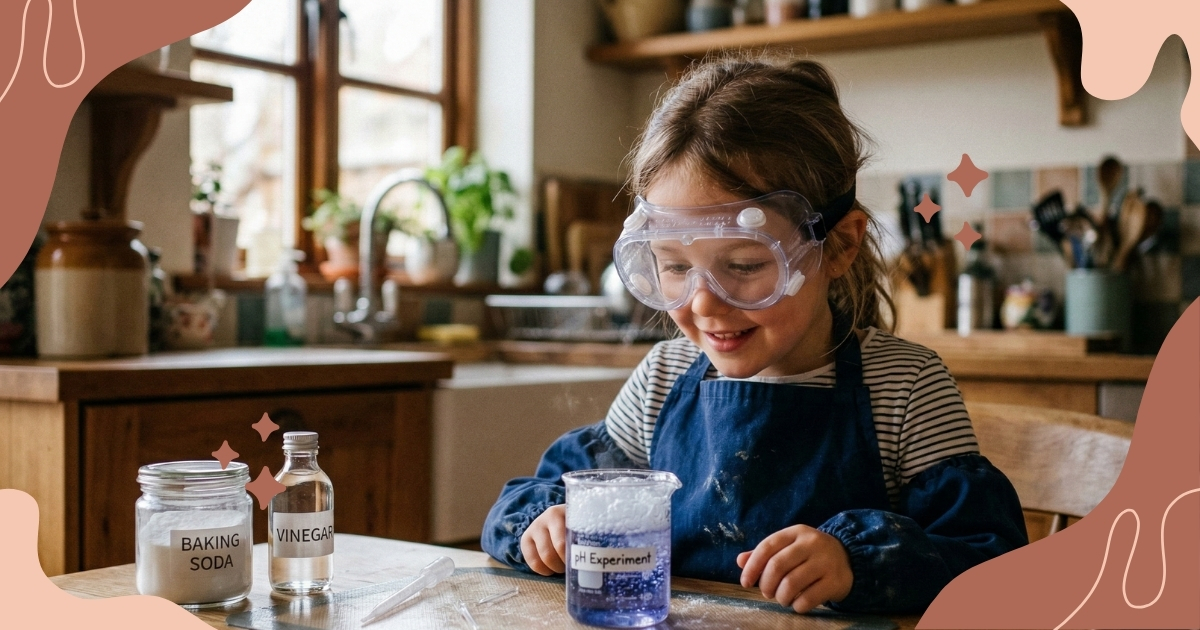
Science doesn’t have to stay in a lab—it can happen right in your kitchen! Teaching kids about acids and bases is both fun and educational, and the best part is, you can do it with everyday household items. From vinegar to baking soda, lemons to soap, these simple ingredients can turn your kitchen into a hands-on chemistry lab.
Hands-on experiments help children see science in action. Watching reactions, mixing substances, and observing color changes makes abstract concepts like pH tangible. These activities also encourage critical thinking, problem-solving, and careful observation—skills that are valuable across all subjects.
In this blog, we’ll share 4 simple, safe experiments that teach acids and bases at home. You’ll find step-by-step instructions, tips for homeschool parents, and ways to extend learning beyond the kitchen. Plus, we’ll show how to use a chart to record observations, making science both organized and interactive for your children.
What Experiments Can You Do with Acids and Bases?
Introducing kids to acids and bases can be both exciting and educational with simple, hands-on experiments. Using everyday items found in your kitchen, children can see chemical reactions in real time and understand how substances interact. Vinegar, baking soda, lemon juice, and even soap can all demonstrate important scientific concepts in a safe, controlled way.
One classic experiment is the vinegar and baking soda reaction, which produces fizzing and bubbling as carbon dioxide gas is released. This reaction is a fun way to show how acids and bases interact. Another experiment uses red cabbage juice as a natural pH indicator, which changes color depending on whether a liquid is acidic or basic. Kids can test lemon juice, soap, or other household liquids to observe these changes.
Homeschool parents can also explore neutralization reactions by mixing acids and bases together and watching what happens. Children can experiment with ratios, predict outcomes, and record their observations to see patterns emerge.
The key learning goals for these experiments include:
- Understanding the difference between acids and bases
- Observing chemical reactions and color changes
- Learning how to predict outcomes and test hypotheses
- Recording and analyzing results
These experiments are flexible and can be adapted for different ages. Younger children may focus on observation and simple predictions, while older children can measure, record pH levels, and explain the science behind the reactions.
By starting with these simple experiments, children not only gain a hands-on understanding of acids and bases, but they also build curiosity and confidence in their ability to explore science at home.
Experiment 1: Vinegar and Baking Soda Volcano
The vinegar and baking soda volcano is a classic kitchen experiment that excites kids while teaching basic acid-base chemistry. It’s simple, safe, and perfect for homeschool science lessons.
What You Need:
- Baking soda (base)
- Vinegar (acid)
- A small container or cup
- Optional: food coloring or dish soap for extra fun
How to Do It:
- Place the container on a tray or in a shallow dish to catch overflow.
- Add 2–3 tablespoons of baking soda to the container.
- Optional: Add a few drops of food coloring or a squirt of dish soap to make the reaction more dramatic.
- Slowly pour vinegar into the container and watch the fizzing eruption.
What’s Happening:
The reaction occurs because vinegar (acetic acid) reacts with baking soda (sodium bicarbonate), producing carbon dioxide gas, which creates the bubbling effect. This demonstrates a basic acid-base reaction and introduces kids to the concept of chemical change.
Tips for Homeschooling:
- Ask children to predict what will happen before adding the vinegar.
- Encourage them to observe and describe the reaction: What do they see, hear, and smell?
- Try variations: use different amounts of baking soda or vinegar and see how the reaction changes.
- Discuss why the reaction is safe and why certain experiments should be done in a controlled area.
This experiment is a great starting point because it’s visual, hands-on, and sparks curiosity about chemical reactions. Children learn that acids and bases can interact in fun ways and that science can be exciting and creative.

Experiment 2: Lemon Juice Color Change with Cabbage Indicator
This experiment uses red cabbage juice as a natural pH indicator to teach kids about acids, bases, and pH levels. It’s safe, colorful, and perfect for visual learners in your homeschool science lessons.
What You Need:
- Red cabbage (for juice)
- Lemon juice (acid)
- Baking soda solution (base)
- Small cups or containers
How to Do It:
- Chop a few pieces of red cabbage and boil them in water for 5–10 minutes to extract the purple juice.
- Pour the cabbage juice into small containers.
- Add lemon juice to one container and baking soda solution to another.
- Watch the cabbage juice change color: it turns red or pink with acids and green or blue with bases.
What’s Happening:
Red cabbage contains a natural pigment called anthocyanin, which changes color depending on the acidity or alkalinity of the solution. This demonstrates how acids and bases affect pH and introduces the concept of indicators in chemistry.
Homeschool Tips:
- Encourage children to predict the color change before adding the liquids.
- Ask them to describe the differences between acid and base reactions.
- Experiment with other household liquids like vinegar, soap, or lemon-lime soda to see how they affect the cabbage juice.
- Have children record their observations in a science journal or chart for comparison.
This activity is perfect for teaching acids and bases in a hands-on way while also encouraging critical thinking and observation skills. Kids see immediate results, making abstract concepts like pH both fun and understandable.
Experiment 3: Soap vs. Acid Test
The Soap vs. Acid Test is a simple way to explore how acids and bases interact with everyday substances. This experiment allows children to observe reactions and learn about neutralization in a safe and engaging way.
What You Need:
- Liquid hand soap or dish soap (mild base)
- Vinegar (acid)
- Lemon juice (acid)
- Small bowls or cups
How to Do It:
- Pour a small amount of soap into one bowl.
- In separate bowls, pour vinegar and lemon juice.
- Have children slowly add the acid to the soap and observe what happens.
- Note differences in reaction between the two acids.
What’s Happening:
Soap is slightly basic, and acids like vinegar and lemon juice can react with it to neutralize the solution. The reaction is usually subtle—bubbles may form, or the texture of the soap may change slightly—but it demonstrates that acids and bases interact differently depending on the substances involved.
Homeschool Tips:
- Ask children to predict what will happen before adding the acids.
- Encourage them to compare reactions and explain why the two acids behave differently with the soap.
- Discuss real-life applications, such as why soap cleans better in some water conditions or how neutralization is used in everyday products.
- Record observations in a journal or chart to help kids track patterns and differences.
This experiment reinforces key concepts about acids, bases, and neutralization, while also teaching careful observation and reasoning skills. Children begin to see that chemistry is not just theoretical—it happens in the kitchen and the world around them.
Experiment 4: Homemade pH Paper
Creating homemade pH paper is a hands-on way for kids to test the acidity or alkalinity of everyday substances. This experiment combines observation, measurement, and scientific reasoning, making it a perfect addition to your homeschool science lessons.
What You Need:
- Red cabbage juice (prepared as in Experiment 2)
- Coffee filters or small strips of paper
- Small cups of household liquids (vinegar, lemon juice, soap solution, soda, milk, etc.)
- A tray or plate for drying strips
How to Do It:
- Cut coffee filters or paper into small strips.
- Dip the strips into the red cabbage juice until fully soaked.
- Lay the strips out to dry on a tray or plate.
- Once dry, use the strips to test different liquids by dipping them in and observing color changes.
- Record the results in a chart, noting which substances are acidic, neutral, or basic.
What’s Happening:
The cabbage juice contains anthocyanins, which change color depending on the pH of the liquid. Acidic liquids turn the strips red or pink, neutral liquids remain purple, and basic liquids turn green or blue. This shows children how indicators reveal chemical properties in everyday materials.
Homeschool Tips:
- Encourage children to predict the color change before testing each liquid.
- Compare and contrast the reactions of different liquids.
- Discuss how scientists use indicators in real labs to determine pH.
- Extend learning by having children create a pH scale chart and plot their results.
This experiment is perfect for older children or those ready for more investigative science. It teaches careful observation, data recording, and critical thinking, while also showing that chemistry can be both safe and fun at home.
Visualizing Results: Experiment Chart
After completing all four kitchen chemistry experiments, using a chart to organize observations helps children make sense of what they’ve learned. Charts allow kids to compare reactions, identify patterns, and draw conclusions, reinforcing both science skills and critical thinking.
How to Set Up the Chart:
| Substance | Experiment | Reaction Observed | pH (Acid/Base) | Color Change | Notes/Observations |
| Vinegar | Volcano | Fizzing, bubbling | Acid | N/A | Strong reaction with baking soda |
| Lemon Juice | Cabbage Indicator | Color turns red/pink | Acid | Red | Highly acidic |
| Baking Soda Solution | Cabbage Indicator | Color turns green/blue | Base | Green | Basic reaction |
| Soap | Acid Test | Slight bubbles | Base | N/A | Reaction varies with acid type |
| Various Liquids | Homemade pH Paper | Color changes | Acid/Base/Neutral | Red, Purple, Blue/Green | Compare and record differences |
Homeschool Tips:
- Encourage children to fill in the chart themselves after each experiment.
- Ask questions to promote deeper thinking, such as: “Which substances were the strongest acids or bases?” or “Did anything surprise you?”
- Use the chart to look for patterns, helping kids see how acids and bases behave differently with different materials.
- Let children draw symbols or use colors to make the chart visually engaging and memorable.
Using a chart not only reinforces observation skills, but it also teaches children how scientists organize data, look for trends, and present findings. It turns a fun kitchen activity into a structured, educational science lesson that builds critical thinking and analysis skills.
Teaching Tips for Homeschool Parents
Kitchen chemistry experiments are more than just fun—they’re an opportunity to teach children critical scientific skills like observation, prediction, and data analysis. With a little guidance, homeschool parents can turn simple kitchen activities into a full science lesson that is safe, engaging, and memorable.
Safety should always come first. Make sure children are supervised while handling liquids and teach them to clean up spills immediately. Simple precautions like using gloves or aprons can keep hands and clothes clean while experimenting.
Encouraging observation and prediction helps children think like scientists. Ask questions such as:
- “What do you think will happen when we mix these ingredients?”
- “Why do you think this reaction looks different from the last one?”
- “What did you notice about the colors or bubbles?”
Recording and comparing data is another important skill. Using an experiment chart allows kids to track results and look for patterns, such as which substances are acidic, which are basic, and which are neutral. Discussing why reactions differ strengthens analytical thinking and introduces the idea of evidence-based conclusions.
You can also extend learning beyond the kitchen:
- Explore acids and bases in everyday life, like cleaning products, digestion, or gardening.
- Encourage children to safely design their own experiments to test predictions.
- Incorporate other skills, such as measuring ingredients (math), writing observations (language arts), or illustrating reactions (art).
Finally, make learning enjoyable. Celebrate “wow” moments and let children choose variations for experiments. Turning these activities into a mini science lab routine helps children build curiosity, confidence, and a lasting love of learning.
Extending the Lesson Beyond the Kitchen
Once your children have completed the four kitchen chemistry experiments, you can take learning further by connecting acids and bases to the world around them. This helps them see that science isn’t just something that happens in a bowl—it’s everywhere in daily life.
Start with household connections. Vinegar, lemon juice, and baking soda aren’t just for experiments—they’re used for cleaning, cooking, and even gardening. Ask children to identify other products that are acidic or basic and discuss how their chemical properties affect their use. For example, vinegar can clean surfaces because its acidity breaks down stains, while baking soda deodorizes because of its basic nature.
Another way to extend learning is through food experiments. Children can test the acidity of orange juice, milk, or soda with homemade pH paper. They can then discuss how acidity affects taste, preservation, and even digestion. This encourages curiosity and makes science practical and relevant.
You can also explore environmental science connections. Rainwater can be slightly acidic, and soil pH affects plant growth. Children can test soil samples from your yard or garden with pH paper, learning how acids and bases impact ecosystems.
Encourage creative extensions as well. Children can:
- Keep a science journal of new experiments or observations in their daily life
- Draw diagrams showing reactions they’ve observed
- Make predictions about how other household items might behave in acid-base reactions
By connecting kitchen chemistry to real-world examples, children learn to observe, question, and apply scientific thinking beyond the experiments themselves. These extensions make science meaningful, memorable, and a natural part of everyday life.
Making Chemistry Fun at Home
Teaching acids and bases at home doesn’t have to be complicated. With simple kitchen ingredients, children can see chemical reactions, test pH levels, and explore science in a hands-on, memorable way. These experiments build observation, prediction, and critical thinking skills while keeping learning fun and interactive.
By extending lessons beyond the kitchen—through everyday products, food experiments, or environmental observations—homeschoolers can connect chemistry to the real world. With creativity and guidance, parents can turn science into an exciting adventure that inspires curiosity, confidence, and a love of learning that lasts long after the experiment ends.