
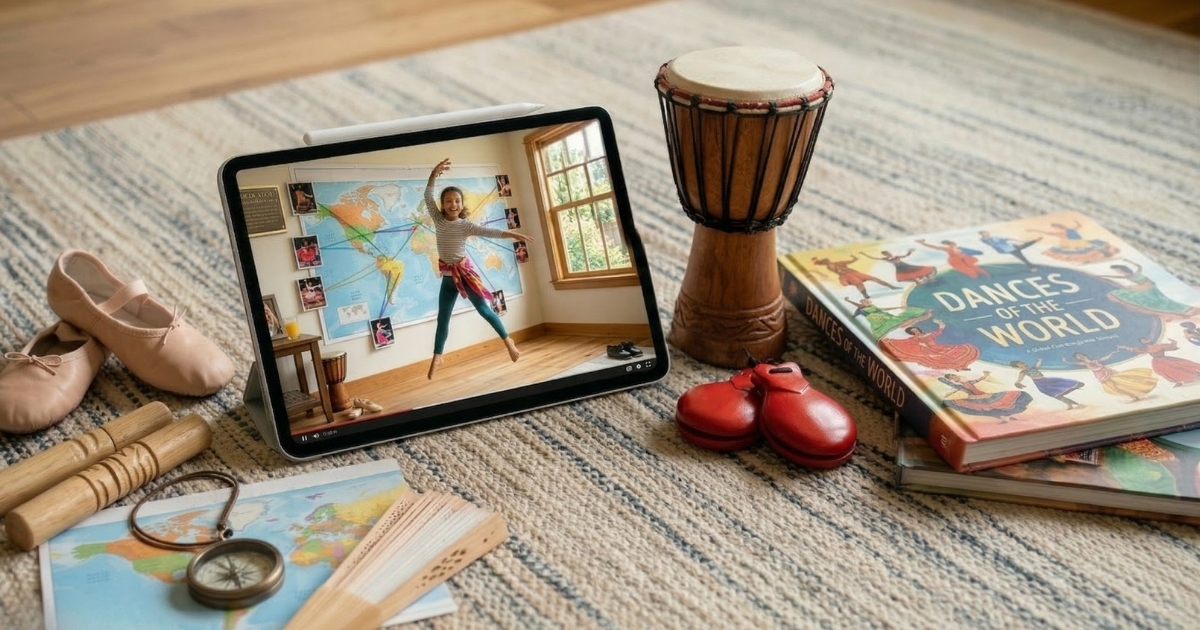
Imagine traveling the world without ever leaving your living room—learning about new cultures, listening to their music, and moving your body through traditional dances. That’s the magic of a “Dance Around the World” unit study. It combines physical education, music, and cultural exploration into one engaging homeschool experience.
This approach benefits children in multiple ways. Dancing improves coordination, balance, and endurance while building confidence and creativity. Learning music from different cultures develops rhythm, listening skills, and musicality. Exploring the history and meaning behind each dance introduces children to geography, social studies, and global traditions. Together, these elements create a dynamic, hands-on learning experience.
The purpose of this blog is to guide homeschool families in designing a “Dance Around the World” unit study. You’ll learn how to structure lessons, select countries and dances, integrate PE and music, explore cultural context, and involve the whole family. By the end, you’ll see that learning through dance can be fun, educational, and a meaningful way to connect your children with the world.
What Are Unit Studies?
Unit studies are a thematic, interdisciplinary way to explore a topic in depth. Rather than separating subjects into isolated lessons, a unit study combines multiple areas of learning—like PE, music, history, geography, and language arts—around a single theme. This allows children to see connections between subjects, making learning more meaningful and memorable.
In a “Dance Around the World” unit, movement, music, and culture are all tied together. For example, when learning about Brazil, children might practice samba steps (PE), listen to traditional Brazilian rhythms (music), and explore the history and festivals of the region (culture). Every lesson builds on the others, creating a cohesive experience rather than random activities.
Unit studies are highly flexible. They can be adapted to different age groups, learning styles, and interests. Younger children might focus on simple dance movements and colorful music, while older children could dive deeper into cultural context, choreography, and musical composition. Children also have the opportunity to take ownership of their learning by choosing which dances, instruments, or cultural elements interest them most.
The beauty of unit studies lies in their natural integration. Children learn by doing, observing, listening, and moving, rather than through worksheets or rote memorization. In a “Dance Around the World” unit, they develop physical skills, cultural awareness, and artistic expression—all while having fun and staying active.
Choosing Countries and Dances to Include
Selecting the right countries and dances is key to making a “Dance Around the World” unit study engaging, educational, and diverse. The goal is to provide a mix of movement styles, music genres, and cultural experiences that are age-appropriate and fun.
Here are some tips for choosing countries and dances:
- Balance Continents and Cultures: Include dances from multiple continents to expose children to a variety of traditions and styles. For example, you might include African drumming and dance, Irish step dance, and Japanese Bon Odori.
- Consider Age Appropriateness: Some dances may be complex or require advanced coordination. Choose simpler movements for younger children and more intricate routines for older students.
- Highlight Traditional and Folk Dances: Folk dances often carry cultural stories or historical significance, giving children a deeper understanding of the country’s traditions.
- Incorporate Contemporary Styles: Modern dance styles, like hip-hop or salsa, show cultural evolution and keep the experience relevant and relatable.
- Connect Music and Movement: Ensure the music chosen fits the dance style and introduces children to traditional instruments, rhythms, and tempos.
- Research Cultural Context: Understanding why a dance exists and when it’s performed adds meaning to the movement and strengthens cultural awareness.
- Rotate and Expand: Start with a few dances and add more over time. This keeps the unit dynamic and allows children to explore new interests.
Example countries and dances to include:
- Ireland: Irish step dance
- West Africa: Traditional drumming and dance
- Spain: Flamenco
- India: Bollywood dance
- China: Ribbon dance
- Latin America: Salsa or samba
Choosing a variety of dances ensures children gain a well-rounded experience. They develop coordination, rhythm, and physical stamina while learning about global traditions, musical styles, and cultural stories. By intentionally selecting dances and countries, you set the stage for a unit study that is engaging, meaningful, and educational.

Integrating Physical Education Through Dance
Dance is a natural way to combine physical education with cultural learning. When children move to music from around the world, they develop coordination, endurance, balance, and flexibility—all while having fun.
Here’s how to make PE purposeful within a “Dance Around the World” unit study:
- Warm-Ups: Begin each session with stretches, light cardio, or basic movement patterns to prepare the body and prevent injury.
- Technique Practice: Teach key steps or movements specific to each dance style, focusing on posture, rhythm, and control.
- Full Dance Routines: Combine steps into short sequences or choreographies, gradually increasing complexity as skills improve.
- Improvisation: Encourage children to explore creative movements inspired by the music and cultural context, promoting self-expression and confidence.
- Cool-Downs: Finish with gentle stretches or slow movements to reinforce body awareness and relaxation.
In addition to physical skills, integrating PE through dance supports cognitive and social development. Children learn to follow sequences, memorize steps, and work collaboratively if dancing in pairs or groups. Movement also reinforces musical concepts like tempo, rhythm, and beat, creating a deeper connection between body and music.
Tips for success:
- Rotate dance styles to keep sessions fresh and engaging.
- Adjust intensity and complexity based on children’s age and ability.
- Incorporate short breaks or brain breaks to maintain energy and focus.
- Use mirrors, video recordings, or partner feedback to help children observe and refine movements.
By intentionally planning dance sessions with physical education objectives in mind, children gain both fitness and cultural knowledge. Dance becomes a fun, active, and integral part of learning, showing that PE doesn’t have to be separate or random—it can be an engaging way to explore the world.
Exploring Music and Rhythm Across Cultures
Music is the heartbeat of every dance, and exploring rhythms from different cultures enriches a “Dance Around the World” unit study. Listening to traditional instruments, unique melodies, and distinctive tempos helps children understand the connection between music and movement while deepening cultural awareness.
Start by introducing the characteristic sounds of each culture. For example, the fast, intricate rhythms of West African drumming, the smooth guitar and percussive claps of Flamenco, or the melodic patterns of Indian classical music all influence the style and energy of the dance. Allow children to listen, identify beats, and move along with the music, experimenting with tempo and dynamics.
Children can also create their own instruments or percussion tools from household items, adding a hands-on element that reinforces rhythm and timing. Singing or chanting along with music encourages auditory skills and helps children internalize patterns while moving.
Movement and music should be explored together. Children can practice coordinating their steps with the rhythm, learning to adjust their speed, intensity, and style according to the music. Encourage improvisation so that children can interpret the music in their own way while maintaining awareness of tempo and beat.
In addition to movement skills, exploring music develops listening, memory, and creativity. Children learn to recognize patterns, anticipate changes, and express emotion through their bodies. Understanding how music shapes dance also provides insight into cultural traditions, celebrations, and social values.
Finally, incorporate reflection. After each dance session, ask children to describe the music they heard, how it influenced their movements, and what they learned about the culture. This not only reinforces musical concepts but also strengthens comprehension, observation, and cultural appreciation.
By integrating music and rhythm across cultures, children gain a richer, multisensory learning experience. Music becomes a bridge that connects physical activity, cultural exploration, and creative expression, making the unit study engaging, memorable, and meaningful.
Cultural Context and History
Understanding the cultural context behind each dance adds depth and meaning to a “Dance Around the World” unit study. Children gain insight into the history, traditions, and social significance of the dances they perform, making the movement more purposeful and engaging.
Here are some ways to integrate cultural context and history:
- Introduce Historical Background: Teach children when and why a dance developed. For example, Flamenco originated in southern Spain as a form of expression for marginalized communities, while African tribal dances often mark celebrations or rites of passage.
- Discuss Social Significance: Explore how dances connect to festivals, rituals, or community traditions. Children learn that movement can communicate stories, emotions, or cultural values.
- Examine Costumes and Props: Show images or videos of traditional attire and props used in each dance. This adds visual context and helps children understand the symbolism behind certain movements.
- Connect to Geography: Highlight the country or region where the dance originates. Discuss climate, culture, and customs to create a full picture of the environment that shaped the dance.
- Incorporate Stories and Legends: Many traditional dances are tied to myths, historical events, or folklore. Sharing these stories helps children remember the dance and its cultural significance.
- Use Multimedia Resources: Videos, music recordings, and virtual tours provide immersive experiences, bringing the cultural context to life.
- Encourage Reflection: Ask children how performing the dance made them feel and what they learned about the culture. Reflection deepens understanding and empathy.
By connecting movement to cultural and historical context, children appreciate that dance is more than steps—it is a living expression of a community’s identity and heritage. This approach builds cultural awareness, respect for diversity, and a deeper understanding of global traditions.
Integrating history and context ensures that dance in your unit study is meaningful, not just physical activity. Children leave the lesson with both skills and knowledge, experiencing a holistic connection between music, movement, and culture.
Creating a Dance Schedule and Lesson Plan
Organizing your “Dance Around the World” unit study with a clear schedule and lesson plan helps make the experience structured and effective while keeping it fun and flexible. A well-planned schedule ensures each dance, music style, and cultural lesson has time to shine without overwhelming children.
Here are some tips for creating a lesson plan:
- Set Weekly or Daily Themes: Focus on one country or region at a time. This allows children to explore the dance, music, and cultural context in depth.
- Balance PE, Music, and Culture: Allocate time for warm-ups, learning dance steps, practicing music or rhythms, and exploring history or stories related to the dance.
- Include Reflection Time: Build in a few minutes for children to discuss what they learned, how they felt dancing, and what they noticed about the culture.
- Plan Progression: Start with simpler dances and gradually introduce more complex styles. Build on skills such as coordination, rhythm, and memory throughout the unit.
- Use a Printable Tracking Sheet: Include columns for country, dance style, music type, duration, skills practiced, and notes. Children can mark completed activities and reflect on progress.
- Alternate Active and Restful Days: To avoid fatigue, mix high-energy dances with slower, interpretive, or cultural exploration activities.
- Allow Flexibility: Children’s interests may guide which dances get more attention. Adjust the schedule as needed to accommodate curiosity and engagement.
A sample schedule might look like this:
Sample Weekly Dance Schedule
| Day | Activity |
| Monday | Introduce country, watch videos of dance, practice basic steps |
| Tuesday | Focus on music and rhythm exercises |
| Wednesday | Full dance routine practice with reflections |
| Thursday | Cultural exploration—costumes, stories, geography |
| Friday | Family dance session or creative improvisation |
By having a clear schedule and lesson plan, physical activity, music, and cultural learning flow naturally together. Children stay engaged, develop skills systematically, and gain a deeper appreciation for each culture explored. Using a printable tracking sheet reinforces progress and makes the unit tangible and motivating.
Combining Dance With Art, Language, and Geography
A “Dance Around the World” unit study becomes even richer when you integrate other subjects like art, language, and geography. These connections help children see the bigger picture and make learning multi-sensory.
Art can complement the dances by exploring traditional costumes, creating dance-themed crafts, or drawing instruments and patterns associated with each culture. Children can also design posters or storyboards depicting the country, its landmarks, and the dance itself. This strengthens observation, creativity, and fine motor skills.
Language integration adds another layer of engagement. Children can learn basic greetings, dance-related vocabulary, or song lyrics in the native language. Singing or chanting in another language while moving reinforces memory, listening skills, and pronunciation.
Geography ties everything together. Mapping the countries they are studying helps children understand the location, climate, and cultural context of each dance. Discussing how geography influenced traditional clothing, music instruments, or dance styles makes the learning tangible.
Tips for cross-curricular integration:
- Schedule art projects to coincide with the culture you are studying that week.
- Incorporate short language lessons into warm-ups or cool-downs.
- Use maps or globes to show the country before practicing its dance.
- Encourage creative projects that combine movement, art, and cultural facts.
By combining dance with art, language, and geography, children experience an immersive, interdisciplinary unit. They develop not only physical and musical skills but also creativity, cultural awareness, and a sense of global connection. This makes the unit study dynamic, memorable, and educational.
Family Participation and Performance Opportunities
Involving the whole family in a “Dance Around the World” unit study adds excitement, motivation, and shared learning. When parents and siblings participate, children experience teamwork, social connection, and encouragement, making PE, music, and cultural learning more enjoyable.
Here are ways to encourage family participation:
- Family Dance Nights: Set aside one evening each week for everyone to practice dances together. Children can demonstrate what they’ve learned and even teach the steps to parents or siblings.
- Performance Projects: Encourage children to create short performances based on the dances studied. This can include choreographed routines, music accompaniment, or cultural storytelling.
- Collaborative Improvisation: Let family members join in improvisation exercises where everyone interprets the music in their own way. This fosters creativity and confidence.
- Role Sharing: Children can take turns leading warm-ups, demonstrating steps, or explaining cultural facts. This builds leadership and communication skills.
- Celebrate Achievements: End each unit or dance cycle with a family celebration. Discuss what was learned, reflect on progress, and acknowledge effort and participation.
Family involvement also strengthens social and emotional skills. Children practice cooperation, patience, and encouragement while modeling healthy habits and learning to support one another. Sharing movement and cultural exploration creates meaningful memories and reinforces the idea that learning can be active, fun, and inclusive.
Incorporating family participation makes dance feel like a shared adventure rather than an individual task. Children gain confidence, develop physical and musical skills, and deepen their understanding of culture, while parents and siblings join in the joy of discovery.
Reflection and Assessment
Reflection and assessment are essential parts of a “Dance Around the World” unit study. They help children recognize their growth, understand what they’ve learned, and connect movement, music, and culture in meaningful ways.
Encourage children to reflect after each dance session. Ask questions like: What did you enjoy most? Which steps were challenging? How did the music influence your movements? Reflection builds self-awareness, reinforces learning, and develops critical thinking skills.
Assessment doesn’t have to be formal or stressful. Use observation to see how children improve coordination, rhythm, and stamina. Notice whether they can recall dance steps, demonstrate musical timing, or explain cultural details. Video recordings or photos of practice sessions can provide visual evidence of progress over time.
Printable tracking sheets or journals are excellent tools for documenting achievements. Children can note which dances they have learned, how confident they feel with each step, and what they found interesting about the music or culture. Over time, these records create a tangible portfolio of skills, knowledge, and creativity.
Assessment also informs planning. By reflecting on what worked well and which areas were more challenging, parents can adjust future sessions. Perhaps certain dance steps need more practice, or a particular culture sparks greater curiosity—modifying the unit keeps it engaging and tailored to the children’s interests.
Finally, encourage self-assessment. Let children identify personal goals, celebrate milestones, and express what they’ve discovered about themselves and the cultures they explored. This fosters motivation, independence, and a sense of accomplishment.
By incorporating reflection and assessment, the unit study becomes more than just physical activity. Children connect movement with cultural understanding, musicality, and creative expression. They leave each session with a sense of achievement, deeper knowledge, and the excitement to continue exploring the world through dance.
Bringing Dance, Music, and Culture Together
A “Dance Around the World” unit study shows homeschoolers that learning can be active, creative, and culturally rich. By combining movement, music, and cultural exploration, children develop physical skills, musicality, and global awareness—all while having fun and staying engaged.
When dance is paired with art, language, geography, and family participation, learning becomes immersive and memorable. Reflection, assessment, and intentional planning help children see their growth and connect each activity to a larger understanding of the world. This approach turns homeschool lessons into a vibrant journey, where education, creativity, and movement come together naturally.