
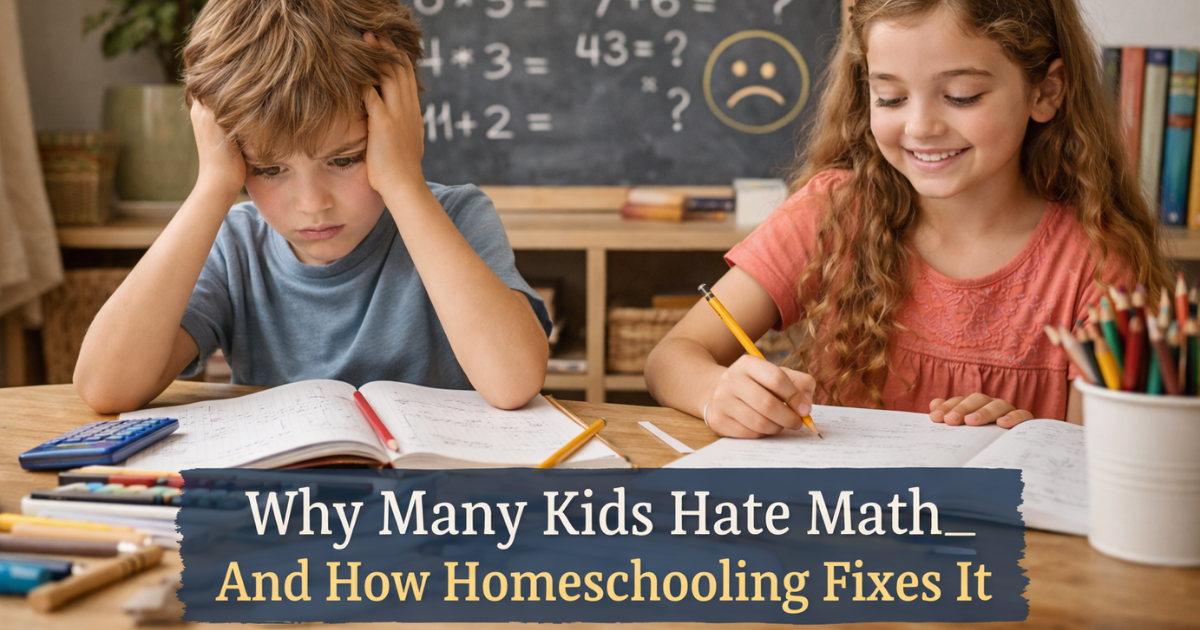
Many kids hate math because it feels confusing, rushed, and disconnected from real life—but homeschooling can completely change that experience. With the right approach, math becomes flexible, personalized, and even enjoyable.
Is Math Really Important For Kids To Learn?
Yes—but probably not for the reasons you were told growing up.
Math isn’t just about solving equations or memorizing formulas. It builds problem-solving skills, logical thinking, and confidence. Kids who understand math learn how to break down challenges, think critically, and make decisions.
But here’s the key: how math is taught matters just as much as what is taught.
When math is rushed, rigid, or disconnected from real life, kids shut down. When it’s flexible and meaningful, they engage.
Why So Many Kids End Up Hating Math
Let’s be honest—most kids don’t start out hating math. That frustration builds over time.
Here are the most common reasons:
1. They fall behind early
Math builds on itself. If a child doesn’t understand addition well, multiplication becomes overwhelming.
2. The pace is too fast
In traditional classrooms, teachers have to keep moving—even if half the class is confused.
3. Too much memorization, not enough understanding
Kids are often told what to do, but not why it works.
4. Fear of being wrong
Math is often treated as “right or wrong,” which creates anxiety and pressure.
5. It feels irrelevant
“Why do I need this?” is a question many kids never get answered.
One of the biggest issues we see at DKM Homeschool Resource is that math frustration isn’t actually about ability—it’s about experience. Kids who struggle often believe they’re “bad at math,” when in reality they were never given the right pace or explanation. Once that belief sets in, it becomes harder to rebuild confidence, even if the child is fully capable of understanding the material.
Parents often carry their own math baggage too. If you struggled with math as a child, it’s easy to feel unqualified to teach it. But homeschooling doesn’t require you to be a math expert—it requires you to be willing to slow down, try different approaches, and learn alongside your child when needed.

How Homeschooling Changes Everything
This is where homeschooling becomes incredibly powerful.
Instead of forcing your child into a one-size-fits-all system, you can build math around them.
Here’s how that transforms the experience:
1. Learn at their pace
- Slow down when needed
- Move ahead when concepts click
- No pressure to “keep up”
2. Use different teaching styles
Every child learns differently:
- Visual learners → diagrams, charts
- Hands-on learners → manipulatives, games
- Auditory learners → discussions, explanations
3. Make math practical
Turn math into real-life skills:
- Cooking = fractions
- Shopping = budgeting
- Building = measurement
4. Remove the pressure
No grades. No classroom comparisons. Just learning.
5. Build confidence first
Understanding comes easier when kids feel safe to try.
We’ve seen countless homeschool families where a child who once hated math begins to enjoy it—simply because the environment changed. When there’s no rush, no embarrassment, and no constant testing, kids start asking questions again. They become curious instead of defensive, and that’s where real learning begins.
It’s not about lowering standards—it’s about removing unnecessary barriers. Homeschooling gives you the freedom to focus on mastery instead of speed, which is what math actually requires.
Simple Ways To Make Math Easier (Starting This Week)
You don’t need a complete curriculum overhaul to improve your child’s math experience.
Try these practical steps:
1. Slow down immediately
If your child is struggling:
- Stop moving forward
- Go back one step
- Rebuild confidence
2. Use everyday math
Look for natural opportunities:
- Count change at the store
- Measure ingredients
- Estimate time or distance
3. Switch the format
If worksheets aren’t working:
- Try math games
- Use apps (like Khan Academy or Prodigy)
- Watch short explanation videos
4. Let them teach YOU
Have your child explain:
- How they solved a problem
- Why they chose that method
This builds understanding fast.
5. Keep sessions short
- 20–30 minutes is often enough
- Stop before frustration kicks in
Common Mistakes Homeschool Parents Should Avoid
Even with the best intentions, it’s easy to fall into habits that make math harder.
Watch out for these:
1. Pushing through confusion
If your child doesn’t understand, stopping is more productive than continuing.
2. Overloading with worksheets
More practice doesn’t help if the concept isn’t clear.
3. Comparing to grade levels
Your child’s pace matters more than arbitrary benchmarks.
4. Expecting instant mastery
Math takes repetition and time—especially for deeper understanding.
5. Sticking to one method
If something isn’t working, change it.
Another mistake we see often is assuming that frustration means laziness or lack of effort. In reality, most kids who resist math are overwhelmed, not unwilling. When something feels confusing or impossible, avoidance becomes a natural reaction. The goal isn’t to push harder—it’s to make the path clearer and more approachable.
It’s also important to remember that consistency beats intensity. A calm, steady approach to math—even in small daily doses—creates far better results than long, stressful sessions. Over time, those small wins build confidence, and confidence changes everything.
Helpful (And Affordable) Math Resources
You don’t need expensive programs to teach math effectively.
Here are some great options:
Free resources
- Khan Academy (full math curriculum)
- YouTube (search specific concepts)
- Printable worksheets online
Low-cost options
- Math-U-See
- Teaching Textbooks
- Workbooks from Amazon or local stores
Hands-on tools
- Base ten blocks
- Fraction tiles
- Measuring cups
Game-based learning
- Prodigy Math
- Board games (Monopoly, Yahtzee)
One of the best things about homeschooling is that you’re not locked into one resource. You can mix and match until you find what works. If a curriculum isn’t clicking, you’re allowed to pivot—immediately. That flexibility is one of the biggest advantages you have as a homeschool parent, and it can make a dramatic difference in your child’s relationship with math.
Got Questions? We Have Answers!
FAQ: Why do homeschooled kids often do better in math?
Homeschooled kids often perform better in math because they learn at their own pace and receive individualized instruction. Homeschool math allows for deeper understanding instead of rushing through concepts. This flexibility helps reduce frustration and builds long-term confidence.
FAQ: What if I’m not good at math myself?
You don’t need to be a math expert to successfully homeschool your child. Many homeschool math programs are designed to guide parents step by step. Plus, using online resources and learning alongside your child can actually model great problem-solving skills.
FAQ: How long should a homeschool math lesson be?
Most homeschool math lessons can be effective in 20–45 minutes, depending on age and focus level. Shorter, consistent sessions are better than long, overwhelming ones. The goal is understanding—not endurance—especially in early math education.
Building Confidence In You And Your Child
If your child hates math right now, that’s not the end of the story—it’s just a signal that something needs to change. Homeschooling gives you the freedom to make that change in a way that actually works for your child.
Start small. Slow things down. Try one new approach this week. You don’t have to fix everything overnight.
At DKM Homeschool Resource, we’re here to help you simplify homeschooling, reduce stress, and build confidence in your child—one step at a time. Explore more of our blog for practical tips, encouragement, and tools to make your homeschool journey smoother and more successful.