

Spring is the perfect season to refresh your homeschool routine, and yes, spring-themed writing prompts are one of the easiest ways to spark creativity in young learners. They help kids connect learning to the world around them while building confidence in writing.
What Are The Best Homeschool Planners Or Systems?
The best homeschool planners or systems are the ones that keep things simple, flexible, and easy to maintain. Many parents succeed with a mix of a weekly planner, a daily checklist, and a loose routine rather than a rigid schedule. Systems that allow room for creativity, like journaling and writing prompts, work especially well for younger kids.
When it comes to incorporating writing into your homeschool day, planning matters, but it doesn’t have to be complicated. In fact, writing prompts are one of the easiest tools to plug into any system.
Here are a few planning approaches that work well with writing prompts:
- Loop scheduling: Rotate writing prompts every few days instead of doing them daily
- Morning basket: Include one short writing prompt as part of your morning routine
- Themed weeks: Focus on spring topics like weather, animals, or gardening
- Flexible journaling: Let kids write when they feel inspired, not forced
Quick tip: Keep a notebook labeled “Spring Writing Journal” and let your child decorate it. This small step increases buy-in immediately.
Why Spring Writing Prompts Work So Well For Homeschoolers
Spring naturally invites curiosity. Kids notice the weather changing, animals appearing, and plants growing. This makes it one of the easiest seasons to inspire writing without forcing it.
Instead of staring at a blank page, kids can look outside and connect their ideas to real-life experiences. That connection is powerful, especially for younger learners who struggle with abstract thinking.
Spring writing prompts also help you:
- Break out of winter burnout
- Add creativity without extra curriculum
- Encourage independent thinking
- Build consistent writing habits
Most importantly, they make writing feel less like “school” and more like expression.
You don’t need a full language arts overhaul to see results. Just adding 10–15 minutes of writing a few times a week can make a noticeable difference.
25 Spring-Themed Writing Prompts Your Kids Will Love
Here’s where things get fun. These prompts are designed to be simple, engaging, and adaptable for different ages.
You can have your child write a sentence, a paragraph, or even just draw and dictate, whatever fits their level.
Nature & Outdoors Prompts
- Describe what you see on a spring walk
- What is your favorite flower and why?
- Write about a rainy day adventure
- Imagine you are a butterfly, what do you do all day?
- What sounds do you hear in spring?
Imagination Prompts
- If you could plant anything, what would grow?
- Write a story about a talking tree
- What if animals could talk in spring?
- Imagine a garden that grants wishes
- You find a hidden door in a tree, what’s inside?
Seasonal Life Prompts
- What do you like most about spring?
- Describe your perfect spring day
- What changes happen from winter to spring?
- Write about playing outside with friends
- What would you do on a warm sunny day?
Fun & Silly Prompts
- A frog invites you to a party, what happens?
- What if it rained flowers instead of water?
- Write about a mischievous bunny
- If you could shrink to the size of an ant, what would spring look like?
- You discover a rainbow you can walk on, where does it lead?
Simple Starter Prompts (Great for Beginners)
- I see…
- I hear…
- I feel…
- Spring is…
- My favorite part of today is…
Quick tip: Let your child choose the prompt whenever possible. Choice increases motivation more than anything else.
How To Actually Use These Prompts (Without Overwhelm)
Here’s where many homeschool parents get stuck, they have great ideas but no system to follow through.
Let’s simplify it.
Step-by-step plan for this week:
- Pick 3 prompts from the list
- Assign them to 3 days (example: Monday, Wednesday, Friday)
- Set a timer for 10–15 minutes
- Let your child write without correction during that time
- Praise effort, not perfection
That’s it. No grading. No pressure.
Helpful structure options:
- Younger kids: Draw + dictate sentence
- Early writers: 2–3 sentences
- Older kids: Short paragraph
Low-cost resource ideas:
- Dollar store notebooks
- Printable writing pages (free online)
- Nature journals
- Clipboards for outdoor writing
The goal is consistency, not complexity.
Common Mistakes Parents Make With Writing Prompts
Even with something simple like writing prompts, there are a few pitfalls that can turn a good idea into frustration.
Avoid these common mistakes:
- Overcorrecting: Fixing every grammar mistake kills confidence
- Forcing writing daily: Leads to burnout (2–3 times per week is enough)
- Giving prompts that are too hard: Keep it age-appropriate
- Not modeling writing: Kids learn by seeing you write too
- Skipping encouragement: Positive feedback matters more than technical skill early on
Quick tip: Focus on ideas first, mechanics later. You can always revisit spelling and grammar when your child is ready.
Homeschooling writing isn’t about producing perfect essays, it’s about building confidence and expression.
Making Writing Part Of Your Spring Homeschool Rhythm
Spring has a way of shifting energy in your home. Kids want to be outside more, attention spans change, and routines loosen a bit. Instead of fighting that shift, you can lean into it by making writing feel like a natural extension of the season rather than another structured task.
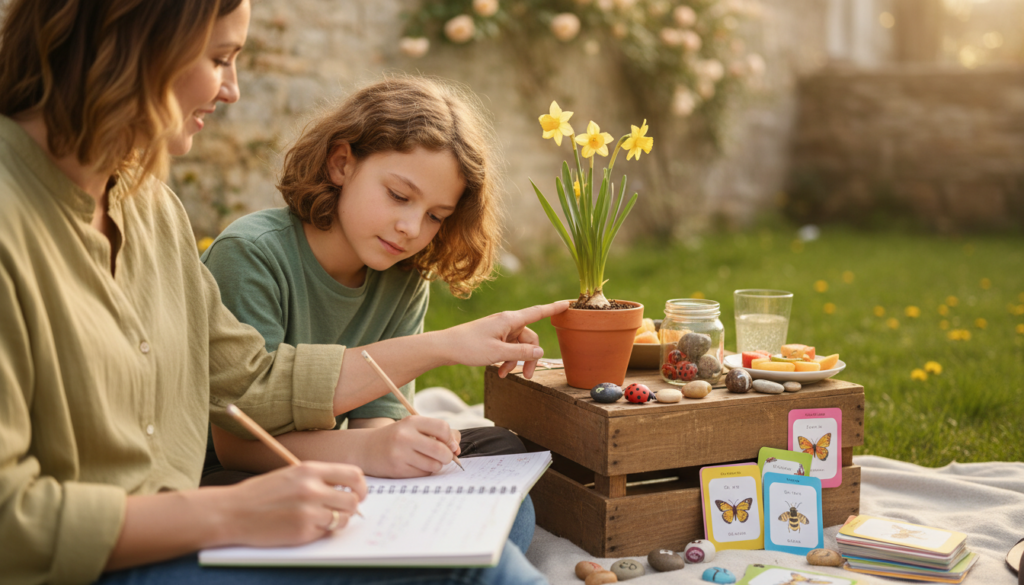
One of the easiest ways to do this is to bring writing outdoors. A simple clipboard, a pencil, and a blanket in the yard can transform writing time into something your child actually looks forward to. When kids associate writing with fresh air and freedom instead of sitting at a desk, resistance drops quickly and creativity tends to show up on its own.
You might also notice that your child starts talking more about what they see and experience during spring. That’s a perfect opportunity to turn those conversations into writing. If they’re excited about a bird they spotted or a puddle they jumped in, invite them to write about it later in the day. This keeps writing relevant and personal instead of forced and disconnected.
Another helpful shift is letting go of the idea that writing has to look the same every day. Some days might be full sentences, other days might be lists, drawings, or even just a few words. Progress in writing often happens in small, uneven steps, especially with younger homeschoolers, and that’s completely normal.
Over time, these small, flexible habits build something much bigger: a child who sees writing as a tool for expression rather than a chore. That mindset is far more valuable than any perfectly structured lesson plan.
Spring Homeschool FAQs
FAQ: What are easy spring writing activities for homeschoolers?
Simple activities include nature journaling, creative writing prompts, drawing and labeling spring scenes, and short daily reflections. These homeschool writing ideas keep kids engaged while building foundational writing skills without overwhelm.
FAQ: How often should my child do writing prompts?
Most young homeschoolers benefit from writing 2–3 times per week. This keeps consistency without burnout and fits well into flexible homeschool schedules while still improving writing confidence and skills.
FAQ: Are writing prompts good for reluctant writers?
Yes, especially seasonal prompts like spring writing prompts. They give kids a starting point, reduce pressure, and make writing feel fun and relevant, helping reluctant writers build confidence over time.
Making Homeschool Enjoyable
Spring is a fresh start, and your homeschool can feel that way too. Adding simple writing prompts is one of the easiest ways to bring creativity, structure, and joy back into your routine without overwhelming yourself or your child.
Remember, you don’t need a perfect system to raise confident writers. You just need consistency, encouragement, and a willingness to keep things simple.
If you found this helpful, explore more guides, tools, and real-life homeschool strategies right here at DKM Homeschool Resource. We’re here to help you make homeschooling feel doable, and even enjoyable, every step of the way.