

Yes, 20 minutes of circuit training is absolutely enough for homeschool PE—especially when it’s structured, intentional, and consistent. You don’t need a full gym class to keep your kids healthy. You just need a simple plan and a little movement.
At DKM Homeschool Resource, we work with busy homeschool parents every day. Most feel stretched thin trying to fit in math, reading, meals, and laundry—then suddenly realize, “Oh no… we forgot PE again.” The good news? You don’t need a complicated plan. A simple 20-minute indoor fitness routine can completely change the energy in your homeschool day.
Let’s walk through exactly how to make it work.
Is 20 Minutes Of Circuit Training Enough?
Absolutely. When done 4–5 days per week, a 20-minute homeschool fitness circuit can provide meaningful cardiovascular activity, muscle engagement, and coordination practice. Kids don’t need hour-long workouts. They need consistency, variety, and movement that feels fun rather than forced.
Many parents assume physical education has to look like public school gym class. It doesn’t. In a homeschool setting, you have the advantage of flexibility. A well-designed indoor circuit training routine keeps kids moving efficiently without dragging out the day.
Think about it this way:
- 20 focused minutes = more movement than a distracted 45-minute gym class
- Short bursts keep kids engaged
- It prevents burnout (for you and them)
- It fits naturally between subjects
If your child already plays outside later in the day, rides bikes, or participates in sports, this 20-minute routine becomes the structured foundation of your homeschool PE curriculum.
And honestly? It often improves focus for the next subject.
How To Set Up A Simple Indoor Homeschool Fitness Circuit
You don’t need fancy equipment. You don’t need a Pinterest-perfect playroom. You need about 6–8 feet of space and a timer.
Here’s the simple structure we recommend at DKM Homeschool Resource:
Step 1: Choose 6 Exercises
Pick movements that alternate between cardio and strength.
Example:
- Jumping jacks
- Push-ups (wall or floor)
- High knees
- Squats
- Plank hold
- Mountain climbers
Step 2: Set a Timer
- 40 seconds work
- 20 seconds rest
- Rotate through all 6 exercises
- Repeat once (2 total rounds)
That’s 18–20 minutes.
Step 3: Add a Warm-Up (2 minutes)
- Arm circles
- March in place
- Light stretching
Step 4: Cool Down (2 minutes)
- Slow breathing
- Forward fold stretch
- Shoulder rolls
Total time: 20–25 minutes including transitions.
Quick Tip:
If you have multiple kids, assign one child as the “timer captain.” It gives ownership and reduces sibling squabbles.
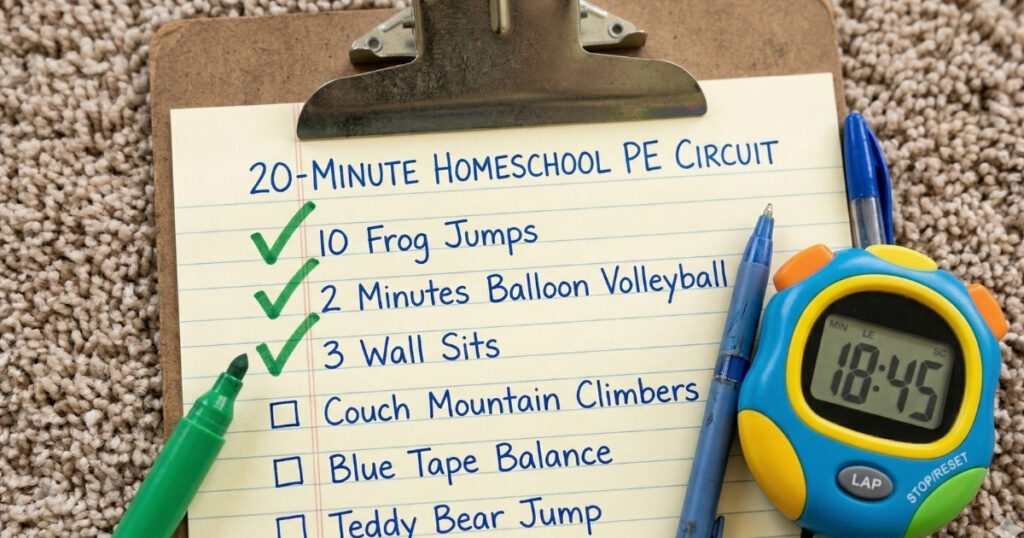
A Sample 20-Minute Indoor Routine You Can Use Today
Let’s make this even easier. Here’s a ready-to-use homeschool PE workout you can start this week.
Round 1 (40 seconds each, 20 seconds rest):
- Jumping jacks
- Wall sit
- High knees
- Modified push-ups
- Plank hold
- Skater jumps
Round 2:
Repeat the same sequence.
If your kids are younger (ages 5–8), simplify:
- Hop in place
- Bear crawl
- Star jumps
- Frog squats
- Freeze dance
- Crab walk
For older students (10+), increase difficulty:
- Burpees
- Full push-ups
- Jump squats
- Plank shoulder taps
- Speed skaters
- Mountain climbers
Keep it playful. Play upbeat music. Let them create silly names for exercises. Homeschool physical education should feel energizing—not like boot camp.
One homeschool mom we worked with started doing the circuit right after lunch because her kids were sluggish. Within a week, she noticed math went smoother and afternoon attitudes improved dramatically. Movement resets the brain.
Common Mistakes Parents Make With Homeschool PE
Let’s talk about what not to do.
Mistake #1: Overcomplicating it
You do not need a full homeschool PE curriculum package to get started. Start simple. You can always expand later.
Mistake #2: Inconsistency
Doing a 60-minute workout once a week doesn’t help much. Short daily routines are more effective.
Mistake #3: Turning It Into Punishment
Exercise should never feel like discipline. Avoid phrases like “Since you didn’t finish your work, go do push-ups.”
Mistake #4: Comparing to Other Families
Some families do organized sports every day. Some don’t. Your homeschool fitness routine only needs to serve your children.
Consistency beats perfection every time.
Homeschooling already asks a lot of you. When PE feels complicated, it’s usually the first subject to disappear. The key is to view movement as part of the rhythm of your day rather than another subject to manage. When fitness becomes routine, it stops feeling like one more thing on your checklist and starts feeling like a reset button for everyone.
You might notice that your child resists at first. That’s normal. Many kids are used to sitting for long stretches. After a week or two of daily indoor exercise, most begin to expect it and even remind you when it’s time. The structure becomes comforting, and the energy boost becomes noticeable.
How To Fit PE Into A Busy Homeschool Schedule
This is where most parents struggle.
Try one of these approaches:
Option 1: Morning Energy Boost
Start your homeschool day with the 20-minute circuit. It wakes everyone up.
Option 2: Midday Reset
Do PE right before or after lunch to break up academic blocks.
Option 3: Afternoon Brain Break
When focus fades, hit the timer.
You can even combine subjects:
- Count jumping jacks for math
- Spell vocabulary words during rest periods
- Track heart rate for science
Physical activity supports learning. Studies consistently show that movement improves concentration and memory retention.
If your homeschool day feels chaotic, anchor it with predictable movement. Children thrive on rhythm. A daily indoor workout becomes a cue: “Now we shift gears.”
And here’s the beautiful part—this routine costs nothing. No gym memberships. No expensive equipment. Just intentional time.
Making Fitness Fun For Different Ages
Homeschool families often teach multiple ages at once. That can feel tricky when it comes to physical education.
Here’s how to simplify:
For Preschoolers:
- Animal walks
- Freeze dance
- Follow-the-leader
- Obstacle courses with couch cushions
For Elementary:
- Timed circuits
- Relay challenges
- Fitness bingo
- Exercise dice (assign moves to numbers)
For Middle School:
- Interval training
- Simple strength tracking
- Step challenges
- Online kid-friendly workout videos
You can rotate themes:
- Superhero workout day
- Olympic-style challenges
- Ninja training
- Dance party circuit
Kids engage more when imagination is involved.
We’ve seen families transform homeschool PE into a highlight of the day simply by shifting mindset. Instead of seeing exercise as another checkbox, they began seeing it as family connection time. Laughter during crab walks and friendly competition during plank holds build memories. Fitness becomes relational, not just physical.
The more positive the environment, the more sustainable the routine becomes. Children who associate movement with encouragement are far more likely to maintain healthy habits long-term.
Simple Steps You Can Take This Week
If you’re feeling overwhelmed, start here:
- Pick a consistent time (even 10:30 AM daily).
- Choose 6 exercises.
- Set a timer for 20 minutes.
- Do it for 5 school days straight.
That’s it.
Optional low-cost resources:
- Free workout timers on YouTube
- Printable fitness trackers (many free PDFs online)
- Music playlists for motivation
- A $10 jump rope
You don’t need more planning—you need momentum.
Remember, homeschool fitness doesn’t have to look perfect. It just has to happen.
Common PE Homeschool Questions
FAQ: How many days a week should we do homeschool PE?
Ideally, aim for 4–5 days per week. A short indoor fitness routine done consistently is more effective than occasional long workouts. Daily movement supports physical health and improves focus during your homeschool schedule.
FAQ: Does circuit training count toward homeschool PE requirements?
Yes, circuit training absolutely qualifies as physical education in most homeschool settings. It includes cardiovascular activity, strength building, and coordination practice. Always check your state homeschool laws, but structured indoor exercise typically meets PE expectations.
FAQ: What if my child hates exercise?
Start small and keep it playful. Use games, music, or themed workouts to build engagement. Many resistant kids respond well to short homeschool fitness challenges rather than long workouts, especially when parents participate alongside them.
Homeschool Advice You Can Trust
You don’t need a perfect homeschool plan—you need sustainable habits. A 20-minute indoor fitness circuit is one of the simplest ways to support your child’s health, improve focus, and bring positive energy into your day.
At DKM Homeschool Resource, we believe homeschooling should feel doable. Practical systems beat complicated curriculum every time. When you build small routines like daily movement, you create stability that supports every other subject.
If this post helped you, explore more of our homeschool advice, encouragement, and ready-to-use resources. We’re here to help you homeschool with confidence, clarity, and a little less overwhelm.